
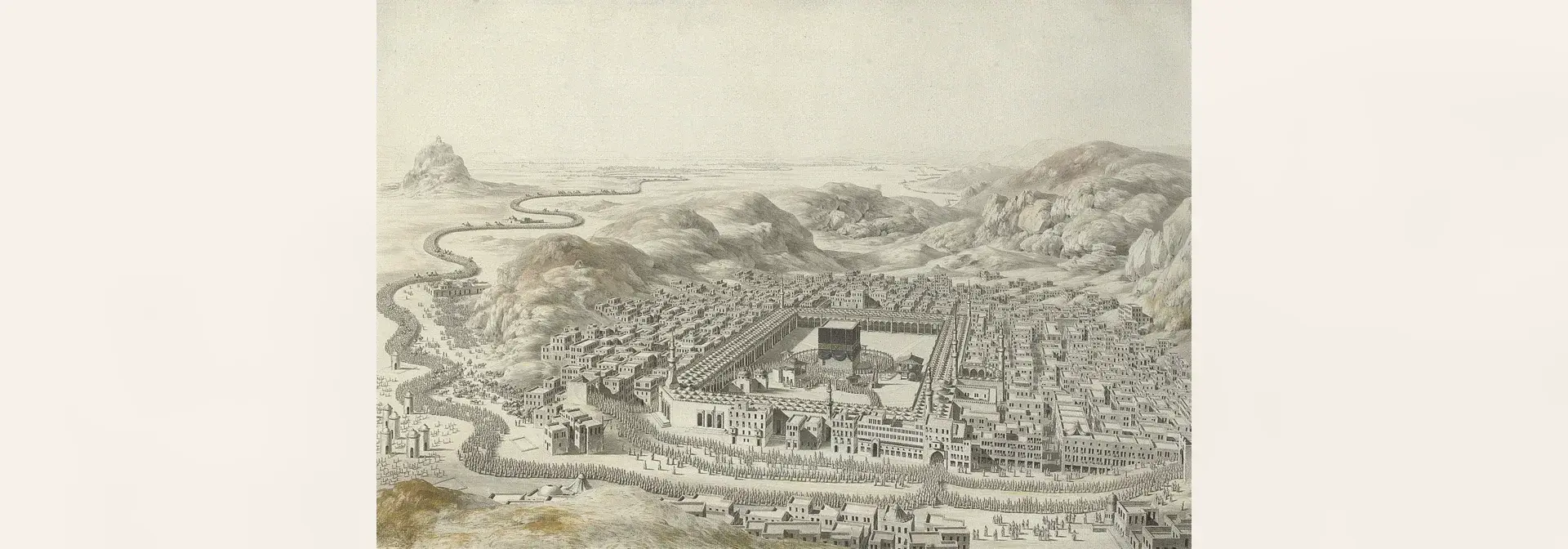
Overview
Makkah is a city in the Hejaz in the Kingdom of Saudi Arabia, and in it stands the Holy Kaaba, the history of whose door is linked to the age of Ibrahim, peace be upon him.[1]
The history of Makkah unfolds across successive eras: the Mamluk era saw endowment and scholarly activity, the Ottoman period brought political events and services for pilgrims, and the Saudi era then witnessed the founding of educational and official institutions that took the city as their seat.[4][6][11]
Makkah in the Mamluk Era
In the Mamluk era (648–923 AH/1250–1517 CE), Makkah witnessed charitable and endowment activity by scholars and jurists, including the building of mosques and schools and the dedication of endowments to sustain them.[4]
Scholarly Life in the Eleventh Century AH
Two Hejazi travel accounts, the journey of Abu Salim al-Ayyashi and the journey of Evliya Celebi, draw a picture of the cultural, religious and scholarly conditions in the Hejaz in the eleventh century AH/seventeenth century CE.[8]
Pilgrim Services and Public Life
Coffee houses spread through the main cities of the Hejaz, among them Makkah, offering pilgrims the preparation of coffee, the supply of water and food, the care of their mounts, and protection from the glare of the sun and the bitter cold; this continued until the beginning of the fourteenth century AH/twentieth century CE.[5]
Political Events in the Ottoman Period
In the tenth century AH/sixteenth century CE, Makkah and Jeddah witnessed events connected with the Lawand group in 932 AH/1526 CE that affected political, social and economic conditions.[6]
Abdulrahman ibn Atiq assumed the ministry in the Hejaz in 1003 AH/1594 CE in the time of Sharif Hasan ibn Abi Numayy, and in his ministry he attended to security and the spread of justice.[7]
Landmarks and Antiquities
The history of the door of the Holy Kaaba is linked to the age of Ibrahim, peace be upon him: the Kaaba was given a door at ground level that was not closed, and Tubba As'ad al-Himyari then made for it a door that closed with a Persian latch.[1]
In the Ma'la cemetery in Makkah there is a group of tombstone inscriptions preserved in the Museum of Antiquities and Heritage in Makkah, dating to a period extending from the first to the fifth century AH (7th–11th CE).[2]
The tombstones of the Ma'la cemetery include inscriptions documenting the death of persons in the sixth century AH/twelfth century CE, preserved in the Makkah Museum of Antiquities and Heritage.[3]
The Hejaz Railway and Journeys of the Modern Era
The Saudi state made efforts to revive the Hejaz Railway extending from Damascus to Madinah, from the era of King Abdulaziz ibn Abdulrahman Al Saud until those attempts ceased in the era of King Khalid (1344–1402 AH/1925–1982 CE).[9]
The report of Farhan al-Rahmah documented a journey from Makkah to Bahrain by way of Riyadh in 1338 AH/1920 CE.[10]
Related people
The Educational and Regulatory Renaissance in the Saudi Era
King Abdulaziz ibn Abdulrahman Al Saud founded Umm Al-Qura newspaper, the official gazette of the Kingdom of Saudi Arabia; its first issue appeared on 15 Jumada al-Awwal 1343 AH, corresponding to 12 December 1924, and it takes the city of Makkah as its seat.[11]
In 1369 AH, King Abdulaziz ibn Abdulrahman Al Saud ordered the founding of the College of Sharia in Makkah to be the first university-level educational institution in the Kingdom, and in 1401 AH Umm Al-Qura University was established.[12]
The regulation for the development of unplanned areas in the city of Makkah and the Holy Sites was issued by a decision of the board of directors of the Royal Commission for the City of Makkah and the Holy Sites, No. (Q-41-4-1), dated 19/4/1441 AH.[13]
Frequently Asked Questions
Q: Where is Makkah located? A: In the Hejaz in the Kingdom of Saudi Arabia, and in it stands the Holy Kaaba.[1]
Q: How did the door of the Holy Kaaba develop through history? A: In the age of Ibrahim, peace be upon him, the Kaaba was given a door at ground level that was not closed, and Tubba As'ad al-Himyari then made for it a door that closed with a Persian latch.[1]
Q: What is the oldest university-level educational institution in the Kingdom? A: The College of Sharia in Makkah, whose founding King Abdulaziz ibn Abdulrahman Al Saud ordered in 1369 AH.[12]
Q: What is the official gazette of the Kingdom and where is its seat? A: Umm Al-Qura, whose first issue appeared on 15 Jumada al-Awwal 1343 AH, corresponding to 12 December 1924, and its seat is Makkah.[11]
Related topics
- EventHistory of MadinahThe history of Madinah is the history of a city in the west of the Kingdom of Saudi Arabia, known before the Prophetic Hijrah as Yathrib and later named Madinah; it is the seat of the Prophet's Mosque and the first capital of the Islamic state. Its history extends from before Islam to the Saudi era, through the building of the Prophet's Mosque and the city's historical landmarks.
- EventHejaz RailwayThe Hejaz Railway is a railway line ordered to be built in March 1900, with work beginning in 1900, to link the Muslims of the northern Arabian Peninsula with the Holy Places; it runs from Damascus station to Madinah station. The first train reached Madinah on 22 Rajab 1326 AH, corresponding to 23 August 1908, and the line operated for about nine years. The Kingdom of Saudi Arabia today preserves its station, its museum and its antiquities in the Tabuk and Madinah regions.
- HistoricHistoric JeddahHistoric Jeddah, or Al-Balad, is an urban core on the Red Sea shaped by maritime trade and pilgrimage, with houses distinguished by projecting wooden windows.
- EventUnification of Saudi ArabiaKing Abdulaziz's path from the recovery of Riyadh in 1902 to the proclamation of the Kingdom of Saudi Arabia on 23 September 1932, now National Day.
- HistoricThe Grand Mosque (Al-Masjid Al-Haram)The Grand Mosque (Al-Masjid Al-Haram) is the mosque at the centre of which stands the Kaaba in Makkah, and successive states and restorations followed upon its construction across the ages. In the Saudi era it witnessed major expansions and construction works, most notably the Third Saudi Expansion and the raising of the capacity of the Mataf and the courtyards.
- RegionMakkah CityMakkah City is a Saudi city in the west of the Kingdom of Saudi Arabia, home to the Grand Mosque and the qibla of Muslims, with a history of more than four thousand years. The city and the Holy Sites are seeing continuous development to raise the standard of services provided to pilgrims and Umrah performers under Saudi Vision 2030.
Sources & references
- King Abdulaziz Foundation – Al-Darah Journal (Issue 27): A study on the history of the door of the Holy Kaaba
- King Abdulaziz Foundation – Al-Darah Journal (Issue 197): A study of an inscription from the tombstones of the Ma'la cemetery
- King Abdulaziz Foundation – Al-Darah Journal (Issue 220): A study of two inscriptions from the tombstones of the Ma'la cemetery
- King Abdulaziz Foundation – Al-Darah Journal (Issue 217): The role of scholars and jurists in the Two Holy Mosques and their endowments
- King Abdulaziz Foundation – Al-Darah Journal (Issue 196): The role of Hejazi coffee houses in serving pilgrims
- King Abdulaziz Foundation – Al-Darah Journal (Issue 216): The Lawand group in the Hejaz
- King Abdulaziz Foundation – Al-Darah Journal (Issue 207): The ministry of Abdulrahman ibn Atiq in the Hejaz
- King Abdulaziz Foundation – Al-Darah Journal (Issue 215): Two Hejazi journeys in the eleventh century AH
- King Abdulaziz Foundation – Al-Darah Journal (Issue 197): Attempts to revive the Hejaz Railway
- King Abdulaziz Foundation – Al-Darah Journal (Issue 206): The journey report of Farhan al-Rahmah from Makkah to Bahrain
- Umm Al-Qura – the official gazette of the Kingdom of Saudi Arabia: the "About Umm Al-Qura" page
- Umm Al-Qura University: the "About the University" page
- Umm Al-Qura – the official gazette of the Kingdom of Saudi Arabia: the regulation for the development of unplanned areas in the city of Makkah and the Holy Sites