

Overview
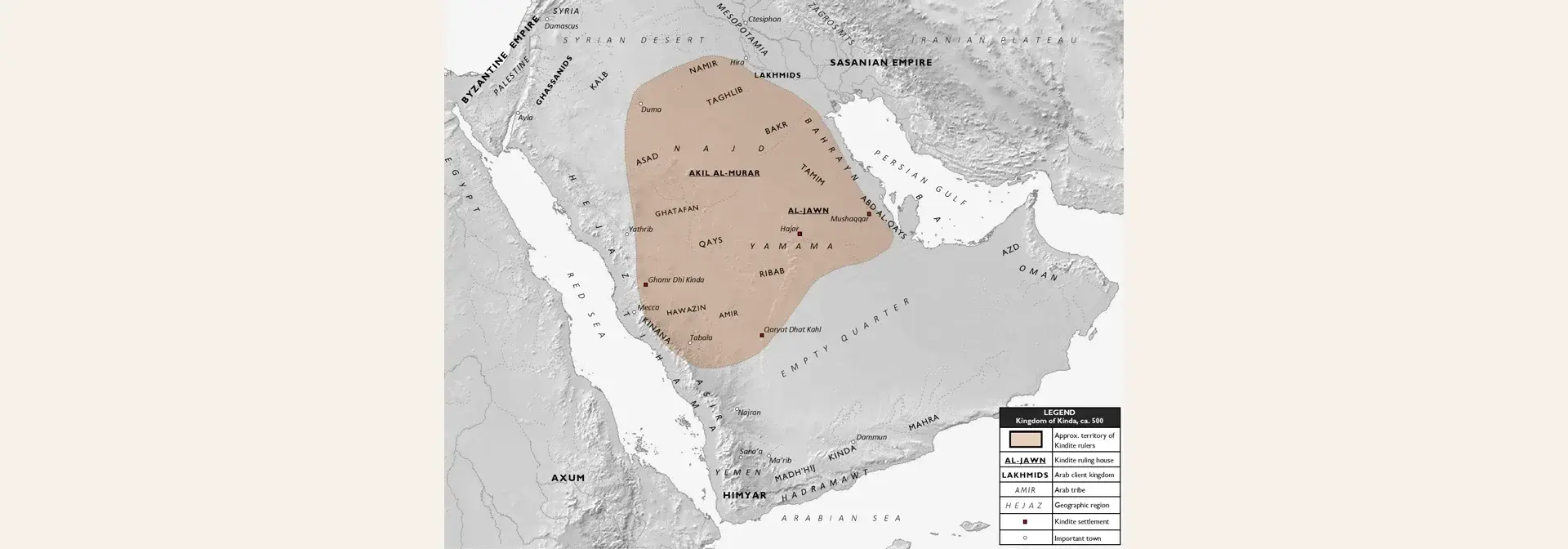
The Kingdom of Kinda was an ancient Arabian entity built on a federal organisation of Arabian desert tribes, and the archaeological city of Qaryat al-Faw was its capital.[1]
The Cultural Landscape of the Al-Faw Archaeological Area, the site that preserved the remains of the Kindite capital, lies in the south of the Kingdom of Saudi Arabia at the junction of the Empty Quarter desert with the sandstone outcrops of the Tuwaiq Mountains plateau and its escarpment.[1]
Administrative Location and Area
Administratively the site belongs to Riyadh Region – Wadi ad-Dawasir Governorate, and its centre lies at the coordinates 19°46'56.59" N and 45°8'52.50" E.[2]
The inscribed Cultural Landscape covers an area of 4,847 hectares, about 48.5 km², and holds more than 99% of the documented archaeological features.[2]
Rise of the City and the Length of its Settlement
The city of Qaryat al-Faw appeared in the middle of the first millennium BCE and lasted about a millennium until its water resources were exhausted, and the site bears witness to the succession of three different peoples and their adaptation to changing environmental conditions over those centuries.[1]
Around the fifth century CE the site was suddenly abandoned, the period in which the Kingdom of Kinda came to an end as a civilisational centre at al-Faw.[1]
A Caravan Station on the Najran Route
Discoveries and Archaeological Documentation
The site holds about 12,000 archaeological remains extending from prehistoric times to the late pre-Islamic era, and among its landmarks is the sacred mountain known as Khashm Qaryah, which bears rock inscriptions in a variety of languages.[1]
Archaeological missions from King Saud University carried out the documentation of the archaeological site.[4]
Inscription on the World Heritage List
The Cultural Landscape of the Al-Faw Archaeological Area was inscribed on the World Heritage List in 2024 CE on the basis of criteria (ii) and (v), by World Heritage Committee decision 46 COM 8B.14.[3]
Statutory Protection and Site Management
The site is protected by the Law of Antiquities, Museums and Urban Heritage, was registered as a National Heritage Site in 2014 CE, and is wholly owned by the State.[1]
Responsibility for its management is shared between the Heritage Commission of the Ministry of Culture and the National Centre for Wildlife, and a circular buffer zone with a radius of twenty kilometres from the centre of the site has been defined around it to protect the quality of the visual setting.[1][4]
Frequently Asked Questions
Q: What is the Kingdom of Kinda? A: An ancient Arabian entity built on a federal organisation of Arabian desert tribes, whose capital was the archaeological city of Qaryat al-Faw.[1]
Q: Where is Qaryat al-Faw, the capital of the Kingdom of Kinda, located? A: In the south of the Kingdom of Saudi Arabia at the junction of the Empty Quarter desert with the sandstone outcrops of the Tuwaiq Mountains plateau and its escarpment, and administratively it belongs to Riyadh Region – Wadi ad-Dawasir Governorate.[1][2]
Q: When did the city of Qaryat al-Faw appear and when was it abandoned? A: It appeared in the middle of the first millennium BCE and lasted about a millennium until its water resources were exhausted, and the site was suddenly abandoned around the fifth century CE.[1]
Q: What is the area of the site and how many archaeological remains does it hold? A: Its area is 4,847 hectares, about 48.5 km², and it holds about 12,000 archaeological remains.[1][2]
Q: When was the site inscribed on the World Heritage List and on which criterion? A: In 2024 CE on the basis of criteria (ii) and (v), by World Heritage Committee decision 46 COM 8B.14.[3]
Tourism and nature
- NatureRub al KhaliThe world's largest continuous sand sea, covering the Kingdom's south-east across the Eastern Province, Riyadh and Najran, named the 'Empty Quarter' for its lack of permanent settlement.
- NatureTuwaiq MountainsAn escarpment forming a narrow plateau in central Saudi Arabia, from the Thuwayrat sands near Al-Zulfi to the edge of the Rub al Khali, also known as Al-Arid.
Related topics
- EventQaryat al-FawQaryat al-Faw is an archaeological site in Wadi ad-Dawasir Governorate, south of the Riyadh Region, also known as Dhat Kahil, and served as the capital of the Kingdom of Kindah from the fourth century BCE until the early fourth century CE. The Cultural Landscape of Al-Faw Archaeological Area was inscribed on the World Heritage List in 2024.
- RegionRiyadh RegionA central Saudi administrative region encompassing the national capital and varied Najdi governorates, with connections to Diriyah, oasis settlement, government and modern economic activity.
- RegionNajran RegionA southern Saudi region administered from Najran, extending from settled wadis towards the Empty Quarter and containing Al Ukhdud, Hima and traditions of local architecture and crafts.
- EventIncense Trade RouteThe Incense Trade Route is a trade artery established by the caravans from the south of the Arabian Peninsula between Makkah and Madinah, on to the Levant to the north and Al-Ahsa and Bahrain to the east. Stations along its course include Qaryat al-Faw, AlUla and the Hegra site, and the Kingdom of Saudi Arabia is reviving this legacy today through cultural and tourism projects.
- EventKingdom of DadanThe Kingdom of Dadan is an ancient Arabian kingdom in the northwest of the Arabian Peninsula; the city of Dadan was its historic capital and later the capital of the Kingdom of Lihyan, with its period extending from the late ninth century BCE. It is located in AlUla Governorate and contains tombs carved into red rock slopes and Dadanitic inscriptions on Jabal Ikmah.
- EventKingdom of LihyanThe Kingdom of Lihyan is an ancient Arab kingdom that flourished in the northwest of the Arabian Peninsula, specifically in the AlUla region, and it followed the Kingdom of Dadan in ruling the area. Its influence extended from the sixth century to the second century BC. Its inscriptions documented its religious thought, its offerings, its civilisational standing and its school of sculpture, and among the most prominent sites connected with it are the Umm Daraj site and the Al-Khuraybah site.
- HistoricHima Cultural AreaOne of the world's largest rock-art complexes, in Thar governorate north of Najran city, inscribed on the UNESCO World Heritage List in 2021.
Sources & references
- UNESCO – Cultural Landscape of Al-Faw Archaeological Area, Statement of Outstanding Universal Value and official Arabic description (State Party: Kingdom of Saudi Arabia)
- Heritage Commission – Ministry of Culture of the Kingdom of Saudi Arabia, World Heritage nomination document (executive summary)
- UNESCO – World Heritage Committee decision 46 COM 8B.14 concerning the Cultural Landscape of Al-Faw Archaeological Area (Kingdom of Saudi Arabia)
- UNESCO – ICOMOS evaluation of the Al-Faw nomination, file no. 1712