

Overview
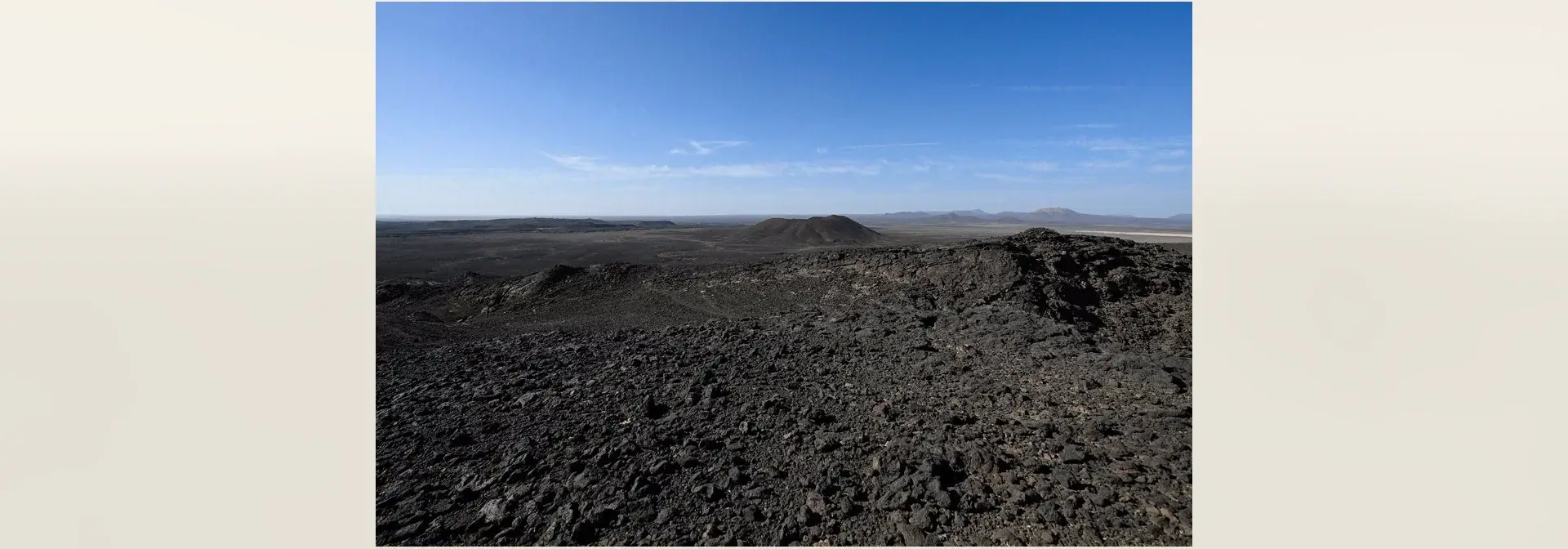
Harrat Kishb is a volcanic lava field within Taif Governorate that contains Al-Wa'bah Crater, also known as Maqla' Tumaiy.[1]
It forms part of a monogenetic volcanic field of 175 small volcanoes and extends over an area estimated at about 6,000 km².[1]
In 2024 Al-Wa'bah Crater was selected among the world's top 100 geological heritage sites.[1] It is the deepest volcanic crater in the Kingdom and a tourist destination today.[2]
Location
The Volcanic Field and the Lava Fields
Harrat Kishb covers an area estimated at about 6,000 km², and its volcanoes range in age from two million years to a few hundred thousand years.[1]
Volcanic activity in the Kingdom dates back about 30 million years and unfolded in two stages: the first came with the flow of basalt lava and the opening of the Red Sea, the second with the onset of volcanic activity in the Arabian Peninsula ten million years ago.[2]
Harrat Rahat is the largest of the lava fields by area, followed by Harrat Khaybar, Harrat Al-Harrah and Harrat Nawasif, and then Harrat Hafr Kishb, which contains Al-Wa'bah Crater.[2] Lava fields cover about 90,000 km² of the Kingdom, roughly 4.6% of its area.[7]
Most of the Hafr Kishb area is black lava strewn with stones, broken by earthen tracts known as al-qay'an.[2] Al-Wa'bah Crater formed about 1.1 million years ago.[1]
Al-Wa'bah Crater and Maqla' Tumaiy
Maqla' Tumaiy lies 30 km north of the village of Umm Ad-Dum in Taif Governorate,[4] and about 175 km north of Taif on the Hejaz–Riyadh Expressway.[5]
The crater is the deepest volcanic crater in the Kingdom and is a tourist destination today.[2]
A UNESCO delegation visited the site in 2016 as part of the drive to develop it into a global tourist landmark.[6]
Tumaiy Lake
Tumaiy Lake lies north-east of Taif, within the range of Harrat Kishb, and occupies the centre of a wide volcanic crater ringed by dark rock walls.[3]
The lake is one of the Kingdom's most distinctive geological formations. Water gathers at the centre of the crater and changes colour with rain and climatic conditions, and white salt layers fringe its edges.[3]
Tourism Development
The Maqla' Tumaiy development project was the first investment tourism project to have its agreement signed with the private sector after the announcement of Saudi Vision 2030.[4]
The project includes a visitor centre with a digital exhibition hall, viewing terraces and canopies overlooking the crater, walkways, a prayer area, restrooms and car parks.[4]
Frequently Asked Questions
Q: Where does Harrat Kishb lie? A: It lies within Taif Governorate and contains Al-Wa'bah Crater, known as Maqla' Tumaiy, about 270 km north-east of Jeddah.
Q: What sets Al-Wa'bah Crater apart? A: It is the deepest volcanic crater in the Kingdom and a tourist destination, and it was selected among the world's top 100 geological heritage sites for 2024.
Q: How large is the volcanic field in Harrat Kishb? A: It holds 175 small volcanoes across an area estimated at about 6,000 km², with ages ranging from two million years to a few hundred thousand years.
Q: What sets Tumaiy Lake apart? A: It occupies the centre of a wide volcanic crater ringed by dark rock walls, its water changes colour with rain and climatic conditions, and white salt layers fringe its edges.
Q: What are the main development works at the Maqla' Tumaiy site? A: A visitor centre with a digital exhibition hall, viewing terraces and canopies, walkways, a prayer area and car parks, within the first investment tourism project to have its agreement signed with the private sector after the announcement of Saudi Vision 2030.
Conclusion
Harrat Kishb brings together its setting within Taif Governorate,[1][2] its extent across a volcanic field of 175 small volcanoes over about 6,000 km²,[1] and Al-Wa'bah Crater, the deepest volcanic crater in the Kingdom and a tourist destination.[2]
Related topics on the platform include Volcanoes in Saudi Arabia, Harrat Rahat, Khaybar Lava Field, Taif City and Taif Season.
Related topics
- HistoricVolcanoes in Saudi ArabiaVolcanoes in Saudi Arabia comprise volcanic fields, basalt formations, craters and cones extending from the north of the Kingdom through its west and south-west. They include globally recognised sites such as Al-Wa'bah crater (Maqlat Tumayyah) in Harrat Kishb and Jabal Qidr in Harrat Khaybar, and the basalt of the volcanic fields is the first Saudi heritage stone on the International Union of Geological Sciences list.
- HistoricHarrat RahatHarrat Rahat is a vast volcanic field in the Kingdom of Saudi Arabia whose lava flows extend from the north of Makkah to Madinah, and it contains lavas formed over widely separated periods, running from millions of years ago to the last volcanic eruption in 654 AH. Its recent volcanic activity is concentrated in its northern part, along the southern and eastern edges of Madinah.
- HistoricKhaybar Lava FieldKhaybar Lava Field is a volcanic field in the Madinah Region of the Kingdom of Saudi Arabia and the largest harrat in the Kingdom by area, estimated at about 21,500 square kilometers. It contains Jabal Al-Qidr, listed among the world's top 100 geological sites, three rare volcanoes, and lava tubes among the longest in the Arab world.
- HistoricHarrat Al-Harrah ReserveHarrat Al-Harrah Reserve is a high-conservation natural area in northwestern Saudi Arabia, extending across the Northern Borders and Al-Jawf regions within the boundaries of the King Salman bin Abdulaziz Royal Reserve. It features a volcanic plateau and plant and wildlife diversity, and is the first reserve established by the Saudi Wildlife Authority.
- RegionTaif CityTaif City is a Saudi city in the west of the Kingdom, known as the “City of Roses and Bride of Saudi Summer Resorts” for its moderate summer climate and its natural views in Al-Shafa and Al-Hada. It contains more than 700 rose farms, farms of seasonal fruits, and cultural and historical landmarks including Souq Okaz and Shubra Palace.
- HistoricTaif SeasonTaif Season is a tourism and entertainment event held in Taif city under the name “the Summer Resort of the Arabs”, whose first edition launched on 29 Dhu al-Qi'dah 1440 AH, corresponding to 1 August 2019, within the Saudi Seasons 2019 initiative. It is concerned with presenting Taif as a destination for summer resorts, heritage and cultural activities and the Taif rose.
- EventHistory of TaifThe history of Taif extends from ancient settlement on its fertile highland and the rise of Souq Okaz in its surroundings before Islam, to the entry of its people into Islam in the tenth year of the Hijrah, then its entry into Saudi rule in 1343 AH and the revival of Souq Okaz there. Taif holds historical landmarks, among the most prominent of which are the Abdullah ibn Abbas Mosque, its old wall and Shubra Palace.
- HistoricEdge of the WorldThe Edge of the World is a natural site at the far end of the Tuwaiq mountain range in the centre of the Kingdom of Saudi Arabia, about 100 kilometres from the capital, Riyadh, at an elevation of some 1,131 metres. It is one of the most prominent natural landmarks in the Kingdom, and is listed among the tourist attractions of the city of Riyadh as a destination for desert views, escarpments and adventure and nature experiences.
- National visions and programmesSaudi Vision 2030: A Framework for TransformationAn introduction to Saudi Vision 2030, its social, economic and institutional themes, and the relationship between implementation programmes, long-term targets and measured results.
- HistoricHijaz MountainsThe Hijaz Mountains are a mountain range in the Kingdom of Saudi Arabia that embraces a number of peaks and natural landmarks, and its range takes in Jabal an-Nur in Makkah. They are cut through by volcanic lava fields and granite peaks, and among their most prominent landmarks are Jabal Shada in the Al-Bahah region, Jabal al-Lawz in the Tabuk region and Jabal Fifa in the Jazan region.