
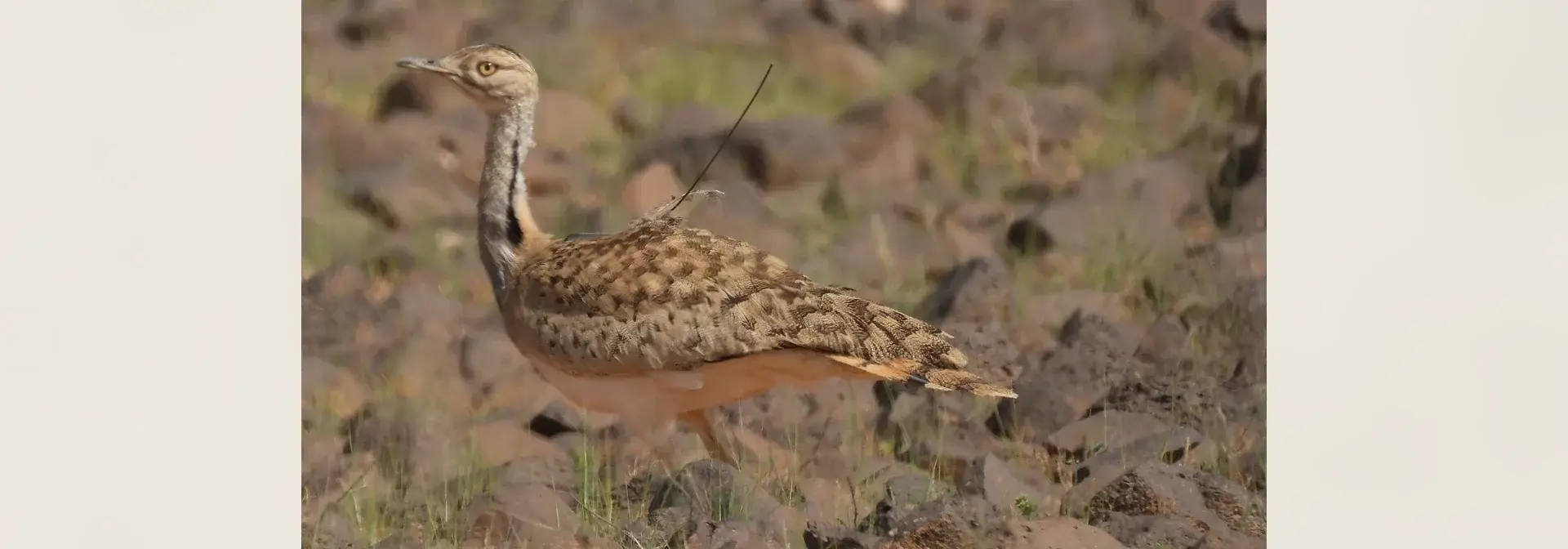
Overview
The houbara bustard is a desert bird and one of the most prominent in the Arabian Peninsula, with an environmental and cultural value linked to the desert environment and the history of falconry in the region, and it plays a role in preserving ecological balance in arid and semi-arid environments.[1]
It is found in open areas with sparse vegetation and adapts well to harsh climatic conditions such as high temperatures and scarce water, feeding on insects and small plants, which makes it an important part of the ecological balance in these regions.[1]
Description and Species
The houbara bustard is among the largest birds and the heaviest bird capable of flight, with a distinctive crest, plumage and neck; the male is known as the "kharb" and the female as the "dajaja".[2]
Its length ranges between 55 and 75 cm, the male's weight between 1,800 and 3,200 g, and the female's weight between 1,200 and 1,700 g.[3] The species is divided into two main groups: the Asian houbara, which migrates from Central Asia to the Arabian Peninsula, and the North African houbara, which is native to the Maghreb.[1]
Habitat and Breeding
The houbara bustard nests on open ground, in a shallow, unlined depression usually located near a low shrub, and its daily range in search of food reaches about 60 km.[3]
The female lays 2 to 3 eggs, and the incubation period reaches 24 days, after which the chicks become capable of flight after about 35 days.[3] The bird feeds on grains, plants, insects and worms, resources provided by the natural cover of arid and semi-arid environments.[3]
Cultural Value and Falconry
The houbara bustard is linked to the desert environment and the history of falconry in the Arabian Peninsula, and it is the most prominent quarry of hunting with falcons.[1][4] UNESCO inscribed falconry in the Arabian Peninsula, whose most prominent quarry is the houbara bustard, on its list of intangible cultural heritage in 2021.[4]
The Saudi Falcons Club announced that houbara hunting would be permitted from 1 November 2021 to 31 January 2022, restricted to hunting with falcons and without any type of firearm.[5]
Conservation, Breeding and Reintroduction Efforts
Prince Saud bin Faisal established the first research centre specialising in houbara breeding in Taif in 1985, which played a pioneering role in developing effective captive-breeding methods.[4] The Imam Turki bin Abdullah Royal Reserve Development Authority launched construction of the Houbara Breeding Centre, which includes 22 facilities over 4 square kilometres and will reach a capacity of 25,000 birds at its final stage.[6]
The National Centre for Wildlife granted the first official permit to produce houbara bustards in the Kingdom to a specialised centre, valid for one renewable year, in a project covering more than 500,000 square metres and targeting the production of 15,000 birds by 2026.[7] The Prince of Al-Qassim region received the Kingdom's first licence to produce the bird, a project that aims at steadily rising annual production from more than 2,000 birds to 15,000 and at achieving self-sufficiency.[8]
The King Salman bin Abdulaziz Royal Reserve Development Authority reintroduced 124 rare houbara bustards across the reserve, which is the largest terrestrial reserve in the Middle East, with an area of 130,700 square kilometres.[3] The Prince Mohammed bin Salman Royal Reserve reintroduced the Asian houbara after an absence of more than 35 years, releasing 20 birds, 10 of them fitted with satellite tracking devices, in cooperation between the reserve, the National Centre for Wildlife and the Prince Mohammed bin Salman Foundation for Houbara Conservation.[4]
The King Abdulaziz Royal Reserve Development Authority signed a memorandum of understanding with the Prince Mohammed bin Salman Foundation for Houbara Conservation to support the protection of the bird and its reintroduction into its natural habitats, covering the development of reintroduction programmes, the monitoring of bird movements and the reduction of the risks of power lines and overhunting.[9] The International Union for Conservation of Nature classifies the Asian houbara as endangered throughout the Arabian Peninsula, and the Kingdom has no resident wild populations, which makes breeding and reintroduction programmes a foundation for rebuilding sustainable wild groups.[4]
Frequently Asked Questions
Q: What is the houbara bustard? A: It is a desert bird and one of the most prominent in the Arabian Peninsula, with an environmental and cultural value linked to the desert environment and the history of falconry, and it plays a role in preserving ecological balance in arid and semi-arid environments.[1]
Q: Where does the houbara bustard live and what does it feed on? A: It lives in open areas with sparse vegetation and feeds on grains, plants, insects, worms and small plants.[1][3]
Q: How long and how heavy is the houbara bustard? A: Its length ranges between 55 and 75 cm, the male's weight between 1,800 and 3,200 g, and the female's weight between 1,200 and 1,700 g.[3]
Q: How many eggs does the houbara bustard lay and how long is the incubation period? A: The female lays 2 to 3 eggs, the incubation period reaches 24 days, and the chicks become capable of flight after about 35 days.[3]
Q: What are the Kingdom's efforts to protect and breed the houbara bustard? A: They include establishing specialised centres for its breeding and release, the first of which was a research centre in Taif in 1985, along with its reintroduction in the royal reserves, including the release of 124 birds in the King Salman bin Abdulaziz Royal Reserve and 20 Asian birds in the Prince Mohammed bin Salman Royal Reserve.[3][4]
Conclusion
In the Kingdom's reserves, the houbara bustard combines its environmental value in preserving ecological balance, its cultural standing tied to the history of falconry, and its role in programmes for breeding and reintroducing native species.[1][4]
Its subjects on the platform are linked to King Salman bin Abdulaziz Royal Reserve, Prince Mohammed bin Salman Royal Reserve, Falconry, Wildlife in Saudi Arabia and Al-Qassim Region.
Related topics
- HistoricKing Salman bin Abdulaziz Royal Nature ReserveKing Salman bin Abdulaziz Royal Nature Reserve is a royal nature reserve in the northwest of the Kingdom of Saudi Arabia and the largest reserve in the Middle East, with a total area of 130,700 square kilometres extending across four administrative regions. It contains broad biodiversity and rock art sites inscribed on the UNESCO World Heritage List.
- HistoricPrince Mohammed bin Salman Royal ReservePrince Mohammed bin Salman Royal Reserve is a royal reserve in the northwest of the Kingdom of Saudi Arabia. It extends over an area of 24,500 square kilometers and encompasses 15 ecosystems, containing more than 50% of the Kingdom's wildlife species. Established by royal decree and overseen by the Council of Royal Reserves chaired by His Royal Highness the Crown Prince and Prime Minister, it combines wildlife reintroduction, ecological tourism and biodiversity conservation.
- HistoricFalconryFalconry is an intangible cultural heritage of the Kingdom of Saudi Arabia, inscribed on the Representative List of the Intangible Cultural Heritage of Humanity of UNESCO since 2010. It receives official attention through the Saudi Falcons Club and the King Abdulaziz Falconry Festival, the largest gathering of falcons in the world, along with the International Falcon Breeders Auction and the AlUla Falcons Cup.
- HistoricWildlife of Saudi ArabiaWildlife in Saudi Arabia is a system of desert, sandy, valley, and plateau environments that shelter hundreds of species of mammals, birds, reptiles, and wild plants.[1][2] Nature reserves work to protect and develop it and to reintroduce endangered species into their habitats.[1][3]
- RegionQassim RegionAn inland Najdi region administered from Buraydah, associated with trading towns, date cultivation and markets, and the geographical corridor of Wadi Al Rummah.