
Overview
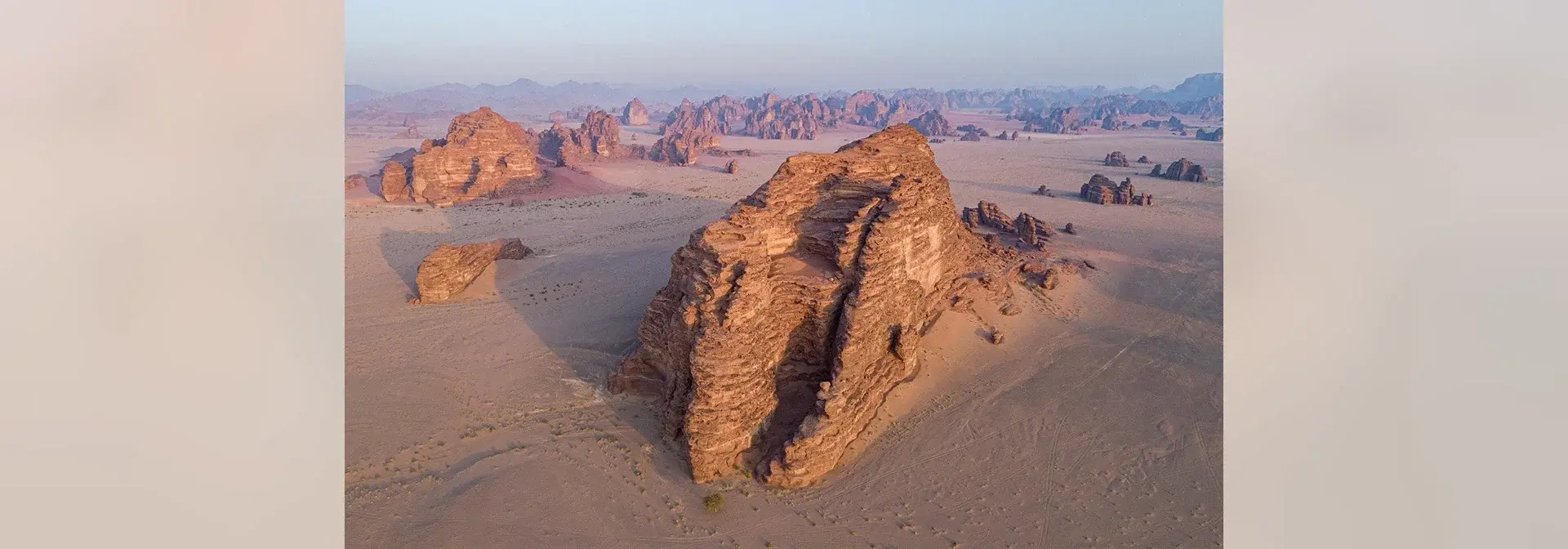
Jabal Hisma is a group of rock formations extending across the Hisma desert in the north-western part of the Tabuk region, in north-western Saudi Arabia.[1]
The desert gives the site a geological and aesthetic dimension through its red sands and its carved sandstone hills, and it holds rock formations that are more than 500 million years old.[1][2]
Since ancient times Hisma has been a stop on the old trade route to and from the Arabian Peninsula, crossed by caravans and riders throughout successive civilisations.[1]
Geographical Location
The Hisma desert lies in the north-western part of the Tabuk region, and dozens of rock arches stand in its heart and along its edges.[1][4]
The geological formations of the Tabuk region follow one another from oldest to youngest, beginning with the Shaq, Shaqra, AlUla and Saq formations and ending with the Neogene formation.[2]
Geologically, the Hisma desert lies within the Saq formation, and the Tabuk formation takes its name from the city, because the best outcrop of it, of sandstone and shale, is found around it.[6]
Rock Formations
The rock formations of Hisma are more than 500 million years old, and specifically between 542 million and 488 million years old.[2]
These rocks consist of sandstone with a little silt and clay, and their valleys and subsurface layers hold reservoirs of groundwater.[2]
Erosion has carved forms out of the rock, among them valleys, hills, rock pinnacles, gorges and mesas, which have turned the site into an open natural museum and a destination for tourism and scientific interest.[2][5]
The rock arches take shape through the combined action of wind and the underlying geology, as the wind drives particles of sand up the slope of the lithified formation.[4]
Caves and Rock Masses
The desert contains caves with sustained warmth all year round, because the temperature inside them remains stable.[5]
Erosion has also formed valleys, hills, rock pinnacles, gorges and caves, so that the area stands like an open museum.[5]
Among its most prominent features is a rock mass at Umm Sarhayj, part of Bajdah centre west of Tabuk city, close to thirty metres tall on a small, slender base in the manner of a rock pinnacle.[6]
The Ancient Trade Route
Hisma has served since ancient times as a stop on the old trade route to and from the Arabian Peninsula, crossed by caravans and riders throughout successive human civilisations.[1]
Inscriptions and the Hismaic Dialect
Hisma has precedence in the discovery of some Arabic inscriptions that became known as the Hismaic dialect, an Arabic dialect similar to Nabataean.[3]
The Hismaic dialect is the earliest Arabic writing in which letters are joined to one another, as in Kufic script, and its letters resemble the Safaitic letters, though they are distinguished from them by their location and date.[3]
Mountains of the Tabuk Region
Mountains and highlands are among the most prominent landforms of the Tabuk region and among its largest divisions by area, covering a third of the region.[8]
Among the most prominent peaks of the region are Jabal Al-Lawz, which rises to 2,580 metres, and Jabal Ash-Shayati, which rises to 2,103 metres.[8]
Hisma Museum
The Hisma Museum, well known in the Tabuk region, includes a section documenting the history of Saudi media with print, audio and visual media equipment.[9]
The museum has acquired rare cameras, among them early box cameras, cinema cameras from 16 mm to 35 mm, underwater cameras and flash cameras, some of which are more than 100 years old.[9]
Tourism Destination
The Hisma viewpoint is one of the most prominent natural sites in the Tabuk region and a destination for researchers and for those interested in nature and photography, because of the wide visual outlook it offers.[7]
The mountainous areas of the Tabuk region have become a destination for those seeking quiet and relaxation at sunset, when the sun's rays break over the summits of its mountains.[10]
Frequently Asked Questions
Q: Where is Jabal Hisma located? A: In the Hisma desert in the north-western part of the Tabuk region, in north-western Saudi Arabia.[1]
Q: How old are the rock formations of Hisma? A: More than 500 million years, and specifically between 542 million and 488 million years.[2]
Q: What is Hisma known for? A: Its rock arches, caves and rock pinnacles, along with the Arabic inscriptions in the Hismaic dialect that have made it an open natural museum.[2][3][4]
Q: What is the historical importance of Hisma? A: It was a stop on the old trade route to and from the Arabian Peninsula, crossed by caravans and riders throughout successive civilisations.[1]
Q: Is there a museum at Hisma? A: Yes; the Hisma Museum in the Tabuk region includes a section documenting the history of Saudi media, with equipment and rare cameras, some of which are more than 100 years old.[9]
Related topics
- HistoricHijaz MountainsThe Hijaz Mountains are a mountain range in the Kingdom of Saudi Arabia that embraces a number of peaks and natural landmarks, and its range takes in Jabal an-Nur in Makkah. They are cut through by volcanic lava fields and granite peaks, and among their most prominent landmarks are Jabal Shada in the Al-Bahah region, Jabal al-Lawz in the Tabuk region and Jabal Fifa in the Jazan region.
- HistoricJabal Al-LawzJabal Al-Lawz is a mountain peak in north-western Saudi Arabia, located within the Madyan Mountains in the Tabuk region and rising 2,580 metres above sea level. It is known for the snow that settles on its summit in winter, and it contains rock carvings dating back more than ten thousand years.
- HistoricHarrat Al-Harrah ReserveHarrat Al-Harrah Reserve is a high-conservation natural area in northwestern Saudi Arabia, extending across the Northern Borders and Al-Jawf regions within the boundaries of the King Salman bin Abdulaziz Royal Reserve. It features a volcanic plateau and plant and wildlife diversity, and is the first reserve established by the Saudi Wildlife Authority.
- HistoricWadi SirhanWadi Sirhan is a wadi in the Al-Jawf region of northern Saudi Arabia and the longest and best-known wadi of the region, with a length of 180 km. It occupies the northern part of the region, where the surface falls below 300 m above sea level, and its name is linked to the project to settle the Bedouin and spread agriculture from 1380 AH.
- HistoricWildlife of Saudi ArabiaWildlife in Saudi Arabia is a system of desert, sandy, valley, and plateau environments that shelter hundreds of species of mammals, birds, reptiles, and wild plants.[1][2] Nature reserves work to protect and develop it and to reintroduce endangered species into their habitats.[1][3]
- RegionTabuk RegionA northwestern Saudi region administered from Tabuk city, combining Red Sea and Gulf of Aqaba coasts with inland centres such as Tayma and a history of trade and pilgrimage routes.
- RegionTabuk CityTabuk City is a Saudi city whose presence dates back to more than 500 years before the Common Era. Al-Tawbah Mosque formed the nucleus from which it grew, with its neighbourhoods and markets, and it was there that the Battle of Tabuk, the last of the Prophet's battles, took place in Rajab 9 AH.
- HistoricMadyan MountainsThe Madyan Mountains are a mountain range in the Tabuk region of northwestern Saudi Arabia, and they form the northern part of the western highlands. They contain towering peaks, foremost among them Jabal Al-Lawz, alongside heritage and archaeological landmarks including Alqan Heritage Village.
Sources & references
- Saudi Press Agency (SPA) — “The Hisma Desert in the Tabuk Region”
- Saudi Press Agency (SPA) — “The Unique Rock Formations of Hisma”
- Saudi Press Agency (SPA) — “The Inscriptions of Hisma and the Hismaic Dialect”
- Saudi Press Agency (SPA) — “The Rock Arches in the Hisma Desert”
- Saudi Press Agency (SPA) — “The Caves and Rock Formations of Hisma”
- Saudi Press Agency (SPA) — “The Rock Mass at Umm Sarhayj in Hisma”
- Saudi Press Agency (SPA) — “The Hisma Viewpoint in the Tabuk Region”
- Saudi Press Agency (SPA) — “The Mountains of the Tabuk Region”
- Saudi Press Agency (SPA) — “The Hisma Museum in the Tabuk Region”
- Saudi Press Agency (SPA) — “The Mountainous Areas of the Tabuk Region at Sunset”