
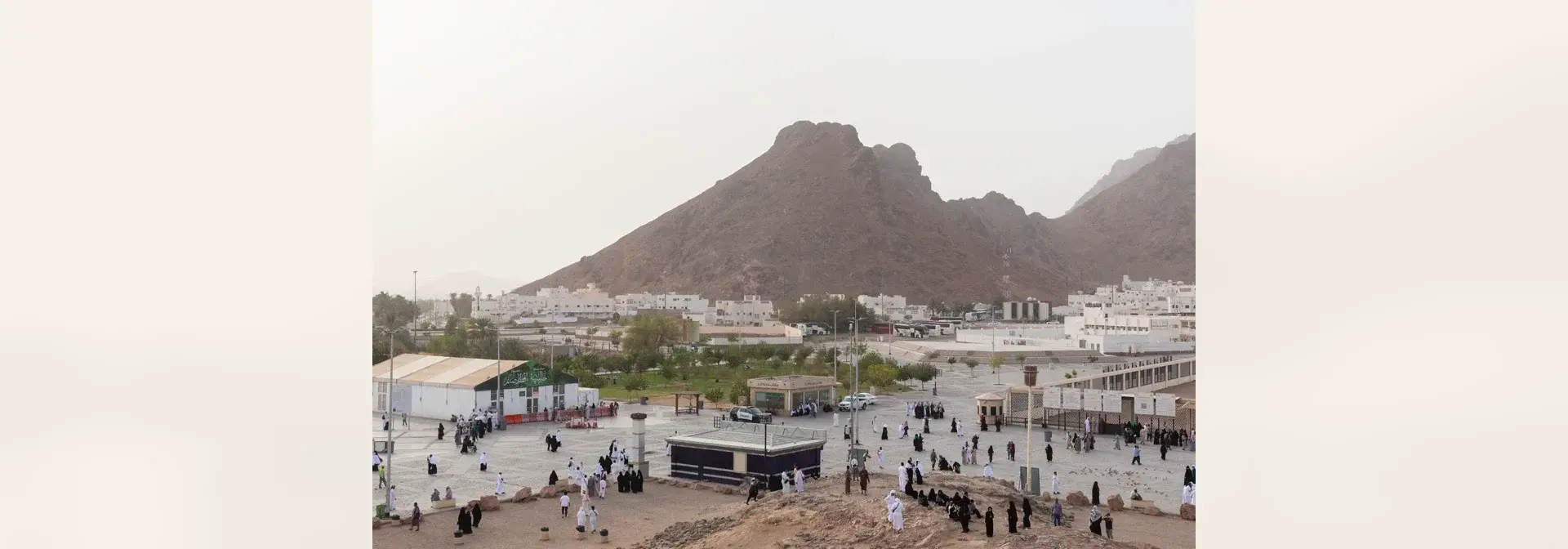
Overview
Jabal Uhud is a natural and historic landmark in the Madinah region, lying north of the Prophet's Mosque, and it is among the most prominent natural features embracing Madinah from its northern side.[1]
The mountain holds historic and archaeological landmarks and early Islamic writings and inscriptions, and its area is linked to the events of the great Battle of Uhud in the third year after the Hijrah, which makes it one of the most prominent natural and historic sites in Madinah.[1]
Location and Extent
Jabal Uhud extends as a rocky chain from east to west with a tilt towards the north; it is seven kilometres long, between two and three kilometres wide, and rises to 350 m.[2]
The mountain overlooks Madinah from the northern side as a natural barrier, and its highest point above sea level reaches about 1,077 m.[2][3]
Geological Formation and Vegetation Cover
Most of the rocks of Jabal Uhud are red granite, and parts of it tend towards dark green and black.[4]
The "Maharis" are natural hollows in the mountain that hold the water flowing down from its upper reaches.[2]
"Shi'b al-Jirar" holds many early Islamic inscriptions and writings, and together with the Maharis it forms part of the historic and archaeological landmarks of the mountain.[1]
The mountain also grows the hummad plant, which has a sharp taste and pink leaves, alongside al-'awsaj, as-samar, as-salam, as-sidr, al-hanzal and shawkat al-ibil, which strengthens the vegetation cover of the area.[3]
The area of the mountain holds forms of wildlife and environment, and its geographical, environmental and historic landmarks have received the attention and care of the relevant bodies in the Kingdom, among them the Heritage Commission and the Madinah Region Development Authority, to preserve the environment of Jabal Uhud and its natural components.[1]
The Battle of Uhud
The historic area at Jabal Uhud witnessed in the third year after the Hijrah / 625 CE the events of the Battle of Uhud, in which the Muslim army was able to protect Madinah and repel the aggressors.[5]
The area of Jabal Uhud became known for this battle, which took place between the Muslims and the polytheists at the beginning of the Islamic era under the leadership of the Prophet Muhammad, peace be upon him, and in which more than seventy Companions were martyred.[4]
The Martyrs of Uhud
Jabal Uhud contains the graves of 70 Companions who were martyred in the Battle of Uhud, foremost among them Hamza ibn Abd al-Muttalib, Mus'ab ibn Umayr, Abdullah ibn Jahsh, Hanthala ibn Abi Amir, Abdullah ibn Jubayr, Amr ibn al-Jamuh and Abdullah ibn Haram.[2]
The Virtue of Jabal Uhud
Prophetic hadiths have been related on the virtue of Jabal Uhud, among them the saying of the Prophet, peace be upon him: "Uhud is a mountain that loves us and we love it", narrated by al-Bukhari.[6]
Historic Landmarks around the Mountain
The site of the Uhud martyrs area includes "Jabal ar-Rumah" (also called Jabal Aynayn), a small hill where the archers took up position by the order of the Prophet, peace be upon him, to protect the rear of the Muslims, and their disobedience of his order was a cause of the change in the course of the battle.[5]
The area also embraces the "Sayyid al-Shuhada Mosque", which was established in 2017 in the Martyrs' square and plaza; it has an area of 54,000 square metres and a capacity of about 15,000 worshippers.[5]
The "Al-Fasih Mosque" (known as the Uhud Mosque and the Al-Fushah Mosque) lies on the northern side of Jabal Uhud, and it is one of the historic mosques of Madinah, near the site of the Battle of Uhud.[7]
"Wadi Qanah" is among the most important valleys of Madinah; it lies on the north-western side of Jabal Uhud, and its surroundings witnessed the events of the Battle of Uhud in the third year of the Prophetic Hijrah.[8]
Preservation and Development
His Royal Highness Prince Faisal bin Salman bin Abdulaziz, Governor of the Madinah region, directed the relevant bodies to develop the "Sayyid al-Shuhada" square and to raise the level of services provided to its visitors from among the residents and visitors of Madinah.[9]
Frequently Asked Questions
Q: Where is Jabal Uhud located? A: In the Madinah region, north of the Prophet's Mosque, extending as a rocky chain from east to west with a tilt towards the north.
Q: What are the dimensions of Jabal Uhud? A: It is seven kilometres long, between two and three kilometres wide, and rises to 350 m, with its highest point above sea level reaching about 1,077 m.
Q: What is the relationship between Jabal Uhud and the Battle of Uhud? A: Its area witnessed the events of the Battle of Uhud in the third year after the Hijrah / 625 CE, in which the Muslim army was able to protect Madinah and repel the aggressors, and in which more than seventy Companions were martyred.
Q: Who are the most prominent martyrs buried at Jabal Uhud? A: Hamza ibn Abd al-Muttalib, Mus'ab ibn Umayr, Abdullah ibn Jahsh, Hanthala ibn Abi Amir, Abdullah ibn Jubayr, Amr ibn al-Jamuh and Abdullah ibn Haram.
Q: What are the most prominent mosques and landmarks around the mountain? A: The Sayyid al-Shuhada Mosque, established in 2017 and accommodating about 15,000 worshippers, and the Al-Fasih Mosque on the northern side of the mountain, alongside Jabal ar-Rumah (Aynayn) and Wadi Qanah.
Conclusion
Jabal Uhud brings together natural and historic standing in Madinah: it is among its most prominent natural landmarks and a site linked to the Battle of Uhud and the cemetery of its martyrs, and its surroundings receive official attention in development and the preservation of the environment.[9][1]
Related topics
- RegionMadinah RegionA western Saudi region combining Madinah, Yanbu, AlUla and other governorates, with Islamic landmarks, oases, archaeological sites and a Red Sea coastline.
- HistoricThe Prophet's MosqueThe Prophet's Mosque is the mosque of the Prophet Muhammad ﷺ in Madinah, built in the first year of the Hijrah over an area of 1,050 square meters. Several constructions followed across the Islamic eras, and the mosque saw its widest expansions in the Saudi era.
- EventBattle of BadrThe Battle of Badr is the first decisive battle fought by the Muslims. It took place on the seventeenth of Ramadan in the second year of the Hijrah between Makkah and Madinah, and its day was named the Day of the Criterion. It ended in the defeat of the polytheists, and its site in Badr Governorate preserves its landmarks and its historic route.
- EventHistory of MadinahThe history of Madinah is the history of a city in the west of the Kingdom of Saudi Arabia, known before the Prophetic Hijrah as Yathrib and later named Madinah; it is the seat of the Prophet's Mosque and the first capital of the Islamic state. Its history extends from before Islam to the Saudi era, through the building of the Prophet's Mosque and the city's historical landmarks.
- HistoricVegetation Cover in Saudi ArabiaVegetation Cover in Saudi Arabia is the total of the native plant species and the varied ecological regions across the Kingdom, whose sites are developed, protected and monitored and whose degraded parts are rehabilitated through national programmes for afforestation, combating desertification and land rehabilitation.
- HistoricWildlife of Saudi ArabiaWildlife in Saudi Arabia is a system of desert, sandy, valley, and plateau environments that shelter hundreds of species of mammals, birds, reptiles, and wild plants.[1][2] Nature reserves work to protect and develop it and to reintroduce endangered species into their habitats.[1][3]