
Overview
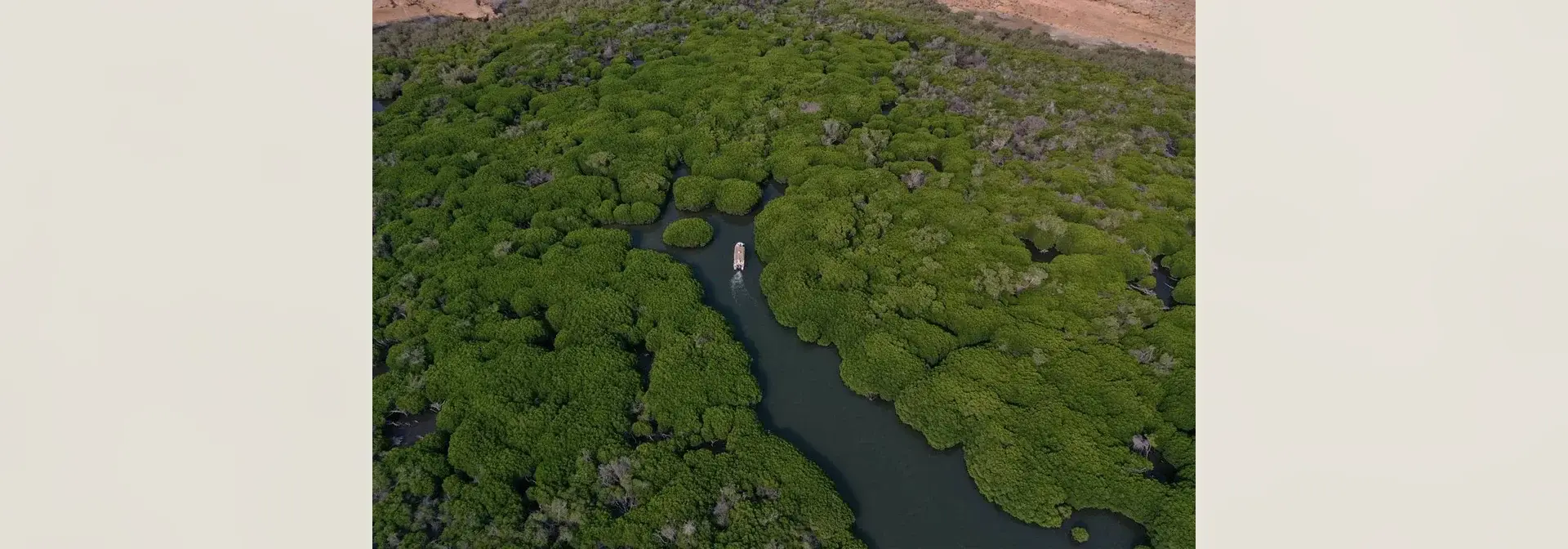
Mangrove forests in Saudi Arabia are coastal plants that grow in the intertidal zone along the Kingdom's coasts on the Red Sea and the Arabian Gulf, and their soil is rich in organic matter and highly resistant to salinity.[2]
Two families of mangrove trees are widespread in the Kingdom: Al-Qurm, which grows on the coasts of the Arabian Gulf and the northern and central Red Sea, and Al-Qandal, which grows on the southern coasts of the Red Sea.[1] The number of mangrove species on the Red Sea coast does not exceed two.[3]
The total area of mangrove trees in the Kingdom is 60 million square metres, with an average density of 86,285 trees per hectare, meaning that there are about 400 million mangrove trees.[1]
Species and Geographical Distribution
Mangrove density is concentrated on the shores of Al-Birk Governorate and the centres of Al-Qahmah, Sa'idah Al-Sawalihah and Al-Haridah in the Asir Region, forming an environmental belt that blends life on land with life in the depths of the seas.[3]
The Farasan Islands Reserve contains habitats for mangrove trees in the south-west of the Kingdom, among them Qummah Island, whose area is about 14 square kilometres; its young people have planted about 100 mangrove seedlings along its shores.[11]
The spread of mangroves along the Kingdom's coasts includes sites in Qatif Governorate, Ras Tanura, Al-Lith Governorate, Al-Wajh Governorate and the Farasan Islands.[4][10][12][5]
Mangroves grow widely in the tropical and subtropical regions around the world, with their growth concentrated in the intertidal zone, where the soil is formed from decaying tree remains mixed with clay particles.[2]
Environmental and Climate Importance
Mangrove forests are among the most efficient ecosystems for storing carbon, as their trees absorb carbon from the atmosphere and store it in the depths of their soil for decades, and they can store 10 times the amount of carbon compared with other forests.[6]
These forests form rare and fertile ecological systems, and the areas they cover worldwide have shrunk by half over the past forty years, which has made their conservation and development an environmental objective.[6]
Tourism and nature
Protection and Cultivation Efforts
The Ministry of Environment, Water and Agriculture develops mangroves continuously through seven nurseries dedicated to them, and it has completed in-depth studies covering all the Kingdom's coasts on the Red Sea and the Arabian Gulf, with the aim of protecting and developing the environments that host mangroves.[1]
On the sixth of December 2017, the Ministry announced the first national mangrove park in Jazan, which includes a marine national park at Al-Madaya and Farasan regarded as the first of its kind to be established by the Kingdom, while the number of national parks throughout the Kingdom stands at 27.[1]
The mangrove park in Ras Tanura is regarded as the first nature reserve dedicated to mangrove forests in the Kingdom, and it is classified among the organic natural reserves.[4]
The National Center for Vegetation Cover Development announced that it is continuing its projects by planting 13 million mangrove seedlings distributed across the regions: Jazan 5.5 million seedlings, Makkah 2.4 million seedlings, Madinah two million, Tabuk 1.5 million seedlings, Asir one million seedlings, and the Eastern Province 500,000 seedlings.[5]
The Center launched two projects to plant 700,000 mangrove seedlings, including 200,000 on Ras Abu Ali Island in Jubail Governorate and 500,000 in Al-Wajh Governorate, and it aims, in cooperation with its partners, to plant 100 million mangrove trees on the coasts of the Red Sea and the Arabian Gulf in the coming few years.[5]
The Royal Commission for Jubail and Yanbu, represented by the Jazan City for Primary and Downstream Industries, launched an initiative to plant 19 million mangrove trees, which has so far resulted in the planting of 11 million trees.[8]
His Royal Highness Prince Mohammed bin Abdulaziz bin Mohammed bin Abdulaziz, Governor of Jazan Region, launched two projects to plant 2.5 million trees on the vegetation cover lands of the region.[8]
The National Center for Vegetation Cover Development, together with the Asir Region Development Authority, launched the "Restoring the Mangrove" campaign, which began by planting 500 seedlings on the shores of Al-Birk Governorate, 170 kilometres north-west of Asir Region.[9]
The branch of the Ministry of Environment, Water and Agriculture in the Makkah Region carried out an initiative to plant mangrove trees on the southern corniche in Al-Lith Governorate, with the participation of more than 120 volunteers.[12]
The Al-Shura tree production and planting project in the Jazan Region, one of the Kingdom's largest mangrove production projects, produced and planted more than 875,000 seedlings at the two sites "Bahar 1" and "Bahar 2" south of the Red Sea.[7]
Economic Value and Environmental Occasions
Alongside the environmental role, the mangrove resource has an economic value, as the branch office of the Ministry of Environment, Water and Agriculture in Qatif Governorate carries out an initiative to produce honey from mangrove trees.[10]
The International Day for the Conservation of the Mangrove Ecosystem falls on the twenty-sixth of July each year, an occasion in which environmental bodies in the Kingdom take part to raise awareness of the importance of these forests.[4]
Frequently Asked Questions
Q: What are the types of mangrove trees in Saudi Arabia? A: Two types: Al-Qurm, which grows on the coasts of the Arabian Gulf and the northern and central Red Sea, and Al-Qandal, which grows on the southern coasts of the Red Sea.[1]
Q: How large are the mangrove forests in the Kingdom? A: Their total area reaches 60 million square metres, with an average density of 86,285 trees per hectare, that is about 400 million trees.[1]
Q: Where are the mangrove forests concentrated? A: Their density is concentrated on the shores of Al-Birk Governorate and the centres of Al-Qahmah, Sa'idah Al-Sawalihah and Al-Haridah in Asir Region, alongside sites on the coasts of Jazan, Makkah, Tabuk and the Eastern Province.[3][5]
Q: What efforts are being made to plant mangroves in the Kingdom? A: Projects to plant 13 million seedlings distributed across six regions, an initiative to plant 19 million trees in Jazan of which 11 million trees have been carried out, and two projects of 700,000 seedlings in Jubail and Al-Wajh.[5][8]
Q: What is the environmental importance of mangrove trees? A: They absorb carbon and store it in their soil for decades, and they can store 10 times the amount of carbon compared with other forests.[6]
Related topics
- HistoricVegetation Cover in Saudi ArabiaVegetation Cover in Saudi Arabia is the total of the native plant species and the varied ecological regions across the Kingdom, whose sites are developed, protected and monitored and whose degraded parts are rehabilitated through national programmes for afforestation, combating desertification and land rehabilitation.
- RegionJazan RegionA southwestern Saudi region administered from Jazan city, combining the Red Sea coast, Farasan Islands, plains and mountains with farming, fishing, commerce and industry.
- RegionAsir RegionA southwestern Saudi region administered from Abha, combining Sarawat highlands, Tihamah and the coast, with agricultural terraces, historic villages and distinctive local cultural traditions.
- RegionQatif CityQatif City is a Saudi city in the Eastern Province, on the shore of the Arabian Gulf, known for its palm oases, date farms, fish market, Tarout Island and the town of Darin. Its development is reinforced by the approved development direction for Darin and Tarout Island, waterfront projects and health and leisure services.
- RegionMakkah RegionA western Saudi region administered from Makkah, encompassing Jeddah, Taif and other governorates, where pilgrimage, maritime trade, coastal landscapes and uplands meet.
- RegionEastern ProvinceA large eastern Saudi region administered from Dammam, combining Gulf cities, the oases of Al Ahsa and Qatif, desert areas, energy industries and maritime commerce.
- TopicSaudi Green InitiativeThe Saudi Green Initiative is a national initiative announced by His Royal Highness the Crown Prince and Prime Minister on 27 March 2021, charting the Kingdom's direction in protecting land and nature along a clear and ambitious roadmap. It targets the planting of 10 billion trees, the raising of protected areas to more than 30 percent, and the supply of 50 percent of electricity generation from renewable energy by 2030.
- HistoricSaudi HoneySaudi honey is the product of apiaries spread across the regions of the Kingdom of Saudi Arabia, and its yield varies between grazing ranges depending on the abundance of blossoms and their flowering periods. It receives official attention in licensing, training, marketing, and the organisation of production seasons and festivals.
Sources & references
- Saudi Press Agency (SPA) — "Environment" announces the first national mangrove park in Jazan
- Saudi Press Agency (SPA) — Mangrove forests: natural resources
- Saudi Press Agency (SPA) — "Mangrove": the environmental belt of Asir on the Red Sea shore
- Saudi Press Agency (SPA) — Qatif's environment celebrates the International Day of Mangrove Forests
- Saudi Press Agency (SPA) — "Vegetation Cover" enhances the flourishing of mangrove forests on the Kingdom's coasts by planting 13 million seedlings
- Saudi Press Agency (SPA) — "Environment": mangrove forests are among the most efficient ecosystems for storing carbon
- Saudi Press Agency (SPA) — "Mangrove" trees in Jazan Region: protection for the environment
- Saudi Press Agency (SPA) — "Mangrove" forests in Jazan: a green lung that protects the coasts and revitalises eco-tourism
- Saudi Press Agency (SPA) — Launch of the "Restoring the Mangrove" initiative on the coasts of Asir Region
- Saudi Press Agency (SPA) — FAO is briefed on the initiative to produce honey from mangrove trees in Qatif Governorate
- Saudi Press Agency (SPA) — Young people of Qummah Island succeed in cultivating mangrove trees
- Saudi Press Agency (SPA) — Implementation of an initiative to plant mangrove trees in Al-Lith and rehabilitate degraded areas