
Overview
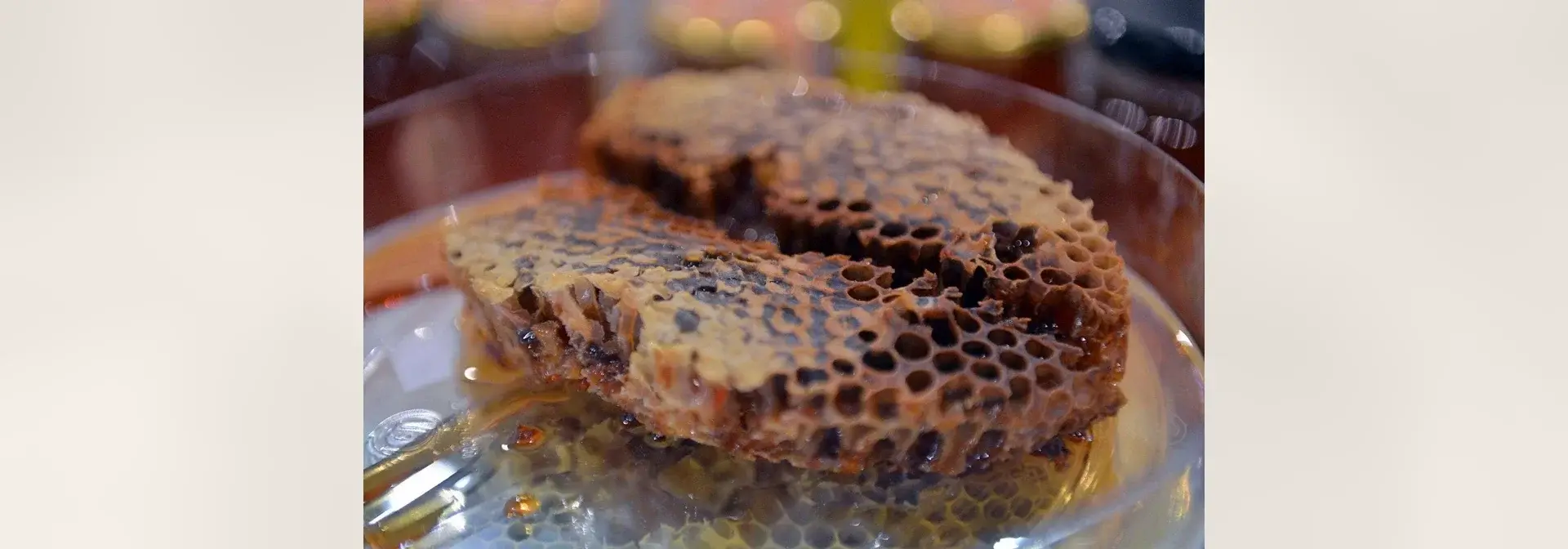
Saudi honey is the product of apiaries spread across the regions of the Kingdom of Saudi Arabia, and its yield varies between grazing ranges depending on the abundance of blossoms, the length of their flowering period, temperature and humidity, and the strength of the colonies and the efficiency of their management. [1]
Official bodies, development programmes, and cooperative associations work to develop its production and marketing system, create organised sales channels that strengthen commercial competition, and secure better economic returns for beekeepers. [2]
Beekeeping in the Regions of the Kingdom
The number of beekeepers in Jazan Region exceeded 3,000, of whom 744 are licensed through the Zirai platform, while the number of traditional honeybee colonies reached 160,915, in addition to 130,000 modern colonies, and the region's annual production recorded 426,526 kilograms. [1]
The branch of the Ministry of Environment, Water and Agriculture in Rafha issued 109 permits for beekeepers to take part in the production seasons, covering a total of 25,737 active honeybee colonies inside the reserves, and granted more than 1,135 licences for beekeeping and honey production within Northern Borders Region. [3] In Najran Region, the Najran Al-Khadra Association succeeded in planting more than 125,000 Christ's thorn trees in recent years, and aims to plant 200,000 trees by 2030 in cooperation with government and community bodies. [4]
Nectar Seasons and Sources
Nectar sources in the apiaries of Jazan vary among the Sidr, Sumar, Salam, Shawkah, Dhahyan, and Qatad trees. [1]
The Qatad honey season begins in January and continues through February until early March, Sumar honey appears in March and April, the Salam honey season extends from late March to May, then Doum honey comes in June and July, and Dhahyan and Sidr honey in October and November. [1]
Honey Festivals and Markets
The eighteenth Honey Festival in Bahah Region concluded with the participation of 45 beekeepers who displayed nearly 30 tons of the finest honey varieties and bee products, and the festival drew about 100,000 visitors. [5]
In Al-Jouf, the sixth edition of the honey festival, organised by the Beekeepers' Cooperative Association in Dumat Al-Jandal Governorate, concluded amid an economic and awareness-raising activity that lasted five days. [6] The Beekeepers' Cooperative Association in Rijal Almaa Village also organised a honey auction that displayed more than 480 kilograms of the finest honey types for which the governorate is known, as part of efforts to develop its production and marketing system and to create organised sales channels for producers and traders. [2]
Bees and the Ecosystem
The King Abdulaziz Royal Reserve Development Authority announced that it has begun receiving applications for apiary permits in the reserve, in recognition of the importance of bees in the ecosystem and their contribution to pollinating 90% of flowering wild plants and 87% of agricultural crops worldwide. [7]
The Imam Turki bin Abdullah Royal Reserve Development Authority recorded the participation of 11,439 honeybee colonies in the Talh and Sidr seasons up to 9 July 2026, of which 8,050 colonies were in the Talh season and benefited 99 beekeepers, and 3,389 colonies were in the Sidr season and benefited 55 beekeepers. [8]
Rural Development Initiatives and Support for Beekeepers
The Sustainable Agricultural Rural Development Programme, Reef Saudi, handed over five development projects in the beekeeping and honey production sector to the Reef Al-Ahliya Foundation at a total value exceeding 48.2 million riyals. [9] The programme also announced the completion of 11 development projects worth more than 70 million riyals to support and develop the beekeeping and honey production sector in the Kingdom. [10]
The honeybee breeding and multiplication programme, carried out by Reef Saudi in cooperation with the Ministry of Environment, Water and Agriculture, contributed to achieving productivity of 200% among a group of model beekeepers. [11] The branch of the Ministry of Environment, Water and Agriculture in Asir Region, represented by the office of Mahayel Asir Governorate, organised a specialised workshop titled "Queen Bee Rearing" in cooperation with the Reef Saudi programme, the Khamis Mushait Municipality, and the Beekeepers' Cooperative Association in Mahayel Asir, with the participation of more than 100 beekeepers and people interested in the sector. [12]
Mangrove Honey in the Eastern Province
The "Mangrove Honey" initiative was launched in Eastern Province in 2021 at two sites on the coasts of the Arabian Gulf, with the participation of 17 beekeepers and 1500 bee colonies, and with production reaching 2.5 tons of honey. [13]
The initiative expanded by 2025 to include more than 6 sites, with the participation of 41 beekeepers and 4169 bee colonies, while production exceeded 20 tons, achieving a growth rate of more than 700% compared with the year of its launch. [13]
National Models and Global Standing
The beekeeper Noura Al-Shawi of Hail Region began her journey over the past ten years from a single bee colony, before gradually expanding to hundreds of productive colonies, relying on seasonal movement between grazing ranges in line with flowering periods. [14]
Tihama Sidr honey produced in Asir Region won the "Best Taste" award at the World Food Gift Challenge 2023, with the participation of the Culinary Arts Commission of the Saudi Ministry of Culture. [15]
Frequently Asked Questions
Q: What are the nectar sources in the apiaries of Jazan? A: The Sidr, Sumar, Salam, Shawkah, Dhahyan, and Qatad trees, in addition to Doum.
Q: What was the annual honey production in Jazan Region? A: 426,526 kilograms.
Q: What are the most prominent honey festivals in the Kingdom? A: The Honey Festival in Bahah, the Honey Festival in Al-Jouf in its sixth edition, and the honey auction in Rijal Almaa.
Q: What share of plants and crops do bees pollinate? A: 90% of flowering wild plants and 87% of agricultural crops worldwide.
Q: How did the Mangrove Honey initiative expand in the Eastern Province? A: From 17 beekeepers and 1500 colonies and 2.5 tons in 2021 to 41 beekeepers and 4169 colonies and more than 20 tons in 2025.
Conclusion
Related topics
- RegionJazan RegionA southwestern Saudi region administered from Jazan city, combining the Red Sea coast, Farasan Islands, plains and mountains with farming, fishing, commerce and industry.
- RegionAsir RegionA southwestern Saudi region administered from Abha, combining Sarawat highlands, Tihamah and the coast, with agricultural terraces, historic villages and distinctive local cultural traditions.
- RegionHail RegionA north-central Saudi region administered from Hail, associated with the Aja and Salma mountains, the Nafud desert, historical caravan routes and varied regional activities.
- RegionBahah RegionA southwestern Saudi region administered from Al Bahah, combining Sarawat uplands and Tihamah, with historic villages, agricultural terraces and vegetation in its mountain landscapes.
- HistoricVegetation Cover in Saudi ArabiaVegetation Cover in Saudi Arabia is the total of the native plant species and the varied ecological regions across the Kingdom, whose sites are developed, protected and monitored and whose degraded parts are rehabilitated through national programmes for afforestation, combating desertification and land rehabilitation.
- HistoricRijal Almaa VillageRijal Almaa Village (also known as Rijal) is a heritage village 45 km west of the city of Abha in the mountainous Asir Region of southwestern Saudi Arabia, with a cultural heritage and history spanning nearly 900 years. It has been on the UNESCO Tentative List since 2015 and was chosen in 2021 as one of the world's best tourism villages.
- GovernorateDumat Al-Jandal GovernorateA governorate in Al-Jawf west of Sakaka and one of northern Arabia's oldest towns, with Marid Castle, the Mosque of Umar ibn al-Khattab and Dumat Al-Jandal Lake.
- RegionEastern ProvinceA large eastern Saudi region administered from Dammam, combining Gulf cities, the oases of Al Ahsa and Qatif, desert areas, energy industries and maritime commerce.
- RegionNajran RegionA southern Saudi region administered from Najran, extending from settled wadis towards the Empty Quarter and containing Al Ukhdud, Hima and traditions of local architecture and crafts.
- RegionNorthern Borders RegionA northern Saudi region administered from Arar, including Rafha, Turaif and Al Uwayqilah, with histories of pilgrimage routes, pastoral activity, Tapline settlement and mining.
Sources & references
- Saudi Press Agency (SPA): Beekeepers, bee colonies, production and nectar seasons in Jazan Region
- Saudi Press Agency (SPA): Honey auction by the Beekeepers' Cooperative Association in Rijal Almaa
- Saudi Press Agency (SPA): Beekeeper permits and beekeeping licences in Rafha
- Saudi Press Agency (SPA): Christ's thorn tree planting in Najran
- Saudi Press Agency (SPA): Conclusion of the eighteenth Honey Festival in Bahah Region
- Saudi Press Agency (SPA): Conclusion of the Honey Festival in Al-Jouf in its sixth edition
- Saudi Press Agency (SPA): Apiary permits in King Abdulaziz Royal Reserve
- Saudi Press Agency (SPA): Bee colonies in the Talh and Sidr seasons in Imam Turki bin Abdullah Royal Reserve
- Saudi Press Agency (SPA): Reef Saudi hands over development projects in the beekeeping and honey production sector
- Saudi Press Agency (SPA): Completion of Reef Saudi projects for the beekeeping and honey production sector
- Saudi Press Agency (SPA): Honeybee breeding and multiplication programme in Reef Saudi
- Saudi Press Agency (SPA): "Queen Bee Rearing" workshop in Mahayel Asir
- Saudi Press Agency (SPA): "Mangrove Honey" initiative in the Eastern Province
- Saudi Press Agency (SPA): The experience of beekeeper Noura Al-Shawi in Hail
- Saudi Press Agency (SPA): "Best Taste" award for Tihama Sidr honey