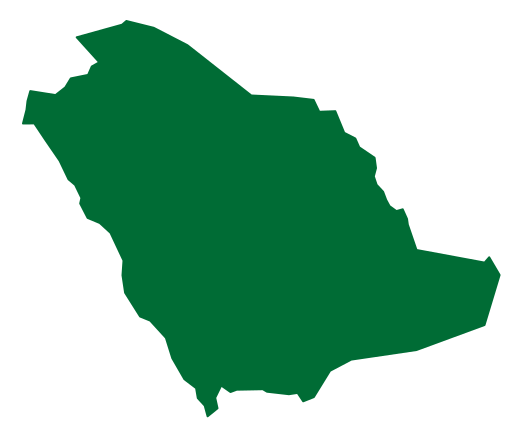

Overview
Al-Tayebat Museum is a heritage museum in the city of Jeddah, in the west of the Kingdom of Saudi Arabia, located in Al-Faisaliyyah district on an area of 10,000 square meters and comprising 12 heritage buildings [1].
It was founded in 1989 and opened to visitors in 1999, and holds more than 365 exhibition halls across four floors, in an architectural design inspired by the houses of Historic Jeddah [1][2]. It is one of the city's most prominent private cultural landmarks [1].
Location and Foundation
The museum is located in Al-Faisaliyyah district in the city of Jeddah, within the Makkah region, and comprises 12 heritage buildings erected on an area of 10,000 square meters, housing collections that range from local heritage to world antiquities representing various civilizations [1].
It was founded by Sheikh Abdulraouf Khalil, who devoted more than 45 years of his life to collecting and documenting archaeological and knowledge pieces, and it opened to visitors in 1999 as an educational and museum platform presenting the stages of development of human civilizations [1]. Yousef Muhammad Kiki serves as General Supervisor of Al-Tayebat World City for Sciences and Knowledge [2][5].
Architecture and Design
The museum's exterior design reflects the architectural style of the old city of Jeddah, with its roshan balconies bearing wooden and coral ornamentation, and its buildings are constructed of Al-Manqabi stone over several floors [2].
The exhibition halls are distributed across four floors in an architectural mosaic inspired by the houses of Historic Jeddah, allowing the visitor to move among themes of Islamic civilization and the history of the Kingdom [1][2].
Wings and Exhibition Halls
The museum contains more than 365 exhibition halls and 150 wings recounting 14 centuries of the history of Islamic civilizations and the lands of the Islamic East, from prehistory to the present day [2]. Its wings include the Saudi Culture Wing and the Islamic Civilization Wing, and it is considered the largest Islamic museum [4].
The King Abdulaziz Wing presents the history of the Kingdom and its journey of unification at the hands of the founder King Abdulaziz ibn Abdulrahman Al Saud, from the recapture of Riyadh in 1902 until the proclamation of the unification of the Kingdom of Saudi Arabia in 1932, alongside maps of the stages of unification and photographs of the Kingdom's monarchs, and a section on the biography of the kings down to the reign of the Custodian of the Two Holy Mosques King Salman ibn Abdulaziz Al Saud [1].
The Islamic Civilization Wing contains art pieces of copper, ceramics and glass, and halls for the Kaaba covering and the earliest manuscripts of the Holy Quran, the oldest of which date to the Abbasid era and the second Hijri century, in addition to a wing for the scientific miracles in the Holy Quran [1].
The Saudi Culture Wing displays costumes, fabrics and handicrafts from every region of the Kingdom, from the western and Hejazi region to the central, eastern, southern and northern regions [5]. It also includes architectural models reflecting the heritage of the Kingdom's regions from south to north, among them halls representing life in "Jeddah of the Past", Madinah, and the traditional majlis of Al-Bahah region [1].
Collection and Library
The museum's knowledge library holds more than 200,000 books and references, and its display spaces cover more than 2,000 square meters, supported by visual content, educational models and knowledge panels exceeding 120,000 historical facts [1].
The value of the museum's collection exceeds tens of millions of riyals [3].
Cultural Programs and Events
The museum presents lasting cultural programs and events, including temporary exhibitions and educational workshops, alongside hosting tourist and student delegations, reinforcing awareness of the national and Islamic heritage [4].
Reopening and Tourism Standing
The General Authority for Tourism and National Heritage in Jeddah governorate reopened Al-Tayebat Museum on 2 Sha'ban 1437 AH, corresponding to 9 May 2016, after it met the conditions and requirements of security and safety set by the Civil Defense Department [3]. The reopening places the museum on the list of approved tourist routes in the Makkah region, given the role private museums play in familiarising the community with the Kingdom's antiquities and cultural heritage [3].
The museum continues to carry out its cultural mission as a national platform supporting the objectives of Saudi Vision 2030 in preserving historical legacy and highlighting the Kingdom's civilisational depth [5].
Frequently Asked Questions
Q: Where is Al-Tayebat Museum located? A: In Al-Faisaliyyah district in the city of Jeddah, within the Makkah region, on an area of 10,000 square meters [1].
Q: When was the museum founded and by whom? A: It was founded in 1989 by Sheikh Abdulraouf Khalil, and it opened to visitors in 1999 [1].
Q: How many exhibition halls and wings does the museum have? A: More than 365 exhibition halls and 150 wings recounting the history of Islamic civilizations [1][2].
Q: What does the Islamic Civilization Wing contain? A: Art pieces of copper, ceramics and glass, and halls for the Kaaba covering and the earliest manuscripts of the Holy Quran, the oldest of which date to the Abbasid era and the second Hijri century [1].
Q: How many books are in the museum's library? A: More than 200,000 books and references [1].
Conclusion
Al-Tayebat Museum brings together the architectural style of Historic Jeddah and the richness of its Islamic and national collections, and continues its role as a cultural and educational destination in the Kingdom [1][2]. Related topics on the platform include the Saudi National Museum and the King Fahd National Library.
Tourism and nature
Related people
- Kings of Saudi ArabiaKing Abdulaziz bin Abdulrahman Al SaudFounder and first king of Saudi Arabia, Abdulaziz recovered Riyadh in 1902 and led the unification proclaimed in 1932. His reign saw the development of state institutions and the beginnings of the oil industry.
- Kings of Saudi ArabiaKing Salman bin Abdulaziz Al SaudThe seventh Saudi king, Salman acceded in 2015 after serving in Riyadh, defence and the crown princeship. His reign has included Vision 2030 and administrative, economic and social changes.
Related topics
- HistoricHistoric JeddahHistoric Jeddah, or Al-Balad, is an urban core on the Red Sea shaped by maritime trade and pilgrimage, with houses distinguished by projecting wooden windows.
- EventUnification of Saudi ArabiaKing Abdulaziz's path from the recovery of Riyadh in 1902 to the proclamation of the Kingdom of Saudi Arabia on 23 September 1932, now National Day.
- National visions and programmesSaudi Vision 2030: A Framework for TransformationAn introduction to Saudi Vision 2030, its social, economic and institutional themes, and the relationship between implementation programmes, long-term targets and measured results.
- MuseumSaudi National Museum: Reading History through ObjectsAn introduction to Riyadh's National Museum, its setting within the King Abdulaziz Historical Center, and the use of objects and multimedia to explore the Arabian Peninsula's past.
- MuseumKing Fahd National LibraryKing Fahd National Library is the national library of the Kingdom of Saudi Arabia, based in Riyadh. It became a national library under a statute issued by Council of Ministers Resolution No. (80) of 1410 AH, and is responsible for collecting, documenting, and making available the Kingdom's intellectual output.
- RegionMakkah RegionA western Saudi region administered from Makkah, encompassing Jeddah, Taif and other governorates, where pilgrimage, maritime trade, coastal landscapes and uplands meet.
Sources & references
- Saudi Press Agency (SPA) — Al-Tayebat City Museum in Jeddah: location, components and collection
- Saudi Press Agency (SPA) — architectural style, exhibition halls and the General Supervisor
- Saudi Press Agency (SPA) — reopening of Al-Tayebat Museum
- Saudi Press Agency (SPA) — Al-Tayebat Museum: exhibition wings and cultural programs
- Saudi Press Agency (SPA) — Saudi Culture Wing, the General Supervisor and support for Vision 2030