

Overview
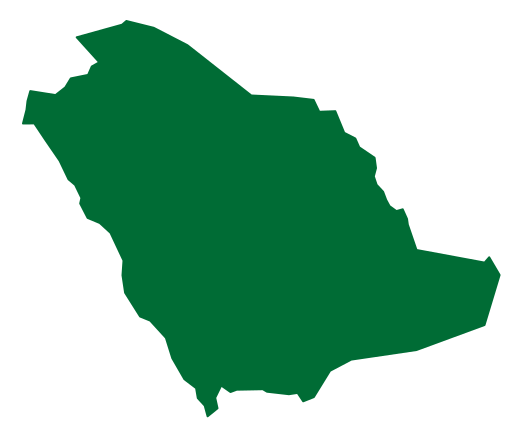
Al-Dahha is a folk heritage and performing art particular to the northern regions of Saudi Arabia. It has become one of the performing arts that shape Saudi culture both within the Kingdom and abroad, and it features prominently in national festivals. [1]
It is performed collectively: men line up in a single row or two facing rows, and the poet standing in the middle of one row sings his versified poem, with the two rows alternating in repeating the following verse. [1]
Performance Style and Al-Badda'
Al-Dahha is a folk art particular to the tribes of the northern Kingdom. A number of men stand in each row, and the poet known as Al-Badda' takes his place in the middle of the row or to its right, singing his poem, called Al-Badda'ah; the rest of the row then answers him with one of the poem's verses or with another verse they agree upon among themselves. [7]
In Tabuk Province and its governorates, this tradition, bound up with Bedouin life, unfolds as participants line up in one row or two parallel rows standing shoulder to shoulder. Al-Badda' prompts the members of his row with the verse in a low voice, and the voices rise together as soon as the opposite row finishes. The poets sing to melodies that include Al-Marbu'ah and Al-Zuraibi, and the Dahhiyah closes with Al-Nahah, of two kinds, Al-Adiyah and Al-Shahouqiyah, a sound resembling a roar whose pace gradually quickens to a peak, accompanied by clapping. [4]
The Closing Movement and the Themes of the Poems
Al-Dahha's closing movement comes at the end of the poetic chanting, when Al-Hashi or Al-Mahwashi performs a dance in front of the row or between the two rows, with a sword or a stick and wearing a bisht, usually joined by another person, while the rows clap in an eager rhythmic motion, closely matched in voice and movement. [1]
Al-Dahha's poems vary in theme across praise, pride, love and patriotism, and are delivered in a storytelling manner. In earlier times it was one of the war dances intended to strike fear into the hearts of enemies or to celebrate victory after battle. [1] In the past Al-Dahha was also among the performing dances distinguished by the fervour of their rhythms: chants and sounds closely resembling the roar of lions or the rumbling of camels, performed collectively by young men and elders alike. [2]
Origins, Spread and the Title "Breaths of Knights"
Al-Dahha is a folk art and heritage and a "war" dance; its first appearance is traced to the Battle of Dhi Qar. From that time the people of Rabi'ah preserved the art on their occasions, and it did not remain confined to the Anizah tribe of Rabi'ah but spread to all the tribes of the northern Kingdom, though it was performed in different artistic styles. [7]
In folk tradition Al-Dahha is known as "Breaths of Knights," because of the importance of coordinating movement and breath during its performance, and it features prominently in every national festival. [2]
Al-Dahha Troupes and the Transmission of the Heritage
The northern Al-Dahha tradition is performed by troupes of those accomplished in the art, numbering no fewer than twenty to forty members. The Society of Culture and Arts in the Northern Borders region has two Al-Dahha troupes, in the city of Arar and Turaif governorate, each with twenty people who take part in national and social occasions. [2]
Al-Dahha is widely spread across social circles and appeals to young people, alongside other arts, most notably the rababa, a locally made stringed instrument with a single string over which the player draws a bow, and Al-Hijini among camel herders. In the Northern Borders region, the Society of Culture and Arts preserves these arts by passing them on to the generations through engaging and training a number of young people to perform them at official occasions such as the Eid holidays, the National Day and festivals. [5]
Al-Dahha at Festivals and Occasions
At the National Festival for Heritage and Culture, a crowd of folk-art enthusiasts gathered in 1430 AH / 2009 CE to watch the Al-Jawf Al-Dahha performances at the Jawfi House of Poetry at the centre of the Janadriyah grounds. The Al-Dahha dance is one of the diverse folk-arts performances presented by Al-Jawf Province alongside the rababa, Nabati poetry, Al-Ardah and Al-Samri. [6]
At the festival's twenty-eighth edition in 1434 AH / 2013 CE, the Turaif Al-Dahha heritage troupe delighted visitors to the Northern Borders pavilion with several distinctive folk arts performed in an enthusiastic manner, along with poetic and patriotic verses and rababa playing. [9]
In the folk-arts competition at Souq Okaz in its eleventh edition in 1438 AH / 2017 CE, the Al-Hazim troupe from Al-Jawf performed the art of Al-Dahha to the engaged response of the audience. [8]
The Jadat Al-Ibil Festival in Tabuk serves as an incubator for strengthening Saudi folk heritage and reviving local culture in line with the objectives of Saudi Vision 2030. Its accompanying events see the people of the region take part with the two arts of Al-Dahha and Al-Rufaihi, which are among the region's most prominent folk arts. [10]
Within the King Abdulaziz Camel Festival, the Northern Borders Emirate's pavilion at the Ministry of Interior's "Oasis of Security" exhibition in 1447 AH / 2025 CE showcased the art of Al-Dahha as an authentic cultural symbol reflecting the history of the northern region and its social identity, and featured live Al-Dahha performances, with visitors engaging with the collective performance built on vocal and kinetic rhythm. [11]
Weddings in Turaif governorate in the Northern Borders region are adorned with Al-Dahha, one of the folk arts that has been tied to the life and celebrations of local people since ancient times, bringing joy and delight during the summer wedding seasons. [3]
Frequently Asked Questions
Q: What is Al-Dahha? A: It is a performing art and folk heritage particular to the northern regions of Saudi Arabia, performed collectively at national and social occasions and festivals.
Q: How is Al-Dahha performed? A: Men line up in a single row or two facing rows, and the poet known as Al-Badda' sings his versified poem from the middle of the row, with the two rows alternating in repeating the following verse.
Q: Who is Al-Hashi or Al-Mahwashi? A: He is the one who, at the end of the poetic chanting, performs a dance in front of the row or between the two rows, with a sword or a stick and wearing a bisht, while the rows clap in an eager rhythmic motion.
Q: Why is Al-Dahha called "Breaths of Knights"? A: Because its performance requires coordinating movement and breath, a title by which it is known in folk tradition.
Q: Where does Al-Dahha appear beyond the northern regions of the Kingdom? A: It features prominently in national festivals and official and social occasions, among them the National Festival for Heritage and Culture, Souq Okaz, the Jadat Al-Ibil Festival in Tabuk, and weddings in Turaif governorate.
Related topics
- National visions and programmesSaudi Vision 2030: A Framework for TransformationAn introduction to Saudi Vision 2030, its social, economic and institutional themes, and the relationship between implementation programmes, long-term targets and measured results.
- HistoricAl-Janadriyah FestivalAl-Janadriyah Festival is the National Festival for Heritage and Culture in the Kingdom of Saudi Arabia. Its beginnings go back to 1405 AH, corresponding to 1985, and it is held at the Heritage Village in Al-Janadriyah to showcase heritage, culture and the arts with international participation. The Ministry of the National Guard organised it over the past decades, and the task of holding and organising it later passed to the Ministry of Culture.
- HistoricSouq OkazAn archaeological site in Taif, one of the oldest Arab markets before and after Islam and a meeting place for trade, poetry and alliances, dating to about 501 CE.
- RegionJawf RegionA northern Saudi region administered from Sakaka, encompassing Dumat Al Jandal, Al Qurayyat and Tabarjal, with farming, historical landmarks and solar and wind energy projects.
- RegionNorthern Borders RegionA northern Saudi region administered from Arar, including Rafha, Turaif and Al Uwayqilah, with histories of pilgrimage routes, pastoral activity, Tapline settlement and mining.
- RegionTabuk RegionA northwestern Saudi region administered from Tabuk city, combining Red Sea and Gulf of Aqaba coasts with inland centres such as Tayma and a history of trade and pilgrimage routes.