
Overview
The bisht is a long-standing traditional attire and a deeply rooted cultural heritage in the Kingdom of Saudi Arabia.[2] It is one of the most prominent heritage symbols there and an essential piece in men's attire during the Eid holidays and official and social occasions.[1]
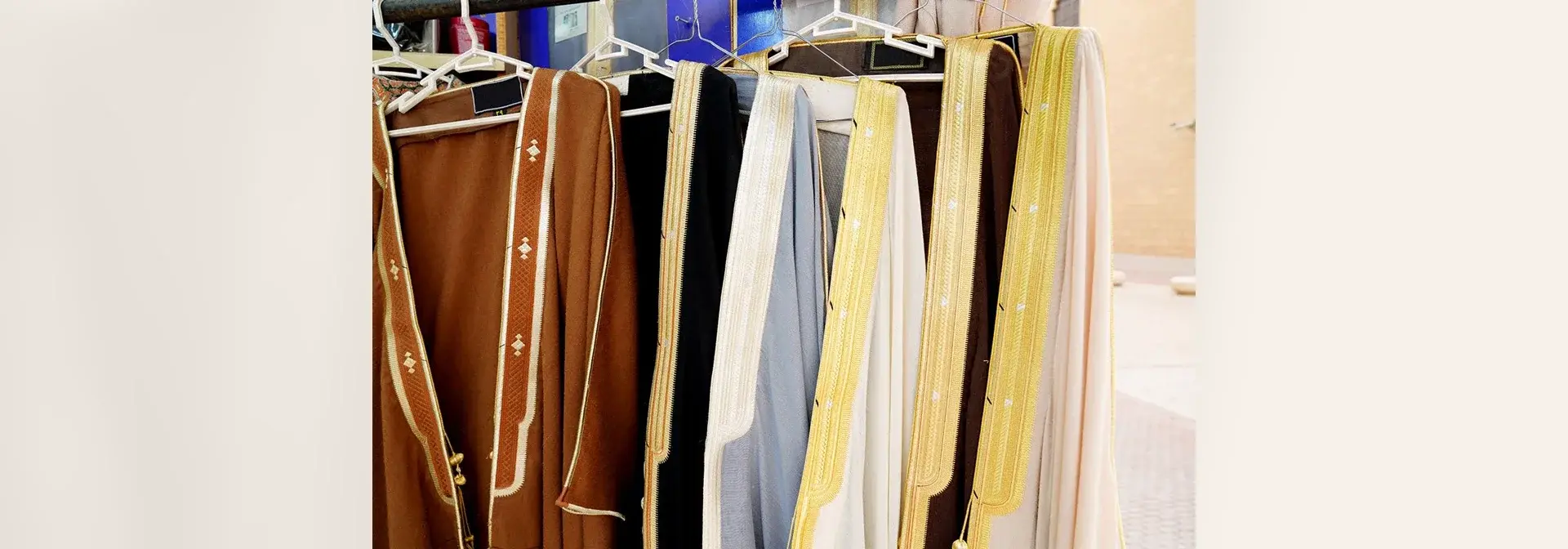
Bishts range from the light summer type, made from soft fabrics suited to hot weather, to the heavy winter type, and their edges are adorned with gold or silver zari threads.[1]
Among the bishts, the Al-Ahsa bisht is renowned in Al-Ahsa Governorate; its weaving is a craft passed down through generations, and it forms part of Saudi traditional dress.[2]
Materials and Colors
Bishts differ in their materials: some are light summer pieces usually made from soft fabrics suited to hot weather, while others are heavy winter pieces that give warmth and elegance at once. Dark colors such as black and brown top the most sought-after choices, alongside beige and cream.[1]
Wearing the bisht in the Kingdom follows customs linked to colors and days: the white bisht is worn on Friday, the tan or brown on Saturday, the cream or yellow on Sunday, the awdi on Monday, the black on Tuesday, the light brown on Wednesday, and the beige on Thursday.[3]
Bisht Weaving and Its Stages
The stages of weaving a bisht begin with selecting suitable fabrics, pass through cutting and sewing, and end with precise hand embroidery. It is a craft that artisans acquire through long practice and accumulated experience, and certain Al-Ahsa families became renowned for their hand-crafted work.[2]
Crafting a bisht by hand takes up to two weeks of manual work, and among the rare pieces are Al-Ahsa bishts made by local hands, some of them more than 100 years old.[4]
The Al-Ahsa Bisht Festival
The festival is held at historic Ibrahim Palace in Hofuf City in Al-Ahsa Governorate, and it is organized by the Heritage Commission of the Ministry of Culture in cooperation with the Al-Ahsa Governorate and the Al-Ahsa Development Authority.[2]
The first edition of the Al-Ahsa Bisht Festival launched on 15 June 2022 in the middle of the Wednesday Market in Al-Ahsa Governorate, organized by the Ministry of Culture as part of the official opening program of the popular Wednesday Market, and it received visitors daily for seven days until 21 June 2022.[5]
The second edition was inaugurated on 14 December 2023 and ran until 22 December. It was inaugurated by the Governor of the Eastern Province, Prince Saud bin Nayef bin Abdulaziz, who met bisht traders from Saudi Arabia, Bahrain, the UAE, Qatar and Iraq, and launched the drone displays announcing the opening of the festival.[6]
More than 70,000 visitors from across the regions of the Kingdom and the Gulf states attended the festival's activities. It included an exhibition introducing the customs of wearing the bisht by color and day, and the "Leaders and Bisht" corner, which displays personal photographs in the bisht of the Founder King Abdulaziz bin Abdulrahman Al Saud, his sons the Kings Saud, Faisal, Khalid, Fahd and Abdullah, the Custodian of the Two Holy Mosques King Salman bin Abdulaziz, and His Royal Highness Prince Mohammed bin Salman bin Abdulaziz, Crown Prince and Prime Minister.[3]
Among the rare exhibits was the "Al-Mu'allama" bisht, similar to the one made in Al-Ahsa and worn by King Faisal bin Abdulaziz during his journey to Britain in 1919.[3]
The second edition's activities concluded at the historic Ibrahim Palace in Al-Kut district in the center of Hofuf city after lasting 10 days, with international participation from factories and workshops for crafting bishts from 4 countries: Bahrain, Qatar, the UAE and Iraq, alongside a display of hand-made and machine-made bishts and products inspired by zari.[4]
The Third Edition and International Recognition
The Deputy Governor of the Eastern Province, Prince Saud bin Bandar bin Abdulaziz, inaugurated the third edition of the Al-Ahsa Bisht Festival, organized by the Heritage Commission with international participation for 11 days at Ibrahim Palace in Al-Ahsa Governorate.[7]
He met bisht traders from the Kingdom, Syria, Iraq, Jordan, Bahrain, Qatar and Kuwait, and viewed the pavilions of the training workshops presented by the Royal Institute of Traditional Arts (Wrth), the Bait Al-Diffa pavilion displaying the traditional women's abaya, and the Little Ma'zab dedicated to introducing children to the bisht industry and how to wear it.[7]
During the third edition, King Abdulaziz Foundation was honored in recognition of its scholarly and knowledge role in documenting national heritage and highlighting traditional dress.[8]
The Heritage Commission concluded the third edition's activities at the historic Ibrahim Palace in the center of Hofuf city, and the edition coincided with the official inscription of the bisht on the Representative List of the Intangible Cultural Heritage of UNESCO.[9]
The activities gained an international dimension with the participation of UNESCO and six sisterly and friendly countries.[9]
Preserving the Craft and Empowering Generations
The Royal Institute of Traditional Arts (Wrth) launched the Founding Day 2025 campaign to introduce the importance and symbolism of the Saudi bisht in the Kingdom's history, under the slogan "It is our heritage".[10]
The "Al-Ahsa Bisht Apprenticeship" program held in Al-Ahsa teaches national generations the skills needed to make the bisht and revives the traditional craft.[10]
The Al-Mahoud Al-Ahsa Bisht factory was inaugurated, implemented by the Al-Ahsa Girls Development Charitable Association in partnership with Saudi Aramco, with the aim of training and empowering more than 100 young men and women in the bisht industry and enhancing the quality of national production under the slogan "Made in Saudi Arabia".[11]
Frequently Asked Questions
Q: What is the bisht? A: A long-standing traditional attire and a deeply rooted cultural heritage in the Kingdom of Saudi Arabia, one of its most prominent heritage symbols and an essential piece during official and social occasions.[2][1]
Q: What are the types of bisht in terms of material? A: A light summer type made from soft fabrics suited to hot weather, and a heavy winter type, with its edges adorned with gold or silver zari threads.[1]
Q: How long does it take to craft a bisht by hand? A: The crafting process takes up to two weeks of manual work.[4]
Q: Where is the Al-Ahsa Bisht Festival held? A: At the historic Ibrahim Palace in Al-Ahsa Governorate, organized by the Heritage Commission in cooperation with the Al-Ahsa Governorate and the Al-Ahsa Development Authority.[2]
Q: What is the significance of the bisht's inscription with UNESCO? A: It was officially inscribed on the Representative List of the Intangible Cultural Heritage, a national achievement that strengthens the international presence of Saudi heritage.[9]
Related topics
- RegionAl-Ahsa GovernorateAl-Ahsa Governorate is a governorate in the Kingdom of Saudi Arabia. Within it lies the Al-Ahsa Oasis, the largest self-contained palm oasis in the world, with more than 2.5 million palm trees; it was inscribed on the World Heritage List in 2018 CE.
- HistoricIbrahim PalaceIbrahim Palace is a historic palace in Hofuf in Al-Ahsa Governorate, eastern Saudi Arabia. It is one of the largest palaces of the Al-Ahsa Oasis and among the most famous historic palaces in the Kingdom. Its construction dates to the Jabrid era, its architecture was renewed in 1216 AH, corresponding to 1801 CE, and it is registered with the Heritage Commission and is one of the elements of the Al-Ahsa Oasis inscribed on the World Heritage List.
- RegionHofuf CityHofuf City is a city in Al-Ahsa Governorate in the Eastern Province of Saudi Arabia. It holds Ibrahim Palace, the Bay'ah House, the Amiriya School and Al-Qaisariya Market, and together with the Al-Ahsa Oasis it forms one of the most prominent examples of architectural heritage in the country.
- HistoricSaudi Traditional DressSaudi traditional dress is a clothing heritage that expresses the identity of the Kingdom of Saudi Arabia and the diversity of its regions. Men's dress rests on the thobe, the agal, and the ghutra, women's dress ranges from the munaykhal and mushallal thobes to the darra'a and the kartah, and the King Abdulaziz Foundation for Research and Archives documents the dress of the Kingdom's regions in a specialised series of publications.
- HistoricSaudi Traditional HandicraftsSaudi traditional handicrafts are a productive activity based primarily on manual work that draws its designs and artistic elements from the cultural heritage inherited across the regions of the Kingdom. The Law of Crafts and Handicrafts was issued by Royal Decree No. (M/49) dated 1447/03/02 AH to regulate the activity, develop it and protect it from extinction. [1][3]
- EventSaudi Founding DaySaudi Founding Day is a national annual occasion on 22 February that commemorates the founding of the First Saudi State by Imam Muhammad bin Saud in 1139 AH (1727 CE), with Diriyah as its capital. The date was set by Royal Decree No. (A/371) dated 24/6/1443 AH.
- HistoricKing Abdulaziz Foundation (Darah)The King Abdulaziz Foundation (Darah) is an official national institution in the city of Riyadh concerned with preserving the sources of national and Arab history, disseminating and refining them, and supporting national identity. It encompasses the historic Murabba Palace, the King Abdulaziz Memorial Hall and an archive of more than one million photographs, and it publishes Al-Darah magazine and runs scholarly programmes and specialised centres.
- TopicSaudi AramcoSaudi Aramco is the Saudi Arabian Oil Company, a national oil and gas company whose roots go back to a concession agreement concluded in 1933 CE, and which achieved its first commercial oil production in 1938 CE. The Kingdom completed its ownership of the company in 1980 CE, and it was formally established under its current name in 1988 CE; its net income for the 2025 fiscal year reached about SAR 392.5 billion.
- HistoricAl-Sadu WeavingAl-Sadu is a handweaving craft based on weaving threads of camel hair, goat hair and sheep wool. It is known among the people of the Kingdom of Saudi Arabia, who used it to make hair houses, carpets, daily necessities and tribal clothing, and its weaving was registered on the Representative List of the Intangible Cultural Heritage at UNESCO.
Sources & references
- Saudi Press Agency (SPA) — The bisht as a heritage symbol: materials, colors and attire
- Saudi Press Agency (SPA) — Bisht weaving in Al-Ahsa and the organization of the festival
- Saudi Press Agency (SPA) — The Al-Ahsa Bisht Festival, its corners and its rare pieces
- Saudi Press Agency (SPA) — Conclusion of the Al-Ahsa Bisht Festival and its rare pieces
- Saudi Press Agency (SPA) — Launch of the first edition of the Al-Ahsa Bisht Festival
- Saudi Press Agency (SPA) — Inauguration of the second edition of the Al-Ahsa Bisht Festival
- Saudi Press Agency (SPA) — Inauguration of the third edition of the Al-Ahsa Bisht Festival
- Saudi Press Agency (SPA) — Honoring of King Abdulaziz Foundation at the festival
- Saudi Press Agency (SPA) — Conclusion of the third edition and the inscription of the bisht with UNESCO
- Saudi Press Agency (SPA) — The Founding Day 2025 campaign and the bisht apprenticeship program
- Saudi Press Agency (SPA) — Inauguration of the Al-Mahoud Al-Ahsa Bisht factory