
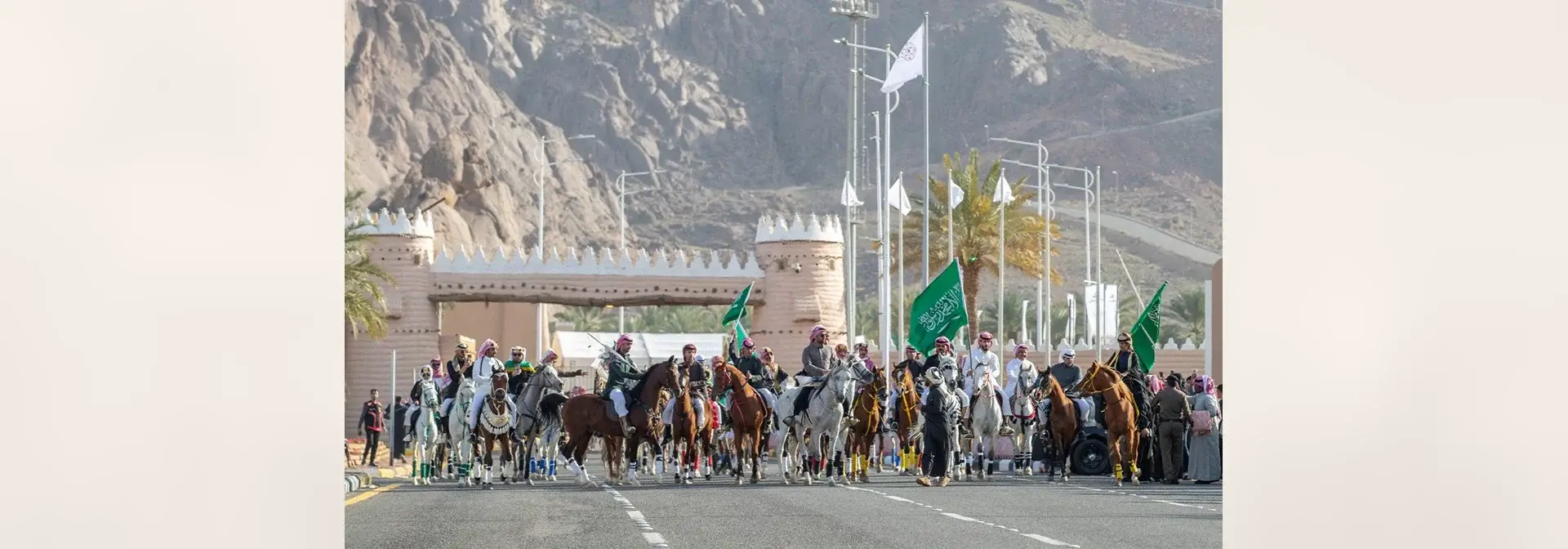
Overview
Saudi Founding Day is a national annual occasion that commemorates the founding of the First Saudi State, which arose in the middle of 1139 AH, corresponding to 22 February 1727, by Imam Muhammad bin Saud, with Diriyah as its capital [1][2].
The occasion is celebrated on 22 February each year, the day set by Royal Decree No. (A/371) dated 24/6/1443 AH to be a day commemorating the founding of the Saudi State under the name "Founding Day" [1]. The occasion represents a recalling of the historical depth of the State and of the bond of its citizens with its leaders since the founding of the First Saudi State three centuries ago [2].
The Saudi State is fully sovereign, its religion is Islam, and its constitution is the Book of God and the Sunnah of His Prophet, from its founding to the present day [2].
Diriyah, the Cradle of the Founding
Prince Mani' al-Muraydi, the ancestor of the Al Saud family, founded Diriyah in 850 AH, corresponding to 1446 CE; it later became the seat of the First Saudi State and its capital [1][2].
In 1139 AH, corresponding to 1727 CE, Imam Muhammad bin Saud assumed the rule of Diriyah, and there the First Saudi State arose [1][2].
The Extension of the Saudi State
The rule of Imam Muhammad bin Saud extended forty years, between 1139 and 1179 AH, corresponding to 1727 and 1765, and the First Saudi State continued until 1233 AH, corresponding to 1818 [1].
The Second Saudi State then arose at the hands of its founder Imam Turki bin Abdullah bin Muhammad bin Saud, and the Kingdom of Saudi Arabia followed it [2].
Setting the Date by Royal Decree
Royal Decree No. (A/371), dated 24/6/1443 AH, was issued designating 22 February each year as a day commemorating the founding of the Saudi State, under the name "Founding Day" [1].
22 February corresponds to the Gregorian date of the establishment of the First Saudi State in the middle of 1139 AH [1][2].
On 17 February 2026, the Council of Ministers considered the Kingdom's celebration of this occasion, which falls on Sunday 22 February 2026, an expression of pride in the historical depth of the Saudi State and its firmly established path for some three centuries [7].
The Visual Identity and the "Yawm Badina" Slogan
The visual identity of the occasion was announced on 3 Rajab 1443 AH, corresponding to 4 February 2022, under the slogan "Yawm Badina" [3].
At the centre of the slogan appears the icon of a man carrying a banner, surrounded by four symbols: dates, the majlis, the Arabian horse and the market [3].
In the slogan, the dates evoke growth, life and generosity; the majlis expresses unity and cultural and social harmony; and the Arabian horse displays the horsemanship and valour of the State's princes and its brave men [3].
The phrase "Founding Day - 1727" was written in a script inspired by manuscripts that documented the history of the First Saudi State [3].
Celebrations Marking the Occasion
The Kingdom of Saudi Arabia marked this occasion on Saturday 23 Sha'ban 1446 AH, corresponding to 22 February 2025 [2].
The Emirate of Riyadh Region, in cooperation with the King Abdulaziz Foundation, held the Founding Exhibition "Min Yawm Badina.. wa Abwabuna Mushra'ah" at Qasr al-Hukm, comprising seven sections on the history of the Saudi State [6].
In the 2026 celebration, a record was registered in the Guinness World Records for the largest group performance of the Saudi Ardah, with the participation of 925 performers [4].
The Saudi Cultural Attaché in London marked, in February 2026, the 299th anniversary of the founding of the Saudi State [5].
Frequently Asked Questions
Q: When is Saudi Founding Day? A: It falls on 22 February each year, the Gregorian date of the founding of the First Saudi State in the middle of 1139 AH [1][2].
Q: Who founded the First Saudi State? A: Imam Muhammad bin Saud, who assumed rule in Diriyah in 1139 AH, corresponding to 1727 [1].
Q: What was the capital of the First Saudi State? A: Diriyah, where the State arose [2].
Q: What is the slogan of Founding Day? A: "Yawm Badina", and the visual identity was announced under this slogan on 4 February 2022 [3].
Q: How long has passed since the founding of the Saudi State? A: 299 years, and this anniversary was celebrated in February 2026 [5].
Related people
- PersonImam Muhammad bin SaudFounder and first imam of the First Saudi State in 1139 AH/1727 CE, who made Diriyah its capital and ruled for forty years, uniting most of Najd.
- PersonImam Turki bin AbdullahFounder of the Second Saudi State in 1240 AH/1824 CE, grandson of Imam Muhammad bin Saud and the first to make Riyadh the seat of Saudi rule.
Related topics
- Saudi statesThe First Saudi StateA state centred on Diriyah under Imam Muhammad bin Saud, officially dated in Saudi chronology to 1727. It expanded across Najd and other regions before its capital fell in 1818.
- Saudi statesThe Second Saudi StateImam Turki bin Abdullah restored Saudi rule in 1824 with Riyadh as capital. The state extended across Najd and eastern Arabia before ending in 1891 with Al Rashid's ascendancy.
- GovernorateDiriyah GovernorateA governorate north-west of Riyadh on Wadi Hanifah, founded in 850 AH/1446 CE, capital of the First Saudi State and home to the World Heritage site of At-Turaif.
- Performing arts and intangible heritageSaudi ArdahA collective performing tradition, also known as Najdi ardah, combining chanted poetry, drumming and movement at social and national occasions.
- HistoricMajlisThe Majlis is a social space in Saudi society for receiving guests and exchanging conversation, where members of the community gather to settle disputes, offer condolences and hold wedding celebrations, and where Saudi coffee is served in line with long-inherited customs. The Majlis and Arabic coffee were inscribed on UNESCO's lists of intangible cultural heritage.
- HistoricBishtThe bisht is a long-standing traditional attire and a deeply rooted cultural heritage in the Kingdom of Saudi Arabia, one of the most prominent heritage symbols there and an essential piece in men's attire during the Eid holidays and official and social occasions. Its Al-Ahsa variety is celebrated by the Ministry of Culture and the Heritage Commission through the Al-Ahsa Bisht Festival and programs to preserve the craft.