
Overview
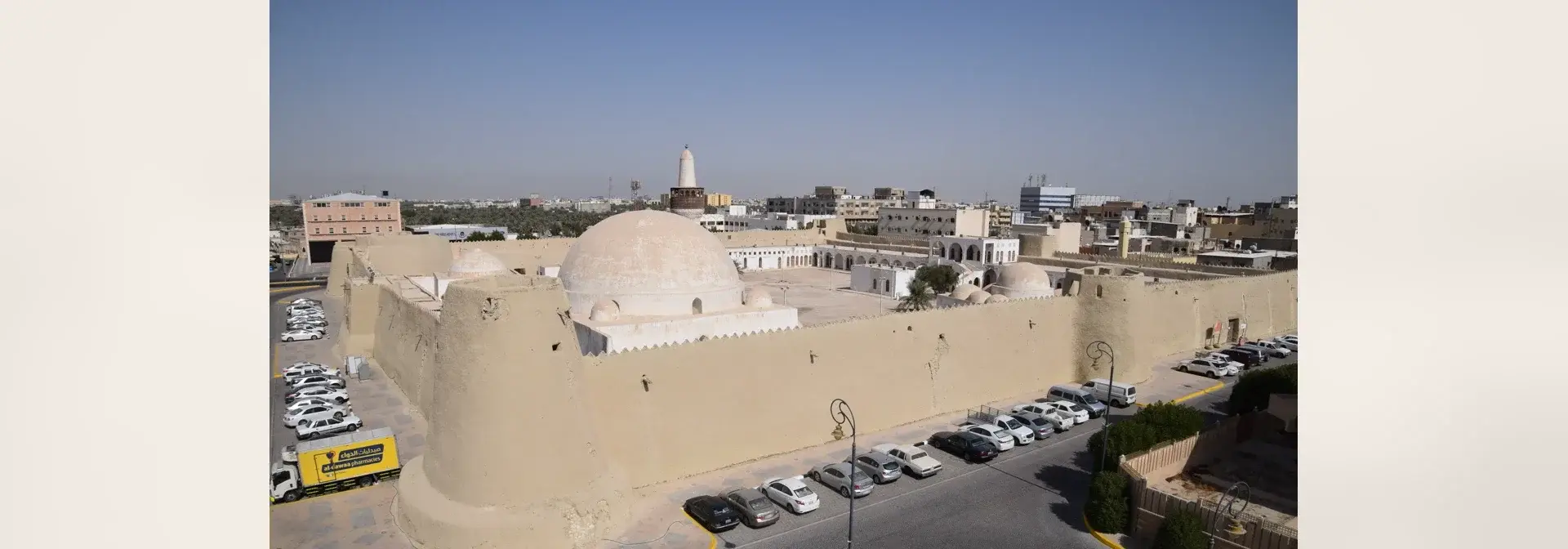
Ibrahim Palace, also known as Ibrahim Fort, is a historic palace in the city of Hofuf in Al-Ahsa Governorate, eastern Saudi Arabia, and is among the historic landmarks of Al-Ahsa. [1]
The palace combines the Islamic and modern architectural styles in its design, is distinguished by special architectural designs, ranks among the largest palaces of the Al-Ahsa Oasis, and its construction dates to the era of the Jabrids, who ruled Al-Ahsa before the arrival of the Ottomans; its architecture was then renewed in 1216 AH, corresponding to 1801 CE, by Ibrahim bin Ufaisan, to whom its name is attributed. [1][2][3]
Location and Status
The palace is located in the Al-Kut neighborhood in the center of the city of Hofuf in Al-Ahsa Governorate, eastern Saudi Arabia, and is among the most famous historic palaces in the Kingdom. [3][4]
The palace lies in the center of Al-Ahsa Governorate in the Eastern Province, eastern Saudi Arabia, and has a high wall surrounded by eight towers on all sides, and it contains a group of buildings within. [2][3]
Architecture and Design
The architecture of the palace is distinguished by combining the Islamic and modern architectural styles, and it includes many military facilities; its walls were built of mud mixed with straw and its roofs were made of palm trunks, shandal and stone, which are local building materials drawn from the oasis environment. [1]
After Al-Ahsa came under the rule of King Abdulaziz in 1331 AH, another architectural style was added to the palace, the religious style, which appears in the semi-circular arches and Islamic domes, alongside the military style represented by the massive towers surrounding the palace and the soldiers' barracks to its east. [1][2]
History
The construction of the palace dates to the era of the Jabrids, who ruled Al-Ahsa before the arrival of the Ottomans, and its architecture is among the special architectural designs of the Al-Ahsa Oasis; after the arrival of the Ottomans in their first campaign, the palace came within their sphere of control. [1][2][3]
Its architecture was then renewed in 1216 AH, corresponding to 1801 CE, and after Al-Ahsa came under the rule of King Abdulaziz in 1331 AH, he was able to take control of the palace and its soldiers and equipment on the day of the conquest of Al-Ahsa on the fifth of Jumada al-Awwal 1331 AH, corresponding to 1913 CE. [1][2]
Related people
- Kings of Saudi ArabiaKing Abdulaziz bin Abdulrahman Al SaudFounder and first king of Saudi Arabia, Abdulaziz recovered Riyadh in 1902 and led the unification proclaimed in 1932. His reign saw the development of state institutions and the beginnings of the oil industry.
- PersonPrince Abdullah bin Jiluwi Al SaudPrince Abdullah bin Jiluwi Al Saud belongs to the Al Saud family, and among his relatives are those who carry his name in historical research in the Kingdom of Saudi Arabia. The Roll of the Immortals preserves the names of the men of the capture of Riyadh, and national projects continue to document the roles of the men of King Abdulaziz in building the Saudi state.
World Heritage Listing
The palace is registered with the Heritage Commission within the urban heritage of Al-Ahsa, and it is one of the elements of the Al-Ahsa Oasis inscribed on the World Heritage List of UNESCO. [2]
The palace is thus part of the world heritage elements in Saudi Arabia. [2]
Restoration and Rehabilitation
In February 2017, a directive was issued to promptly treat and maintain the palace following the damage that had befallen the historic site due to heavy rains, and the palace, which is more than 500 years old, was closed. [5]
In February 2019, the first phase of the palace's restoration works began, as it is among the most famous historic palaces in the Kingdom, and in March 2019 the restoration and rehabilitation works were completed, and the palace is scheduled to host a number of events. [3][4]
Frequently Asked Questions
Q: Where is Ibrahim Palace located? A: It is located in the Al-Kut neighborhood in the center of the city of Hofuf in Al-Ahsa Governorate, eastern Saudi Arabia. [3]
Q: What is the origin of the name Ibrahim Palace? A: Its name is attributed to Ibrahim bin Ufaisan, who renewed its architecture in 1216 AH, corresponding to 1801 CE. [1]
Q: When was Ibrahim Palace built? A: Its construction dates to the era of the Jabrids, who ruled Al-Ahsa before the arrival of the Ottomans. [3]
Q: How many towers does the palace have? A: The palace is surrounded by a high wall with eight towers on all sides, and it contains a group of buildings within. [2]
Q: Is the palace registered as world heritage? A: Yes, it is one of the elements of the Al-Ahsa Oasis inscribed on the World Heritage List of UNESCO, and it is registered with the Heritage Commission within the urban heritage of Al-Ahsa. [2]
Related topics
- RegionAl-Ahsa GovernorateAl-Ahsa Governorate is a governorate in the Kingdom of Saudi Arabia. Within it lies the Al-Ahsa Oasis, the largest self-contained palm oasis in the world, with more than 2.5 million palm trees; it was inscribed on the World Heritage List in 2018 CE.
- RegionHofuf CityHofuf City is a city in Al-Ahsa Governorate in the Eastern Province of Saudi Arabia. It holds Ibrahim Palace, the Bay'ah House, the Amiriya School and Al-Qaisariya Market, and together with the Al-Ahsa Oasis it forms one of the most prominent examples of architectural heritage in the country.
- HistoricAl-Ahsa OasisThe world's largest self-contained oasis according to Guinness World Records, inscribed on the UNESCO World Heritage List in 2018 as a cultural landscape of human interaction with the environment.
- EventConquest of Al-AhsaThe Conquest of Al-Ahsa was a campaign led by the founding King Abdulaziz bin Abdulrahman Al Saud in 1331 AH/1913 CE, through which he entered Al-Ahsa and received the pledge of allegiance of its people at the Bay'ah House, after which the event rested on Ibrahim Palace and Al-Uqair Port.
- RegionEastern ProvinceA large eastern Saudi region administered from Dammam, combining Gulf cities, the oases of Al Ahsa and Qatif, desert areas, energy industries and maritime commerce.
- HistoricBishtThe bisht is a long-standing traditional attire and a deeply rooted cultural heritage in the Kingdom of Saudi Arabia, one of the most prominent heritage symbols there and an essential piece in men's attire during the Eid holidays and official and social occasions. Its Al-Ahsa variety is celebrated by the Ministry of Culture and the Heritage Commission through the Al-Ahsa Bisht Festival and programs to preserve the craft.
- EventHistory of Al-AhsaThe history of Al-Ahsa extends from ancient human settlement at the site of Jawatha, through its presence in the early Islamic era, to its annexation to the Saudi state in 1913 and the inscription of its oasis on the World Heritage List. Al-Ahsa Governorate in the Eastern Province of the Kingdom of Saudi Arabia contains a palm oasis among the largest in the world, the archaeological site of Jawatha, and the historic Al-Uqair Port.
Sources & references
- Saudi Press Agency (SPA): "Ibrahim Palace: A Historic Landmark in Al-Ahsa"
- Saudi Press Agency (SPA): "Ibrahim Palace in Al-Ahsa"
- Saudi Press Agency (SPA): "Completion of the Restoration of Ibrahim Palace in Al-Ahsa"
- Saudi Press Agency (SPA): "Start of the First Phase of the Restoration of Ibrahim Palace"
- Saudi Press Agency (SPA): "Directive to Treat and Maintain Ibrahim Palace in Hofuf"