
Overview
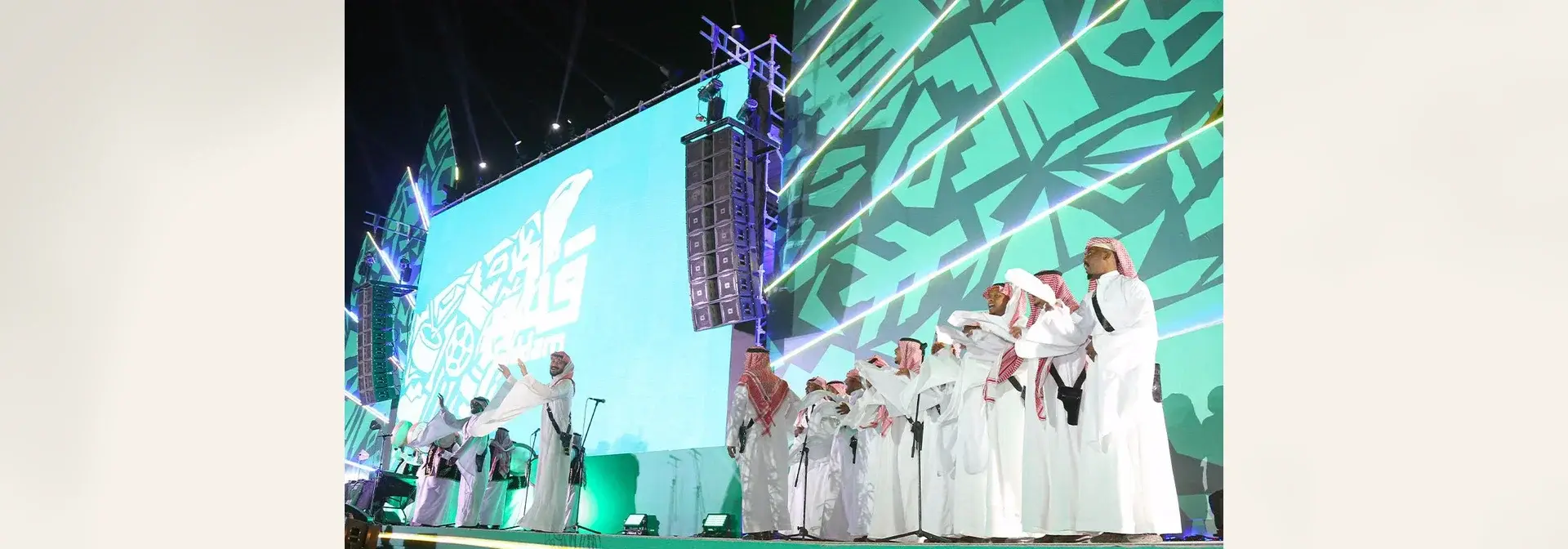
Samri is one of the folk arts of the Kingdom of Saudi Arabia, performed to the beating of drums with distinctive dances, and folk and popular dances are a deep heritage that differs from one region of the Kingdom to another.[1]
It is among the most prominent traditional performing arts in the Najd region and its north, and it rests on harmonious rhythms and a collective performance that reflects the spirit of joy and solidarity in Saudi society.[5] Its name goes back to 'Samar', meaning spending the night with delight and an art that pleases the listener while the performers dance to the beating of drums.[1]
Performance Features and Styles
Unaizah Samri is performed in two facing rows of several people. The poet opens the poem, the row beside him repeats what he has said, and then the second row responds to him.[2] Unaizah Samri differs from the Samri of other regions in that it is not melodic; it consists of two rows with swaying, standing and sitting, with the 'drum' present with every member of the troupe, and it has particular chants and melodies fundamentally different from the familiar Samri.[3]
The tambourine forms an essential element and a living pulse in the performance of Samri, as it sets the rhythm of the evening; the sounds of palms striking the stretched hides give the performance prestige and dignity.[4]
Samri Across the Regions of the Kingdom
The Samri art is concentrated in the Najd region and its north through its collective performance and harmonious rhythms.[5] In the Al-Jawf region, Al-Jawfi Samri is the most widespread folk heritage among members of the community and an authentic element of its various social occasions and gatherings.[6]
In the Hail region, Hail Samri represents an authentic heritage and a destination for residents and visitors of all ages to enjoy its art and the sung poems in its performances.[7]
Samri in Festivals and Events
The Riyadh Municipality and the Emirate of Riyadh organise the 'Evenings of Muhawara and Samri' event at Al-Adl Square in the Qasr Al-Hukm area from 6 November until 23 January, with two evenings weekly, Muhawara on Thursday evenings and Samri on Friday evenings.[5] The 'Samri Night' event was held on the Mohammed Abdo Arena stage as part of Riyadh Season, reviving a long-standing art linked to the cultural identity of the Kingdom.[8]
The Al-Jawf International Olive Festival, in its 17th edition, allocated the 'Al-Jawf Samri' pavilion to present the art through a group of performers with three daily shows, and the audience interacts with the troupe by requesting popular poems from the Samri heritage,[9] and in its 18th edition the festival included a pavilion dedicated to the Samri art that blends poems with performance and melodies, as folk arts are a heritage passed down by Saudis from generation to generation.[10]
As for the National Festival for Heritage and Culture, 'Janadriyah 26', thousands of visitors flocked to the Al-Jawfi hair house to watch the Samri art presented by a number of young men from Al-Jawf.[11] The Al-Jawf Dates Festival, in its 12th edition, hosted a special pavilion for the Samri art presented by the Mared troupe.[4] In Riyadh, the activities of the Saudi Village Festival 'Samriyat' were launched with the participation of the Society of Culture and Arts, a number of charitable societies, volunteer teams and more than 40 productive families, and it included popular and heritage tents displaying the arts of Samri, Rababa, Khubaiti and other folk arts.[13]
Folk Troupes and Documentation of Samri
The 'Dar Unaizah for Folk Arts' troupe is among the most famous folk troupes in the Kingdom in the arts of Samri, Khubaiti, Hawti, Najdi art, Saudi Ardah and others; it began more than 50 years ago by 6 men, and it was officially registered under the name Dar Unaizah Society for Popular Heritage in 1410 AH.[2]
The house launched the 'Samri Store' so that folk art is within everyone's reach at any time through social media channels.[12]
Frequently Asked Questions
Q: What is the Samri art? A: It is one of the folk arts of the Kingdom of Saudi Arabia, performed to the beating of drums with distinctive dances, and it is among the most prominent traditional performing arts in the Najd region and its north.[1][5]
Q: Where does the name 'Samri' come from? A: From 'Samar', meaning spending the night with delight and an art that pleases the listener while the performers dance to the beating of drums.[1]
Q: How is Unaizah Samri performed? A: In two facing rows of several people; the poet begins the poem, the row beside him repeats what he has said, and the second row responds to him, and it is distinguished by being non-melodic with the 'drum' present with every member of the troupe.[2][3]
Q: Where is the Samri art spread? A: In the Najd region and its north, and it has a prominent presence in the Al-Jawf region as the most widespread folk heritage there, and in the Hail region as an authentic heritage.[5][6][7]
Q: How is the Samri art celebrated at festivals? A: Through dedicated pavilions at the Al-Jawf Olive and Dates festivals, and events such as the 'Evenings of Muhawara and Samri' in Riyadh, the 'Samri Night' at Riyadh Season, and the Saudi Village Festival 'Samriyat'.[4][5][8][9][13]
Conclusion
The Samri art is present in national festivals and social occasions in the Kingdom as a heritage passed down by Saudis from generation to generation.[10] Related topics on the platform include Al-Dahha, Saudi Ardah and Janadriyah Festival, and its arts are linked to regions such as Qassim, Al-Jawf and Hail.
Related topics
- HistoricAl-DahhaAl-Dahha is a performing art and folk heritage particular to the northern regions of Saudi Arabia, performed collectively in one or two facing rows in which the poet Al-Badda' sings, and closed with the dance of Al-Hashi. Al-Dahha features prominently in national festivals, social occasions and weddings.
- Performing arts and intangible heritageSaudi ArdahA collective performing tradition, also known as Najdi ardah, combining chanted poetry, drumming and movement at social and national occasions.
- HistoricAl-Janadriyah FestivalAl-Janadriyah Festival is the National Festival for Heritage and Culture in the Kingdom of Saudi Arabia. Its beginnings go back to 1405 AH, corresponding to 1985, and it is held at the Heritage Village in Al-Janadriyah to showcase heritage, culture and the arts with international participation. The Ministry of the National Guard organised it over the past decades, and the task of holding and organising it later passed to the Ministry of Culture.
- RegionQassim RegionAn inland Najdi region administered from Buraydah, associated with trading towns, date cultivation and markets, and the geographical corridor of Wadi Al Rummah.
- RegionJawf RegionA northern Saudi region administered from Sakaka, encompassing Dumat Al Jandal, Al Qurayyat and Tabarjal, with farming, historical landmarks and solar and wind energy projects.
- RegionHail RegionA north-central Saudi region administered from Hail, associated with the Aja and Salma mountains, the Nafud desert, historical caravan routes and varied regional activities.
- HistoricRiyadh SeasonRiyadh Season is an annual entertainment season held in the city of Riyadh and supervised by the General Entertainment Authority, whose first edition launched on 11 October 2019. It is spread across multiple entertainment zones and attracts millions of visitors from within the Kingdom and abroad; the 2023 edition reached 20 million visitors at its close.
Sources & references
- Saudi Press Agency (SPA) — Samri and Its Derivation from 'Samar'
- Saudi Press Agency (SPA) — Unaizah Samri and Dar Unaizah for Folk Arts
- Saudi Press Agency (SPA) — Features of Unaizah Samri
- Saudi Press Agency (SPA) — The Tambourine and the Samri Pavilion at the Al-Jawf Dates Festival
- Saudi Press Agency (SPA) — The Samri Art and the 'Evenings of Muhawara and Samri' Event
- Saudi Press Agency (SPA) — Al-Jawfi Samri at the 19th Al-Jawf Olive Festival
- Saudi Press Agency (SPA) — Hail Samri
- Saudi Press Agency (SPA) — The 'Samri Night' Event at Riyadh Season
- Saudi Press Agency (SPA) — The Al-Jawf Samri Pavilion at the 17th Al-Jawf Olive Festival
- Saudi Press Agency (SPA) — The Samri Pavilion at the 18th Al-Jawf Olive Festival
- Saudi Press Agency (SPA) — Al-Jawfi Samri at Janadriyah 26
- Saudi Press Agency (SPA) — Launching the 'Samri Store'
- Saudi Press Agency (SPA) — The Saudi Village Festival 'Samriyat'