
Overview
The Battle of Al-Rass is a military event associated with the name of the Ar Rass governorate in the western part of the Qassim region, and the governorate's architectural heritage preserves evidence of the battles fought in its surroundings across the stages of the Saudi state.[2]
The historical and cultural heritage of Ar Rass reflects a continuity that begins with early settlement sites and the landmarks of the First Saudi State, passes through traditional markets and natural destinations, and reaches modern projects.[1]
Location of Ar Rass in Qassim
The Ar Rass governorate lies in the western part of the Qassim region, about 90 kilometres from the city of Buraydah, and its history has been tied to agricultural and commercial activity.[1]
The Kingdom of Kinda and Early Settlement
The Ar Rass governorate also contains sites of earlier historical depth, among them the site of the Kingdom of Kinda in Batn Aqil, which is linked to the early settlement history of the area; its presence in Arab history before Islam gives the site a historical and archaeological importance that merits care and study.[1]
Historical Context in the Era of the First Saudi State
After the fall of the First Saudi State to the forces of Muhammad Ali Pasha in 1233 AH/1818 CE, new conditions arose in the Najd region whose effects continued until the end of the Banu Khalid emirate in Al-Ahsa in 1245 AH/1830 CE at the hands of Imam Turki bin Abdullah bin Saud.[5]
At that stage Britain decided to send one of its officers serving in India to Ibrahim Pasha after the fall of Diriyah, carrying a letter that proposed cooperation between his army and the British navy in the Gulf against the Qawasim; on his journey from Qatif to Yanbu in 1234 AH/1819 CE, Captain George Forster Sadleir learned while in Al-Ahsa that Ibrahim Pasha was in Sudair, so he reached Ar Rass in August, then continued to Bir Ali after learning that the Pasha had left for Madinah.[4]
Shinanah Watchtower and the Memory of the Battles of Ar Rass
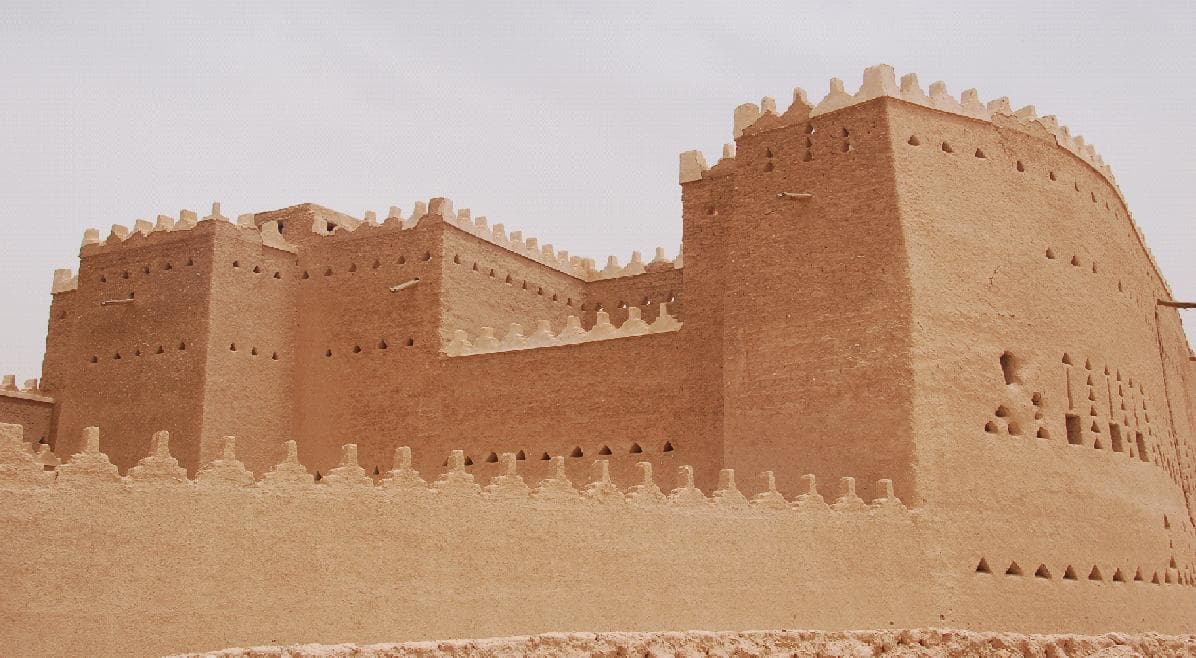
Shinanah Tower, or the Shinanah watchtower, is a historical heritage landmark in Shinanah, in the south-western part of the Ar Rass governorate in the Qassim region. It is an archaeological edifice that recounts the courage of the people of Ar Rass and their strength in repelling aggression, and it stands as a witness to their bravery and their sacrifices in defending their town.[2]
The area around the watchtower witnessed many battles fought in all stages of the Saudi state up to the era of King Abdulaziz bin Abdulrahman, and it withstood the elements for nearly two centuries.[2]
Related people
- PersonImam Turki bin AbdullahFounder of the Second Saudi State in 1240 AH/1824 CE, grandson of Imam Muhammad bin Saud and the first to make Riyadh the seat of Saudi rule.
- Kings of Saudi ArabiaKing Abdulaziz bin Abdulrahman Al SaudFounder and first king of Saudi Arabia, Abdulaziz recovered Riyadh in 1902 and led the unification proclaimed in 1932. His reign saw the development of state institutions and the beginnings of the oil industry.
Construction of the Watchtower and Its Specifications
The watchtower is conical in shape, with an internal diameter of 7 metres at the base, narrowing as it rises to an opening about one metre across, and it stands more than 27 metres high with eight floors.[2]
The watchtower was built from mud, water and chaff alone. It has three windows for ventilation, lighting and observation, and at its top is an observation point from which all directions can be seen, reached by wooden staircases, while roofs of tamarisk trunks and palm fronds separate its levels; men known as al-raqibah, distinguished by their sharp eyesight, took turns on duty there.[2]
Restoration of the Watchtower and the Work of the Heritage Commission
In 1399 AH the Department of Antiquities at the Ministry of Education restored Shinanah Tower, and it was restored again in recent years; supervision of it passed to the Ministries of Tourism and Culture, which worked on its development.[2]
The governor of the Qassim region visited the Shinanah watchtower heritage site and the Shinanah watchtower visitor centre in the Ar Rass governorate, and reviewed the efforts of the Heritage Commission to rehabilitate and develop the site, among them the restoration of the heritage mosque, the complete fencing of the site, the renewed restoration of the watchtower, the provision of car parks, and the preparation of outer courtyards, information and guidance panels, and security guards.[3] The Spatial Documentation Project for the Sites of Arab Poets documented several sites in the Qassim region, among them Shinanah Tower in the city of Ar Rass, which is linked to the poet Zuhayr bin Abi Sulma.[6]
Urban and Modern Landmarks of Ar Rass
Among the urban landmarks of the Ar Rass governorate are the historic Ar Rass trench, Shinanah Tower in the west of the governorate, which embodies the traditional style of Najdi architecture, and Adhilah Palace in the east of the governorate as one of the examples of old local architecture.[1]
The Qassim region secretariat, represented by the Ar Rass municipality, is developing the Samn market and reviving its Najdi identity within a project whose implementation began in June 2026 over an area of 2,518 square metres, to strengthen its standing as a commercial and tourist destination.[1] The Saudi Aviation Club airport in the Ar Rass governorate opened in 2024 as the club's third airport in the Kingdom, and it includes facilities for sport aviation, gliding and parachuting.[1]
Frequently Asked Questions
Q: Where did the Battle of Al-Rass take place? A: In the area around the Ar Rass governorate, in the western part of the Qassim region, about 90 kilometres from the city of Buraydah.[1]
Q: Which landmark preserves the memory of the battles of Ar Rass? A: Shinanah Tower, or the Shinanah watchtower, in the south-western part of the governorate; it is an archaeological edifice whose surroundings witnessed many battles fought in all stages of the Saudi state up to the era of King Abdulaziz.[2]
Q: What are the specifications of the Shinanah watchtower? A: It is conical in shape, with an internal diameter of 7 metres at the base that narrows to about one metre at the opening; it stands more than 27 metres high with eight floors and was built from mud, water and chaff alone.[2]
Q: In what historical context did the Battle of Al-Rass occur? A: At the stage of the fall of the First Saudi State to the forces of Muhammad Ali Pasha in 1233 AH/1818 CE, and the journey of Captain George Forster Sadleir documented his arrival in Ar Rass in August 1234 AH/1819 CE.[5][4]
Q: How is the watchtower site cared for today? A: The watchtower was restored in 1399 AH and again in recent years, supervision of it passed to the Ministries of Tourism and Culture, and the site was rehabilitated through the restoration of the heritage mosque, complete fencing, the provision of car parks, guidance panels and security guards.[2][3]
Related topics
- Saudi statesThe First Saudi StateA state centred on Diriyah under Imam Muhammad bin Saud, officially dated in Saudi chronology to 1727. It expanded across Najd and other regions before its capital fell in 1818.
- EventKingdom of KindaThe Kingdom of Kinda was an ancient Arabian entity built on a federal organisation of Arabian desert tribes, with the archaeological city of Qaryat al-Faw in Wadi ad-Dawasir Governorate as its capital. The Cultural Landscape of the Al-Faw Archaeological Area was inscribed on the World Heritage List in 2024 CE, and it is managed by the Heritage Commission of the Ministry of Culture and the National Centre for Wildlife.
- RegionQassim RegionAn inland Najdi region administered from Buraydah, associated with trading towns, date cultivation and markets, and the geographical corridor of Wadi Al Rummah.
- RegionBuraydah CityBuraydah is a Saudi city in Qassim Province, known for a dates economy in which Qassim's production reaches more than 390,000 tons annually and its dates are exported to more than 100 countries. The city is home to the water tower registered in the National Register of Modern Urban Heritage and to the Aqilat Museum, and it has been included in the UNESCO Creative Cities Network for gastronomy.
- RegionAl-Ahsa GovernorateAl-Ahsa Governorate is a governorate in the Kingdom of Saudi Arabia. Within it lies the Al-Ahsa Oasis, the largest self-contained palm oasis in the world, with more than 2.5 million palm trees; it was inscribed on the World Heritage List in 2018 CE.
- HistoricNajdi ArchitectureNajdi Architecture is a Saudi architectural style that expresses the urban identity of the Najd region, and it draws on local construction materials in a design adapted to the desert climate. Its applications continue in modern urban projects, competitions and cultural events inside the Kingdom and abroad.
- GovernorateDiriyah GovernorateA governorate north-west of Riyadh on Wadi Hanifah, founded in 850 AH/1446 CE, capital of the First Saudi State and home to the World Heritage site of At-Turaif.
- RegionQatif CityQatif City is a Saudi city in the Eastern Province, on the shore of the Arabian Gulf, known for its palm oases, date farms, fish market, Tarout Island and the town of Darin. Its development is reinforced by the approved development direction for Darin and Tarout Island, waterfront projects and health and leisure services.
- RegionYanbu CityYanbu City is a Saudi city on the Red Sea coast west of Madinah, spread across three cities: Yanbu Al-Bahr, Yanbu Al-Nakhl and Yanbu Industrial City.[1] It is known as the "Pearl of the Red Sea" for the historic heritage, industrial and service renaissance and tourism assets it brings together.[15]
- EventBattle of ShinanahThe Battle of Shinanah was fought in the area of Shinanah, in the southwestern part of Al-Rass governorate in the Qassim region, and the surroundings of its site saw battles across every stage of the Saudi state up to the era of King Abdulaziz. At the site stands the Shinanah Tower, known as the Shinanah watchtower, which was built as a wartime bulwark and has been rehabilitated together with its visitor centre.
Sources & references
- Saudi Press Agency (SPA) — report: the historical, heritage and natural landmarks of Ar Rass reflect its cultural depth and enhance its tourist appeal
- Saudi Press Agency (SPA) — report: Shinanah Tower, the bulwark of the people of Ar Rass and an archaeological edifice recounting their glories
- Saudi Press Agency (SPA) — the governor of Qassim visits the Shinanah watchtower and the cultural heritage centre in the Ar Rass governorate
- Darah Journal — King Abdulaziz Foundation: "With Captain Sadleir on his journey from Qatif to Yanbu in 1234 AH/1819 CE" (Al-Sayyid Ahmed Abbas)
- Darah Journal — King Abdulaziz Foundation: "The position of the Banu Khalid leaders towards the political developments in Najd, 1233-1245 AH/1818-1830 CE" (Abdullah Al-Turki)
- Umm Al-Qura newspaper — the Spatial Documentation Project for the Sites of Arab Poets