

Overview
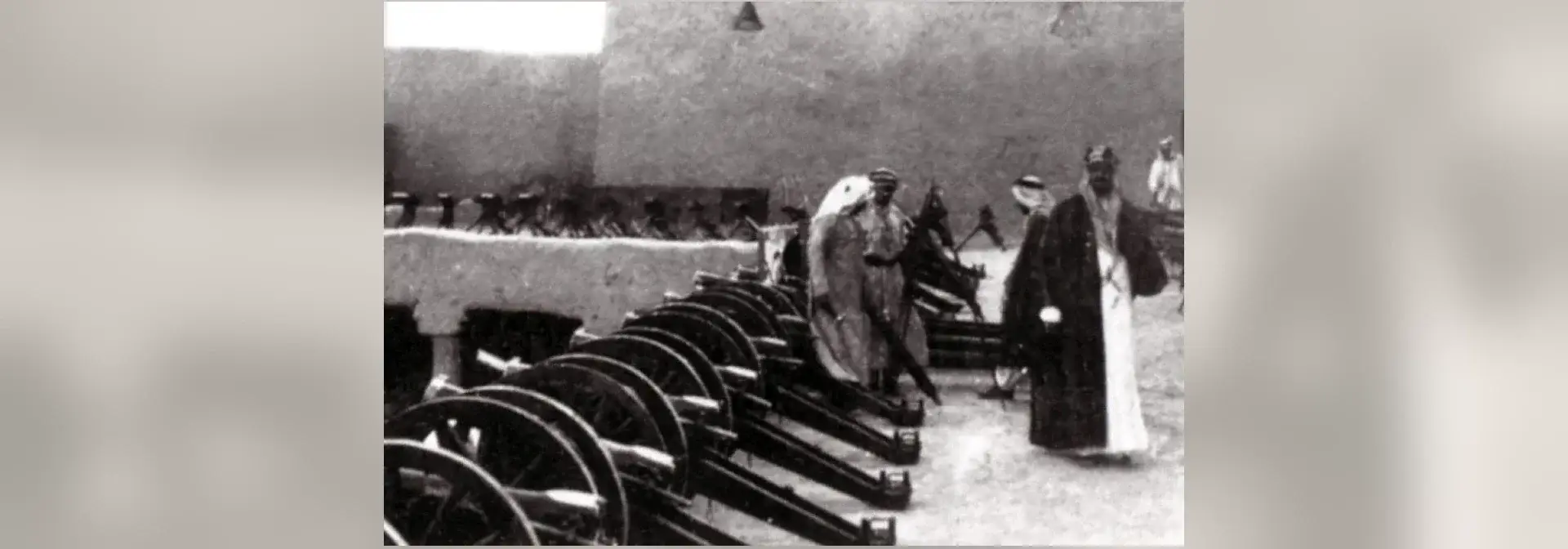
The fall of Hail was an event in the unification of the Kingdom of Saudi Arabia, in which King Abdulaziz took Hail in 1340 AH, following stages that began with his entry into Riyadh and his pledge of allegiance as Emir on the fifth of Shawwal 1319 AH, then the unification of Najd and the conquest of Al-Ahsa. [1]
The beginnings of unity were at the hand of Imam Muhammad bin Saud, and that unity later appeared as a resplendent phenomenon at the hand of King Abdulaziz. [7] The city of Hail bears witness to that stage through urban and administrative landmarks built in the Saudi era, among them Qishlah Palace, which is counted among the most prominent national landmarks of the city. [8]
Background of the Emirate of Hail
The Emirate of Al Ali arose in Hail, and its history was bound up with the city of Hail, its geography and topographical features, its origins and the reason for its naming, and with the presence of the Shammar tribe in the region, then with the emirate's relationship to the First Saudi State and the Second Saudi State. [4] These stages are covered in the topics of the First Saudi State, the Second Saudi State and the Emirate of Al Rashid.
From the Capture of Riyadh to the Treaty of Al-Uqair
King Abdulaziz entered Riyadh with his men on the fifth of Shawwal 1319 AH and was given the pledge of allegiance as Emir, and his next step was the unification of Najd and then the conquest of Al-Ahsa. [1] Among the vanguard of his troops in that stage was Prince Abdulaziz bin Musaed, and a number of them were killed in the Battle of Al-Bukayriyah alone. [6] These events are documented in the topics of the capture of Riyadh and the conquest of Al-Ahsa.
The Treaty of Al-Uqair was concluded in 1334 AH/1915, and it included recognition of the sovereignty of the Saudi State and a guarantee of British assistance against the Ottomans. [1] The ruler of Kuwait, Sheikh Ahmad Al-Jaber, also signed an agreement for peace and the establishment of the Neutral Zone, which served to secure the eastern borders. [1] The Treaty of Al-Uqair topic sets out its terms and outcomes.
The Stance of the Emirate of Hail in World War I
The Emirate of Hail was loyal to the Ottomans before the outbreak of World War I, and Ibn Rashid stood with them and went at the head of a force to the edges of Iraq in Rabi' al-Thani 1334 AH, and when the Turkish forces that were expected to be sent to take part in attacking the British in Iraq did not reach him, he returned to Hail in the last days of Ramadan 1334 AH. [2] His forces reached Al-Zubair and Al-Khamisiyah in Iraq, and the senior political officer in Basra wrote to him setting out the British position and advising him to stand neutral and to move his camp to Linah so as to avoid any clash. [2]
In 1334 AH/1916 the stance of the ruler of Najd, Prince Abdulaziz Al Saud, was closer to neutrality, while the ruler of Hail, Prince Saud bin Abdulaziz Al Rashid, held to his loyalty to the Ottoman State. [3] Relations between Hail and Kuwait were strained after some members of the Shammar tribe raided, in Kuwaiti territory, four hundred camels and other property belonging to the people of the town of Shaqra in Najd in 1915. [3]
The Annexation of Hail in 1340 AH and the Completion of Unification
King Abdulaziz took Hail in 1340 AH, and the city passed to Saudi rule and joined the ongoing unification in Najd and its environs, after the eastern borders had been secured through the Treaty of Al-Uqair and the agreement of peace and the Neutral Zone with Kuwait. [1]
The fall of Hail was followed by the entry of King Abdulaziz into Makkah in 1343 AH and the entry of Prince Muhammad bin Abdulaziz into Madinah in 1344 AH, in a unification drive recorded in the topic of the unification of the Kingdom of Saudi Arabia. [1]
Qishlah Palace
The historic Qishlah Palace in the city of Hail is one of the most prominent national landmarks embodying the depth of Saudi history, and a living witness to important stages in the emergence of the Saudi State. It was built in the reign of King Abdulaziz as a military and administrative headquarters, and it contributed to consolidating stability in the region at a pivotal stage in the history of the unification of the Kingdom. [8]
The palace was built about eight decades ago, in 1360 AH/1941, and its construction took a year and a half in mud, adobe and stone. [9] The historic Qishlah project was opened after the completion of the restoration works carried out by the Heritage Commission with funding from the Quality of Life Program. [10]
Rock Inscriptions in Hail
The Hail region contains Thamudic inscriptions and engravings accompanying horse figures that adorned a rock face at Jabal Fardah Al-Shumus, in the north-central part of the Kingdom of Saudi Arabia, about 184 km north-west of Hail, and those inscriptions date to the early Thamudic period. [5] These antiquities are covered in the topic of the rock art of Hail.
Frequently Asked Questions
Q: When did the fall of Hail take place? A: In 1340 AH, when King Abdulaziz took Hail in the course of the unification of the Kingdom of Saudi Arabia. [1]
Q: What stages preceded the fall of Hail? A: The entry into Riyadh and the pledge of allegiance as Emir on the fifth of Shawwal 1319 AH, then the unification of Najd and the conquest of Al-Ahsa, then the Treaty of Al-Uqair in 1334 AH/1915 and the agreement of peace and the establishment of the Neutral Zone with Kuwait. [1]
Q: What was the stance of the Emirate of Hail in World War I? A: It was loyal to the Ottoman State, and its ruler, Prince Saud bin Abdulaziz Al Rashid, held to his loyalty to it in 1334 AH/1916. [2][3]
Q: What are the most prominent landmarks of Hail linked to the stage of unification? A: Qishlah Palace, which was built in the reign of King Abdulaziz in 1360 AH/1941 as a military and administrative headquarters and was reopened after restoration carried out by the Heritage Commission with funding from the Quality of Life Program. [8][9][10]
Q: What stages of unification followed the fall of Hail? A: The entry of King Abdulaziz into Makkah in 1343 AH, and the entry of Prince Muhammad bin Abdulaziz into Madinah in 1344 AH. [1]
Related topics
- EventEmirate of Jabal ShammarThe Emirate of Jabal Shammar is an emirate that arose in the Hail region, and it came to govern the region after the Emirate of Al Ali that preceded it. In its last years it was linked to its position towards the Ottoman State during the First World War, and then its era ended with the annexation of Hail to the Saudi State in the reign of King Abdulaziz in 1340 AH.
- EventThe Capture of RiyadhThe Capture of Riyadh was King Abdulaziz bin Abdulrahman Al Saud's recovery of the city of Riyadh and his entry into it with his men on 5 Shawwal 1319 AH, corresponding to 16 January 1902, together with his pledge of allegiance as Emir there. It was followed by the unification of Najd, the capture of Al-Ahsa, and his official recognition as ruler of Najd, Qassim, and Al-Ahsa.
- EventTreaty of Al-UqairThe Treaty of Al-Uqair is a treaty signed on 18 Safar 1334 AH, corresponding to 26 December 1915, between King Abdulaziz bin Abdulrahman Al Saud and the British Government represented by Sir Percy Cox, at Al-Uqair Port in Al-Ahsa Governorate. In it Britain recognized Abdulaziz as Emir of Najd and Al-Ahsa, and it was later annulled under the Treaty of Jeddah of 1927.
- EventConquest of Al-AhsaThe Conquest of Al-Ahsa was a campaign led by the founding King Abdulaziz bin Abdulrahman Al Saud in 1331 AH/1913 CE, through which he entered Al-Ahsa and received the pledge of allegiance of its people at the Bay'ah House, after which the event rested on Ibrahim Palace and Al-Uqair Port.
- EventUnification of Saudi ArabiaKing Abdulaziz's path from the recovery of Riyadh in 1902 to the proclamation of the Kingdom of Saudi Arabia on 23 September 1932, now National Day.
- Saudi statesThe First Saudi StateA state centred on Diriyah under Imam Muhammad bin Saud, officially dated in Saudi chronology to 1727. It expanded across Najd and other regions before its capital fell in 1818.
- Saudi statesThe Second Saudi StateImam Turki bin Abdullah restored Saudi rule in 1824 with Riyadh as capital. The state extended across Najd and eastern Arabia before ending in 1891 with Al Rashid's ascendancy.
- HistoricRock Art of HailThe Rock Art of Hail is a World Heritage property in the Hail Region of Saudi Arabia, inscribed on the UNESCO list in 2015, comprising the largest rock art complexes in the Arabian Peninsula with engravings spanning about 10,000 years.
Sources & references
- Majallat Al-Darah (King Abdulaziz Foundation) — National Day anniversary: the march of the unification of the Kingdom
- Majallat Al-Darah (King Abdulaziz Foundation) — the stance of the Emirate of Hail in World War I
- Majallat Al-Darah (King Abdulaziz Foundation) — Hail's relations with Kuwait and its stance in 1334 AH/1916
- Majallat Al-Darah (King Abdulaziz Foundation) — review of a book on the Emirate of Al Ali and the city of Hail
- Majallat Al-Darah (King Abdulaziz Foundation) — Thamudic inscriptions and horse figures at Jabal Fardah Al-Shumus
- Majallat Al-Darah (King Abdulaziz Foundation) — the vanguard of King Abdulaziz's troops at the capture of Riyadh
- Majallat Al-Darah (King Abdulaziz Foundation) — the unity of the country at the hand of King Abdulaziz
- Saudi Press Agency (SPA) — the historic Qishlah Palace in the city of Hail
- Saudi Press Agency (SPA) — details of the archaeological Qishlah Palace
- Saudi Press Agency (SPA) — opening of the restoration project of the historic Qishlah Palace