
Overview
The history of Riyadh reaches far back into the past; its location in the centre of the Arabian Peninsula, the site of the city of Riyadh, was known in ancient times as Hajr Al-Yamamah, the fortified capital of Tasm and Jadis. In the twelfth Hijri century the name “Riyadh” was given to what remained of the old quarters of Hajr.[8]
The city also witnessed the era of the Second Saudi State, founded by Imam Turki bin Abdullah bin Mohammed bin Saud, which extended from 1240 to 1309 AH (1824–1891 CE), and from it the unification of the Kingdom of Saudi Arabia was launched by King Abdulaziz and his men.[3][4][1]
Riyadh in the Era of the Second Saudi State
Imam Turki bin Abdullah bin Mohammed bin Saud founded the Second Saudi State. He was born in Diriyah in 1183 AH (1769 CE), and entered Riyadh in 1240 AH (1824 CE) carrying the Al-Ajrab Sword.[3]
The Second Saudi State extended from 1240 to 1309 AH (1824–1891 CE), and in its era Riyadh became a centre for the re-propagation of the reformist call, and scholarly life flourished there.[4]
A celebration of the bicentenary of the founding of the Second Saudi State and the legacy of its founder was held at Diriyah Season 25/24.[3]
The Old Riyadh Wall and Its Main Axes
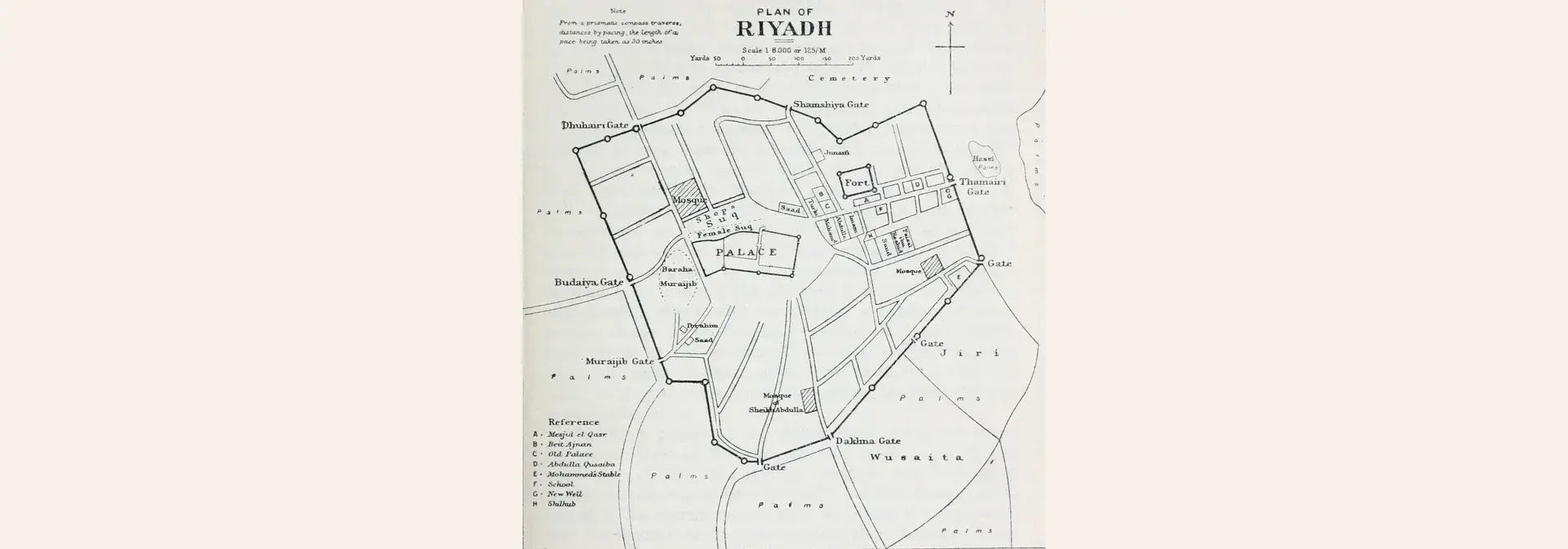
Old Riyadh was surrounded by a mud wall 20 feet high.[2]
Two main streets cut through the town: Al-Suwailem Street running north–south, and Al-Thumairi Street running east–west.[2]
The wall had nine gates: Al-Thumairi, Al-Suwailem, Dakhna, Al-Madhbah, Al-Shamaysi, Al-Dhahirah, Al-Qari, Ar'air and Masaddah.[1]
Masmak Palace
Construction of the Masmak Palace began in the era of Imam Abdullah bin Faisal bin Turki Al Saud in 1282 AH (1865 CE), to serve as the great palace of Riyadh.[1]
For 148 years the Masmak stood at the centre of old Riyadh.[2]
A restoration plan began in 1399 AH and was completed in 1403 AH, and the palace was opened as a museum devoted to the stages of the unification and founding of the Kingdom on 13 Muharram 1416 AH.[1]
The Recapture of Riyadh and the Unification of the Kingdom
The unification of the Kingdom of Saudi Arabia was launched from Riyadh by King Abdulaziz bin Abdulrahman Al Saud and his men, who numbered no more than 63.[1]
The Kingdom of Saudi Arabia celebrated the fiftieth anniversary of the recapture of Riyadh by King Abdulaziz on 4 Shawwal 1369 AH (19 July 1950 CE).[6]
Related people
- Kings of Saudi ArabiaKing Abdulaziz bin Abdulrahman Al SaudFounder and first king of Saudi Arabia, Abdulaziz recovered Riyadh in 1902 and led the unification proclaimed in 1932. His reign saw the development of state institutions and the beginnings of the oil industry.
- PersonImam Turki bin AbdullahFounder of the Second Saudi State in 1240 AH/1824 CE, grandson of Imam Muhammad bin Saud and the first to make Riyadh the seat of Saudi rule.
- PersonHamad Al-JasserHamad Al-Jasser is a Saudi historian and writer, and one of the first to publish historical and geographical research in the early issues of Umm Al-Qura newspaper. He issued Al-Yamamah newspaper in 1952, the first newspaper in Riyadh, and established Riyadh Presses in 1954. He won the King Faisal Prize in Arabic Language and Literature for 1996.
The Service Renaissance in the Era of King Abdulaziz
In the era of King Abdulaziz (1319–1373 AH / 1902–1953 CE), Riyadh saw the introduction of public services and infrastructure for the first time in its history, including electricity, drinking water, and road, air and wireless connections.[7]
The Old Markets of Riyadh
Among the old markets of Riyadh is Souq Al-Hiraj, known in the past as the “Date Market,” for which the King Abdulaziz Foundation documented an archival photograph.[5]
Frequently Asked Questions
Q: What is the origin of the name Riyadh? A: Its location was known as Hajr Al-Yamamah, and in the twelfth Hijri century the name “Riyadh” was given to what remained of the old quarters of Hajr.[8]
Q: How long did the Second Saudi State last? A: It extended from 1240 to 1309 AH (1824–1891 CE), and in its era Riyadh was a centre for the re-propagation of the reformist call.[4]
Q: How many gates did the old wall of Riyadh have? A: Nine gates: Al-Thumairi, Al-Suwailem, Dakhna, Al-Madhbah, Al-Shamaysi, Al-Dhahirah, Al-Qari, Ar'air and Masaddah.[1]
Q: When was Masmak Palace built and when did it become a museum? A: Construction began in 1282 AH (1865 CE), and the palace opened as a museum on 13 Muharram 1416 AH.[1]
Q: How many men did King Abdulaziz have at the start of the unification of the Kingdom? A: They numbered no more than 63.[1]
Summary
The history of Riyadh combines a depth reaching back to Hajr Al-Yamamah, the era of the Second Saudi State that made it a centre for the re-propagation of the reformist call, and then the launch of the unification of the Kingdom of Saudi Arabia from it, followed by the introduction of public services and infrastructure for the first time in the era of King Abdulaziz.[8][4][1][7]
Related topics
- EventThe Capture of RiyadhThe Capture of Riyadh was King Abdulaziz bin Abdulrahman Al Saud's recovery of the city of Riyadh and his entry into it with his men on 5 Shawwal 1319 AH, corresponding to 16 January 1902, together with his pledge of allegiance as Emir there. It was followed by the unification of Najd, the capture of Al-Ahsa, and his official recognition as ruler of Najd, Qassim, and Al-Ahsa.
- Saudi statesThe Second Saudi StateImam Turki bin Abdullah restored Saudi rule in 1824 with Riyadh as capital. The state extended across Najd and eastern Arabia before ending in 1891 with Al Rashid's ascendancy.
- Saudi statesThe First Saudi StateA state centred on Diriyah under Imam Muhammad bin Saud, officially dated in Saudi chronology to 1727. It expanded across Najd and other regions before its capital fell in 1818.
- Saudi statesThe Third Saudi StateThe Third Saudi State began with Abdulaziz bin Abdulrahman Al Saud's recovery of Riyadh in 1902. Regional unification led to the Kingdom of Saudi Arabia proclaimed in 1932 and continuing thereafter.
- EventUnification of Saudi ArabiaKing Abdulaziz's path from the recovery of Riyadh in 1902 to the proclamation of the Kingdom of Saudi Arabia on 23 September 1932, now National Day.
- Urban historyHistory of DiriyahDiriyah developed beside Wadi Hanifah and became the First Saudi State's capital. At-Turaif preserves evidence of its political history and Najdi architecture.
- HistoricMasmak PalaceA historic earthen fortress in Al-Thumairi, central Riyadh, linked to King Abdulaziz's recovery of Riyadh in 1319 AH/1902 CE, now a museum of the Kingdom's founding.
- HistoricMurabba PalaceMurabba Palace is a historic palace in the city of Riyadh in the Kingdom of Saudi Arabia, which King Abdulaziz bin Abdulrahman Al Saud took as his residence and as a centre for administering the affairs of governance and conducting the business of the state alongside Qasr al-Hukm. Today it forms part of the King Abdulaziz Historical Centre, together with the King Abdulaziz Memorial Hall and the King Abdulaziz Private Library.
- CityRiyadh (city)Capital of Saudi Arabia and seat of the Riyadh Region emirate, beside Diriyah, home to Qasr Al-Hukm and Masmak Palace.
- HistoricNajdi ArchitectureNajdi Architecture is a Saudi architectural style that expresses the urban identity of the Najd region, and it draws on local construction materials in a design adapted to the desert climate. Its applications continue in modern urban projects, competitions and cultural events inside the Kingdom and abroad.
- GovernorateDiriyah GovernorateA governorate north-west of Riyadh on Wadi Hanifah, founded in 850 AH/1446 CE, capital of the First Saudi State and home to the World Heritage site of At-Turaif.
- HistoricDiriyah SeasonDiriyah Season is a cultural and entertainment season held in Diriyah Governorate in the Riyadh region of the Kingdom of Saudi Arabia, part of the Saudi Seasons initiative, whose first edition launched in 2019.
- HistoricKing Abdulaziz Foundation (Darah)The King Abdulaziz Foundation (Darah) is an official national institution in the city of Riyadh concerned with preserving the sources of national and Arab history, disseminating and refining them, and supporting national identity. It encompasses the historic Murabba Palace, the King Abdulaziz Memorial Hall and an archive of more than one million photographs, and it publishes Al-Darah magazine and runs scholarly programmes and specialised centres.
- EventBattle of YamamaThe Battle of Yamama was fought in the Yamama region of Najd during the caliphate of Abu Bakr al-Siddiq (11–13 AH), where the Muslims under the command of Khalid ibn al-Walid defeated the apostate Banu Hanifa. It is one of the events of the Ridda wars that followed the death of the Prophet Muhammad.
Sources & references
- Saudi Press Agency (SPA) — Masmak Palace and the unification of the Kingdom
- Saudi Press Agency (SPA) — The old wall of Riyadh and Masmak Fortress
- Saudi Press Agency (SPA) — The Second Saudi State and Diriyah Season
- Saudi Press Agency (SPA) — Scholarly life in Riyadh in the era of the Second Saudi State
- Saudi Press Agency (SPA) — Souq Al-Hiraj in old Riyadh
- Darah Journal — King Abdulaziz Foundation — The fiftieth anniversary of the recapture of Riyadh
- Darah Journal — King Abdulaziz Foundation — Public services and infrastructure in the era of King Abdulaziz
- Darah Journal — King Abdulaziz Foundation — Old Riyadh and Hajr Al-Yamamah