
Overview
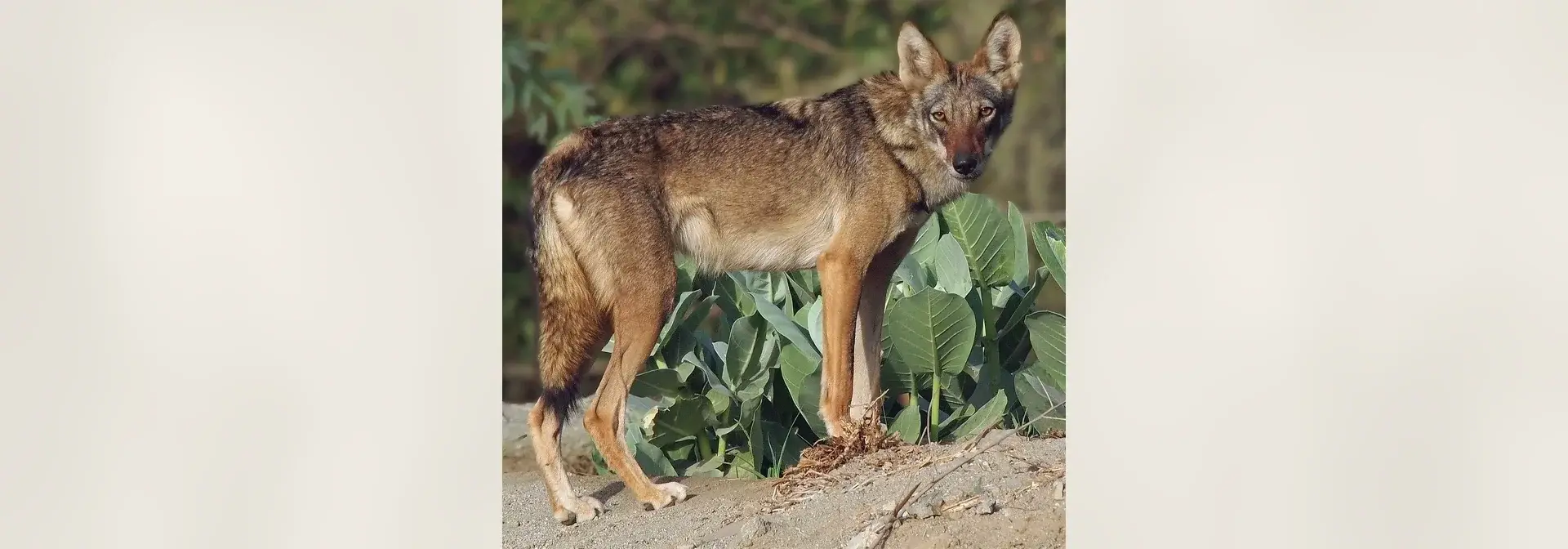
The Arabian wolf is a wild predatory mammal among the mammals of Saudi Arabia, and one of the most prominent species found within the King Salman bin Abdulaziz Royal Reserve.[1]
It plays a role in preserving ecological balance, enhancing biodiversity and stabilising the ecosystem in the Kingdom.[1] The competent bodies monitor the protection of wild species and the reintroduction of those threatened with extinction into their natural habitats, including the Arabian wolf and its pure lineages.[1][2]
Distribution and Habitats
The Arabian wolf has been recorded in several areas within the King Salman bin Abdulaziz Royal Reserve, including the full protection zones: Harrat Al-Harrah, Al-Tubayq and Al-Khunfa.[1] The reserve holds more than 350 species of wild animals, comprising mammals, birds, reptiles and amphibians.[1]
Pure Arabian wolves have been returned to their habitat in the Northern Borders region, where their protection is followed up in Al-Qurayyah.[2] In AlUla governorate, Sharaan Nature Reserve aims to protect the area's sensitive ecosystem by providing a suitable environment for Arabian wolves, gazelles and the large-eared red foxes.[3]
Ecological Importance
The Arabian wolf plays an ecological role in hunting the weakest and diseased individuals, which prevents the spread of disease and ensures the continuity of healthy species.[1]
This role contributes to increasing biodiversity and protecting vegetation cover, and the conservation of predators is therefore one of the objectives of the bodies concerned with wildlife affairs in the Kingdom.[1]
The Al-Ra'an Arabian Wolves
The Al-Ra'an wolves are among the rarest types of pure Arabian wolves, and their scientific name is Al-Bayour.[2] The Al-Ra'an wolf is distinguished by its large size, and in winter it is covered with thick fur that protects it from the severe cold.[2]
13 wolves live in Al-Qurayyah in the Northern Borders region under the protection, care and monitoring of the competent bodies.[2] They are a pure lineage, free of hybridisation, which has led the competent bodies to protect the lineage from hybridisation or tampering.[2]
Protection Efforts and Preservation of Lineages
The competent bodies exert efforts to preserve biodiversity and to reintroduce endangered wild species into their natural habitats, in line with the objectives of Saudi Vision 2030 for improving quality of life.[1] Efforts to protect and monitor Arabian wolves have preserved their pure lineages.[2]
The Al-Ra'an wolves are monitored daily for fear of their extinction and disappearance and of hybridisation entering them.[2] It has been recorded that the possible hybridisation of genetically modified organisms with grey wolves may lead to the loss of original genetic assets, which poses a risk to biodiversity.[4]
Protecting the Arabian Wolf from Hunting
Field patrols of the Special Forces for Environmental Security in Madinah region arrested violators for committing the offence of hunting an endangered wild creature, the Arabian wolf.[5]
The penalty for hunting endangered wild creatures reaches up to 10 years in prison and a fine of up to 10 million riyals, or one of these two penalties.[5] The penalty for hunting the Arabian wolf is a fine of 80,000 riyals, and the penalty for using shotguns in hunting is a fine of 100,000 riyals.[5]
Frequently Asked Questions
Q: What is the Arabian wolf? A: A wild predatory mammal among the mammals of Saudi Arabia, and one of the most prominent species within the King Salman bin Abdulaziz Royal Reserve.[1]
Q: What is its role in the ecosystem? A: It hunts the weakest and diseased individuals, preventing the spread of disease and ensuring the continuity of healthy species, and it contributes to increasing biodiversity and protecting vegetation cover.[1]
Q: How many Al-Ra'an wolves are under protection? A: 13 wolves in Al-Qurayyah in the Northern Borders region; they are a pure lineage free of hybridisation.[2]
Q: What is the penalty for hunting the Arabian wolf? A: A fine of 80,000 riyals, while the penalty for hunting endangered wild creatures in general reaches up to 10 years in prison and a fine of 10 million riyals, or one of these two penalties.[5]
Conclusion
Within the Kingdom's reserves, the Arabian wolf combines its role in the stability of the ecosystem with the protection of pure species and the reintroduction of those threatened with extinction into their natural habitats.[1][2]
Its topics on the platform are linked to King Salman bin Abdulaziz Royal Reserve, Harrat Al-Harrah Reserve, Northern Borders Region, Wildlife of Saudi Arabia and Arabian Leopard.
Related topics
- HistoricKing Salman bin Abdulaziz Royal Nature ReserveKing Salman bin Abdulaziz Royal Nature Reserve is a royal nature reserve in the northwest of the Kingdom of Saudi Arabia and the largest reserve in the Middle East, with a total area of 130,700 square kilometres extending across four administrative regions. It contains broad biodiversity and rock art sites inscribed on the UNESCO World Heritage List.
- HistoricHarrat Al-Harrah ReserveHarrat Al-Harrah Reserve is a high-conservation natural area in northwestern Saudi Arabia, extending across the Northern Borders and Al-Jawf regions within the boundaries of the King Salman bin Abdulaziz Royal Reserve. It features a volcanic plateau and plant and wildlife diversity, and is the first reserve established by the Saudi Wildlife Authority.
- RegionNorthern Borders RegionA northern Saudi region administered from Arar, including Rafha, Turaif and Al Uwayqilah, with histories of pilgrimage routes, pastoral activity, Tapline settlement and mining.
- HistoricWildlife of Saudi ArabiaWildlife in Saudi Arabia is a system of desert, sandy, valley, and plateau environments that shelter hundreds of species of mammals, birds, reptiles, and wild plants.[1][2] Nature reserves work to protect and develop it and to reintroduce endangered species into their habitats.[1][3]
- HistoricArabian LeopardThe Arabian Leopard is a subspecies of the endangered leopard, known scientifically as Panthera pardus nimr, and is one of the smallest and rarest leopard subspecies. The International Union for Conservation of Nature has classified it as Critically Endangered since 1996, and efforts to conserve it in the Kingdom of Saudi Arabia are tied to the Sharaan Nature Reserve and the Arabian Leopard Breeding and Conservation Centre in AlUla.
Sources & references
- Saudi Press Agency (SPA) — The Arabian wolf and wild animal species in the King Salman bin Abdulaziz Royal Reserve
- Saudi Press Agency (SPA) — Return of the Al-Ra'an Arabian wolves to their habitat in the Northern Borders
- Royal Commission for AlUla — Arabian wolves in Sharaan Nature Reserve
- Saudi Press Agency (SPA) — The National Center for Wildlife's position on hybridisation and genetic modification
- Saudi Press Agency (SPA) — Arrest of violators hunting the Arabian wolf and hunting penalties