
Overview
Migratory Birds in Saudi Arabia are a recurring seasonal phenomenon in which numbers of birds cross the Kingdom's territory along fixed routes between their habitats in the Northern Hemisphere and the African continent, and the Kingdom is a passage and a safe habitat for them thanks to its strategic geographic location and its area of more than two million km².[1]
During their passage through the Kingdom, the migratory birds stop for varying periods to feed, among them the turtle dove, the laughing dove, the quail and the crane coming from the African continent during the spring and summer, before returning to their habitats at the end of summer or the beginning of autumn.[1]
Bird Migration Routes
Bird migration in Saudi Arabia follows two main routes: the Red Sea route and a northern route through which birds such as the falcon, the peregrine falcon and the houbara bustard pass.[1]
The King Salman bin Abdulaziz Royal Reserve, located in the north of the Kingdom, is a pivotal station within the migration routes; it is among the first areas to receive birds coming from the continents of Asia and Europe during the autumn migration, and the last station crossed by birds coming from the African continent on their return journey during the spring migration.[3]
One of the most important migration routes passes through the north of the Kingdom, with more than 300 species of birds at different times and seasons, some of which settle to rest and feed, among them those that head to the region to spend the breeding and nesting season.[2]
Migration Seasons
Bird migration across the Kingdom's territory takes place in autumn during the months of September and October, coming from their habitats in the Northern Hemisphere heading south, in a recurring movement that repeats annually in search of food or breeding in suitable environments.[1]
The Northern Borders region witnesses from the end of March until May each year a marked activity of the return migration of birds from the south to the north, coinciding with the arrival of spring, in a recurring seasonal journey during which the birds return to their breeding grounds in the Northern Hemisphere.[3]
Migratory Birds in the North of the Kingdom
The Northern Borders region forms an important route in the migration and annual passage of birds, and a natural haven thanks to its balanced environment and its varied terrain, and it contains more than 300 species of birds that cross the region.[4]
The Imam Turki bin Abdullah Royal Reserve, located in the north-east of the Kingdom within the administrative scopes of the Al-Jouf, Al-Qassim, Hail, Northern Borders and Eastern Province regions, is distinguished by the diversity of its terrain of valleys, ravines, plains, sand dunes and basalt lava fields, environments that contain several species of resident and migratory plants, animals and birds.[2]
Among the most prominent birds passing through during the autumn migration season in the Northern Borders are the European roller, known locally as «Al-Khudayri», and the turtle dove, and the Eurasian hobby (Falco subbuteo), known as «Al-Suqair Al-Shimali», also crosses the region's sky; it is among the small falcons distinguished by their agility, speed and ability to manoeuvre.[5][6]
Migratory Birds on the Coasts and Wetlands
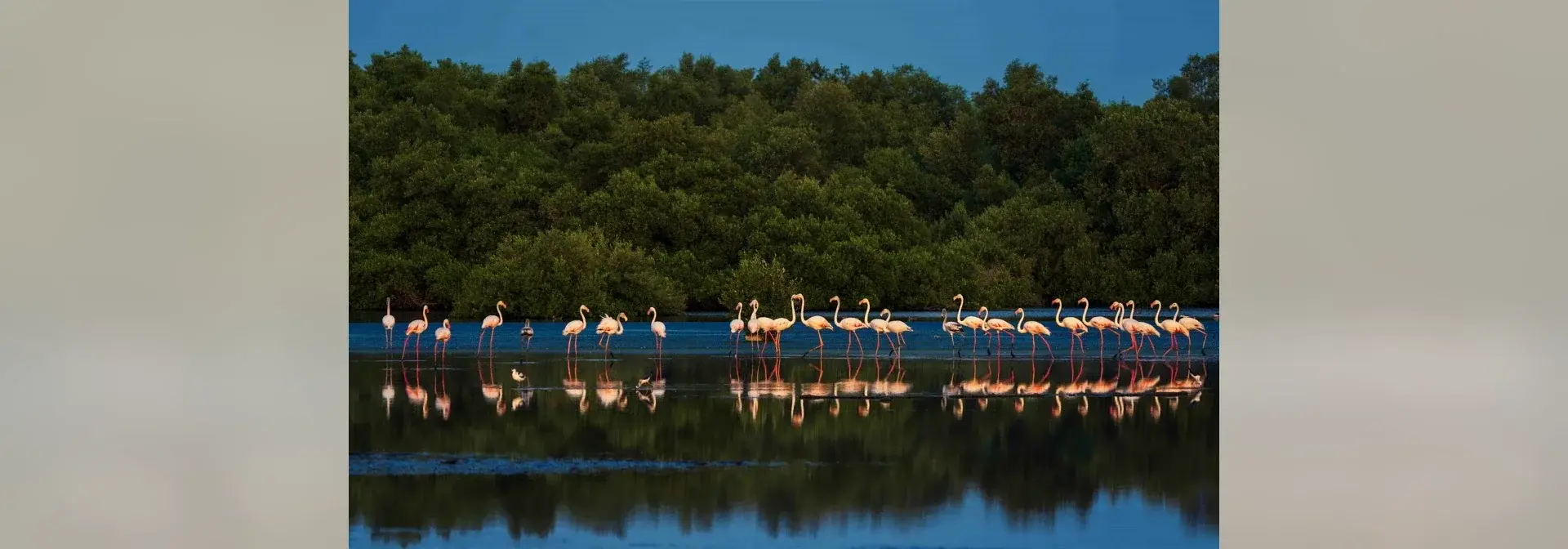
The birds that can be observed along the coasts of Jeddah vary between gulls, terns, herons and egrets, alongside species of wading birds that spread in shallow coastal environments and take the beaches and mudflats as sites for searching for food.[7]
The mangrove trees, wetlands and coastal flats form environments of ecological importance for many species of birds, for the shelter and food sources they provide.[7]
In the Arabian Gulf, the Jubail Wildlife Sanctuary contributes to conserving the resident and migratory species recorded in the region, such as the houbara bustard, the stone-curlew, the falcons and the crane, and it includes a number of sabkhas, bays and islands, among them Sabkhat Al-Fasl, Tarout Bay and the islands of Jana and Karan.[9]
Efforts to Conserve Migratory Birds
The national efforts to conserve migratory birds and their natural habitats, led by the National Center for Wildlife, come to enhance environmental sustainability, in line with the objectives of Saudi Vision 2030 and the Saudi Green Initiative.[7]
The Saudi Wildlife Authority formed a mobile protection force for migratory birds, in implementation of its board's decision that prohibits hunting in the coastal strip on all the Kingdom's coasts with a width of 20 kilometres, except for the netting of falcons in specified seasons.[8]
Migratory birds perform ecological roles in natural systems, including pollination, pest control and seed dispersal.[4]
International Commitments and Awareness
The Kingdom joined the Convention on the Conservation of Migratory Species of Wild Animals (CMS) in 1410 AH, and it is an active member of it, because the migration routes of many species of birds cross through its territory.[10]
The Kingdom is a member of the Convention on the Conservation of Migratory Species of Wild Animals, a member of the Convention on International Trade in Endangered Species of Wild Fauna and Flora (CITES), and a member of the Convention on Biological Diversity.[11]
The celebration of World Migratory Bird Day dates back to the year 2006, to raise awareness of the risks that migratory birds face during their migration from over-hunting, unguided land use and pollution.[10]
The Saudi Falcons Club organised in Riyadh the exhibition «World Migratory Bird Day and the Impact of Plastic on Them», coinciding with the World Day in which 53 countries around the world organise 300 awareness and cultural events.[12]
Frequently Asked Questions
Q: What are the most famous bird migration routes in Saudi Arabia? A: The Red Sea route and a northern route through which birds such as the falcon, the peregrine falcon and the houbara bustard pass.
Q: In which season do migratory birds pass through Saudi Arabia? A: In autumn during the months of September and October, with a return migration season from the south to the north from the end of March until May.
Q: How many species of birds cross the north of the Kingdom? A: More than 300 species at different times and seasons.
Q: What is the national body responsible for conserving migratory birds and their habitats? A: The National Center for Wildlife.
Q: When did the Kingdom join the Convention on the Conservation of Migratory Species of Wild Animals? A: In 1410 AH, and it is an active member of it.
Conclusion
Migratory Birds in Saudi Arabia combine a strategic geographic location that makes the Kingdom a passage and a safe habitat, fixed migration routes the most prominent of which are the Red Sea route and the northern route, recurring seasons in autumn and spring, and coastal, wetland and reserve environments that receive resident and migratory species, within national and international efforts to conserve them and their habitats.[1][7][10]
Related topics
- HistoricKing Salman bin Abdulaziz Royal Nature ReserveKing Salman bin Abdulaziz Royal Nature Reserve is a royal nature reserve in the northwest of the Kingdom of Saudi Arabia and the largest reserve in the Middle East, with a total area of 130,700 square kilometres extending across four administrative regions. It contains broad biodiversity and rock art sites inscribed on the UNESCO World Heritage List.
- RegionNorthern Borders RegionA northern Saudi region administered from Arar, including Rafha, Turaif and Al Uwayqilah, with histories of pilgrimage routes, pastoral activity, Tapline settlement and mining.
- HistoricHoubara BustardThe houbara bustard is a desert bird and one of the most prominent birds of the Arabian Peninsula, with an environmental and cultural value linked to the desert environment and the history of falconry, and it plays a role in preserving ecological balance in arid and semi-arid environments. The Kingdom's efforts to protect it span breeding centres and reintroduction in the royal reserves.
- TopicSaudi Green InitiativeThe Saudi Green Initiative is a national initiative announced by His Royal Highness the Crown Prince and Prime Minister on 27 March 2021, charting the Kingdom's direction in protecting land and nature along a clear and ambitious roadmap. It targets the planting of 10 billion trees, the raising of protected areas to more than 30 percent, and the supply of 50 percent of electricity generation from renewable energy by 2030.
- National visions and programmesSaudi Vision 2030: A Framework for TransformationAn introduction to Saudi Vision 2030, its social, economic and institutional themes, and the relationship between implementation programmes, long-term targets and measured results.
- HistoricWildlife of Saudi ArabiaWildlife in Saudi Arabia is a system of desert, sandy, valley, and plateau environments that shelter hundreds of species of mammals, birds, reptiles, and wild plants.[1][2] Nature reserves work to protect and develop it and to reintroduce endangered species into their habitats.[1][3]
- RegionJeddah CityJeddah City is a Saudi city that is a gateway to the Two Holy Mosques and a station through which cultures have passed. Its history spans more than 1,400 years, and it is home to Historic Jeddah, inscribed on the World Heritage List in 2014, alongside modern development projects, most notably the Jeddah Central Project.