
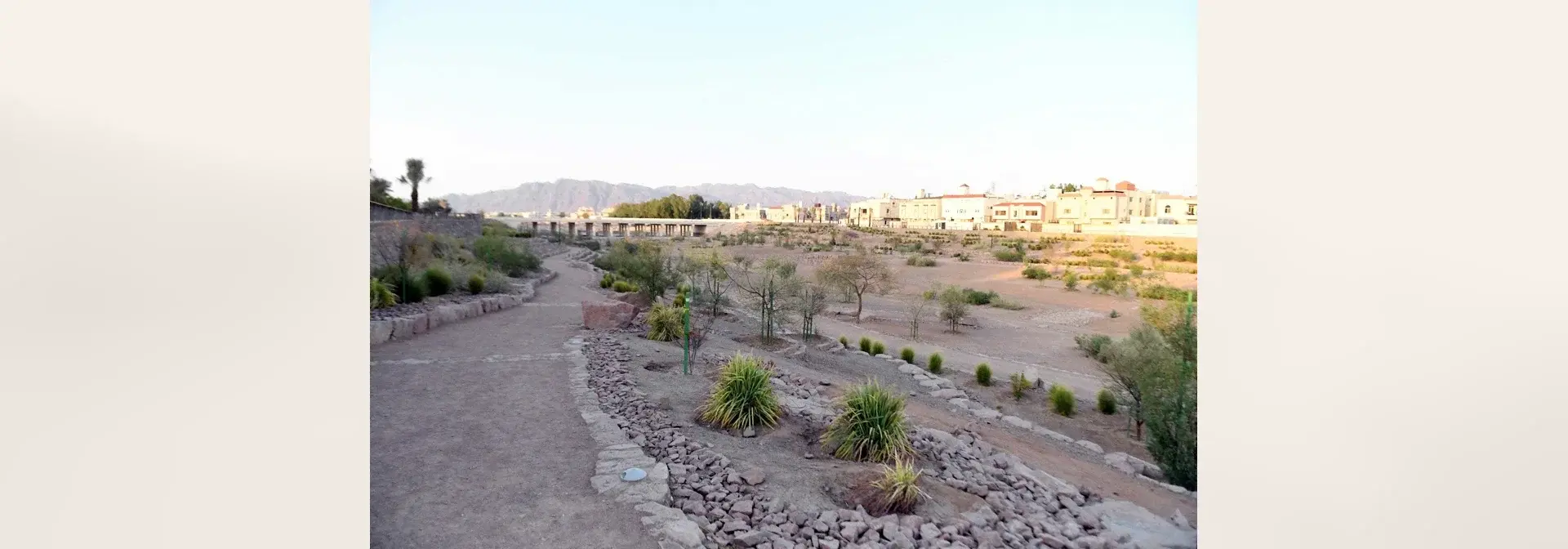
Overview
Wadi Al-Aqiq is one of the best-known valleys of Madinah, lying in its south-western part.[2] In earlier times it was a source of water and agricultural life in the city.[2]
It is called the “Blessed Valley” for its connection to the purified Prophetic biography, and it is one of the well-known geographical landmarks of Madinah mentioned in the Prophetic biography and in historical and geographical sources, alongside Mount Uhud, Mount Ayr, Wadi Bathan and Al-Ranuna.[1][6]
Palaces and farms were built on its banks in the Umayyad and Abbasid eras.[1] Urban development has now extended to the edges of Al-Aqiq as far as Dhu al-Hulayfah.[1]
Location and Route
Wadi Al-Aqiq descends about one hundred kilometers from the south of Madinah, runs alongside Mount Ayr on the western side, and passes through Dhu al-Hulayfah.[1]
It meets Wadi Bathan to the east near the Al-Qiblatayn area, then continues slightly north-east and then north until it meets Wadi Qanah, coming from the east of the city, at the Zughabah area.[1]
The Blessed Valley and the Prophetic Biography
Wadi Al-Aqiq became known as the “Blessed Valley” because it is mentioned in Sahih al-Bukhari, on the authority of Umar ibn al-Khattab, may Allah be pleased with him, that the Prophet, peace be upon him, said of it: “Tonight a visitor came to me from my Lord and said: Pray in this blessed valley.”[1]
It also lies on the route of the Battle of Badr, which the film “The Historical Route of the Battle of Badr” presents beginning from Masjid Al-Suqya, passing through Wadi Al-Aqiq, then Batha Ibn Azhar, the place of the Prophet’s army’s first overnight stay near Al-Aziziyah district in Madinah.[9]
Palaces and Farms on the Banks
In some past eras the valley was like a permanently flowing river, and palaces were built on its banks, especially in the Umayyad and Abbasid eras.[1]
Among its best-known palaces are the palace of Sa’d ibn Abi Waqqas, some of whose remains still stand, the palace of Urwah, and the palace of Sukaynah bint al-Husayn.[1] Date-palm farms, vegetable and fruit nurseries, and the gardens attached to the palaces standing in it also grew near the valley.[1]
Historical Mosques Along the Valley
Among the historical mosques of Madinah are Masjid Al-Manaratayn on Al-Aqiq road, Masjid Urwah in Al-Aqiq, and Masjid Al-Ma’ras in Dhu al-Hulayfah.[7] Masjid Al-Qiblatayn lies in the north-western part of Madinah alongside Wadi Al-Aqiq, and is one of the most prominent historical mosques that witnessed the change of the qiblah from Bayt al-Maqdis to the Holy Kaaba in the second year of the Hijrah.[8]
Environmental Rehabilitation and Walking Paths
The Madinah Region Development Authority is carrying out an environmental rehabilitation project for Wadi Al-Aqiq that aims to achieve a balance between the urban environment and natural resources; its development works extend over a distance of about 15 kilometers, beginning at the Dhu al-Hulayfah miqat area in the south and ending at the Al-Jurf road bridge in the north.[1]
The works take in the valley banks in several areas, among them Qasr Urwah, the intersection of Al-Salam road and the Islamic University square, through to the agricultural areas of Al-Jurf.[1]
The rehabilitation and care works on the banks of parts of the valley contributed to the creation of walking paths extending for a length of about 1.5 kilometers, equipped with lanes prepared for pedestrians and cyclists, overlook seating and a modern lighting system, along with tree-planting works along the paths.[2]
The Valley in the Rainy Season
Investment Opportunities on the Valley Banks
The Madinah Region Municipality has offered an investment opportunity for the construction, operation and maintenance of a multi-use site on the Wadi Al-Aqiq Corniche in Al-Jammawat district, at the intersection of Wadi Al-Aqiq Corniche road with Abu al-Hasan al-Asfara’ini road, over an area of 79,316.66 square meters and with a 50-year investment contract and a 36-month grace period.[3]
The project aims to build a multi-use building that includes commercial, administrative, hospitality, entertainment, residential and health activities; the site lies about 5 kilometers from the Prophet’s Mosque.[3]
The Islamic University of Madinah has offered an investment opportunity to develop the “Aqiq Front” project along Sultanah road and overlooking Wadi Al-Aqiq, over a total area of 53,957 square meters and with a 30-year investment contract, including the construction of a hotel and a commercial and administrative complex.[4]
The Hijaz Railway Bridge over the Valley
The Madinah Region Municipality, in cooperation with the General Commission for Tourism and Antiquities, completed the design studies for the project to rebuild and restore the Hejaz Railway bridge located over Wadi Al-Aqiq.[5]
The bridge had suffered collapses as a result of the floods that swept Madinah in December 2004 CE / 1425 AH, which forced the Al-Aqiq municipality to demolish part of the bridge after two of its arches fell.[5]
Frequently Asked Questions
Q: Where is Wadi Al-Aqiq located? A: In the south-western part of Madinah, descending about one hundred kilometers from its south.[1][2]
Q: Why is it called the Blessed Valley? A: Because it is mentioned in Sahih al-Bukhari, on the authority of Umar ibn al-Khattab, may Allah be pleased with him, that the Prophet, peace be upon him, said of it: “Tonight a visitor came to me from my Lord and said: Pray in this blessed valley.”[1]
Q: What are the best-known palaces on the valley banks? A: The palace of Sa’d ibn Abi Waqqas, some of whose remains still stand, the palace of Urwah, and the palace of Sukaynah bint al-Husayn.[1]
Q: What development works are under way in Wadi Al-Aqiq? A: The environmental rehabilitation project over a distance of 15 kilometers, walking paths about 1.5 kilometers long, and investment opportunities on the valley corniche and frontage.[1][2][3][4]
Q: What historical mosques are near the valley? A: Masjid Al-Manaratayn, Masjid Urwah, Masjid Al-Ma’ras and Masjid Al-Qiblatayn.[7][8]
Related topics
- RegionMadinah RegionA western Saudi region combining Madinah, Yanbu, AlUla and other governorates, with Islamic landmarks, oases, archaeological sites and a Red Sea coastline.
- EventHistory of MadinahThe history of Madinah is the history of a city in the west of the Kingdom of Saudi Arabia, known before the Prophetic Hijrah as Yathrib and later named Madinah; it is the seat of the Prophet's Mosque and the first capital of the Islamic state. Its history extends from before Islam to the Saudi era, through the building of the Prophet's Mosque and the city's historical landmarks.
- HistoricThe Prophet's MosqueThe Prophet's Mosque is the mosque of the Prophet Muhammad ﷺ in Madinah, built in the first year of the Hijrah over an area of 1,050 square meters. Several constructions followed across the Islamic eras, and the mosque saw its widest expansions in the Saudi era.
- HistoricMasjid Al-QiblataynMasjid Al-Qiblatayn is a historic mosque in Madinah in the Kingdom of Saudi Arabia that witnessed the change of the qiblah from Al-Aqsa Mosque to the Sacred Mosque in the second year of the Hijri calendar. The site now hosts the Al-Qiblatayn Civilizational Center Project, which raises its capacity and improves services for its worshippers and visitors.
- EventHejaz RailwayThe Hejaz Railway is a railway line ordered to be built in March 1900, with work beginning in 1900, to link the Muslims of the northern Arabian Peninsula with the Holy Places; it runs from Damascus station to Madinah station. The first train reached Madinah on 22 Rajab 1326 AH, corresponding to 23 August 1908, and the line operated for about nine years. The Kingdom of Saudi Arabia today preserves its station, its museum and its antiquities in the Tabuk and Madinah regions.
- EventBattle of BadrThe Battle of Badr is the first decisive battle fought by the Muslims. It took place on the seventeenth of Ramadan in the second year of the Hijrah between Makkah and Madinah, and its day was named the Day of the Criterion. It ended in the defeat of the polytheists, and its site in Badr Governorate preserves its landmarks and its historic route.
- HistoricDar Al-Madinah MuseumDar Al-Madinah Museum is a specialised project documenting the history of Madinah from its foundation to the present day, foremost among which are the Prophet's biography and the most prominent landmarks of Islamic history. Its premises is located in the Knowledge Economic City in Madinah, and it was founded and is owned by Dr. Engineer Abdulaziz bin Abdulrahman Kaaki.
- HistoricVegetation Cover in Saudi ArabiaVegetation Cover in Saudi Arabia is the total of the native plant species and the varied ecological regions across the Kingdom, whose sites are developed, protected and monitored and whose degraded parts are rehabilitated through national programmes for afforestation, combating desertification and land rehabilitation.
- HistoricWadi Al-HamdWadi Al-Hamd is a valley in the Kingdom of Saudi Arabia and one of the largest in the Arabian Peninsula. It runs from the northwest of the Madinah Region for about 400 kilometres to its outlet on the Red Sea between the governorates of Al-Wajh and Umluj, combining varied terrain with a historical and archaeological dimension.
Sources & references
- Saudi Press Agency (SPA) — “Hajj / Wadi al-Aqiq in Madinah .. the Blessed Valley”
- Saudi Press Agency (SPA) — “Tourism and Entertainment / Mild weather boosts visitors to the Aqiq and Qanah valleys in Madinah”
- Saudi Press Agency (SPA) — “Economy / The Madinah Municipality offers an investment opportunity to develop a multi-use site on the Wadi Al-Aqiq Corniche”
- Saudi Press Agency (SPA) — “Economy / The Islamic University of Madinah offers an investment opportunity to develop the Aqiq Front project”
- Saudi Press Agency (SPA) — “Cultural / His Highness the Secretary-General of the General Commission for Tourism and Antiquities commends the reconstruction of the Hejaz Railway”
- Saudi Press Agency (SPA) — “Cultural / Historical sites in Madinah.. a prominent religious and historical legacy”
- Saudi Press Agency (SPA) — “General / The historical mosques of Madinah”
- Saudi Press Agency (SPA) — “Cultural / The Qiblatayn Mosque and Cultural Centre in Madinah.. integration of religious care and urban development”
- Saudi Press Agency (SPA) — “Ramadan / The Madinah Research and Studies Centre launches the film The Historical Route of the Battle of Badr”