

Overview
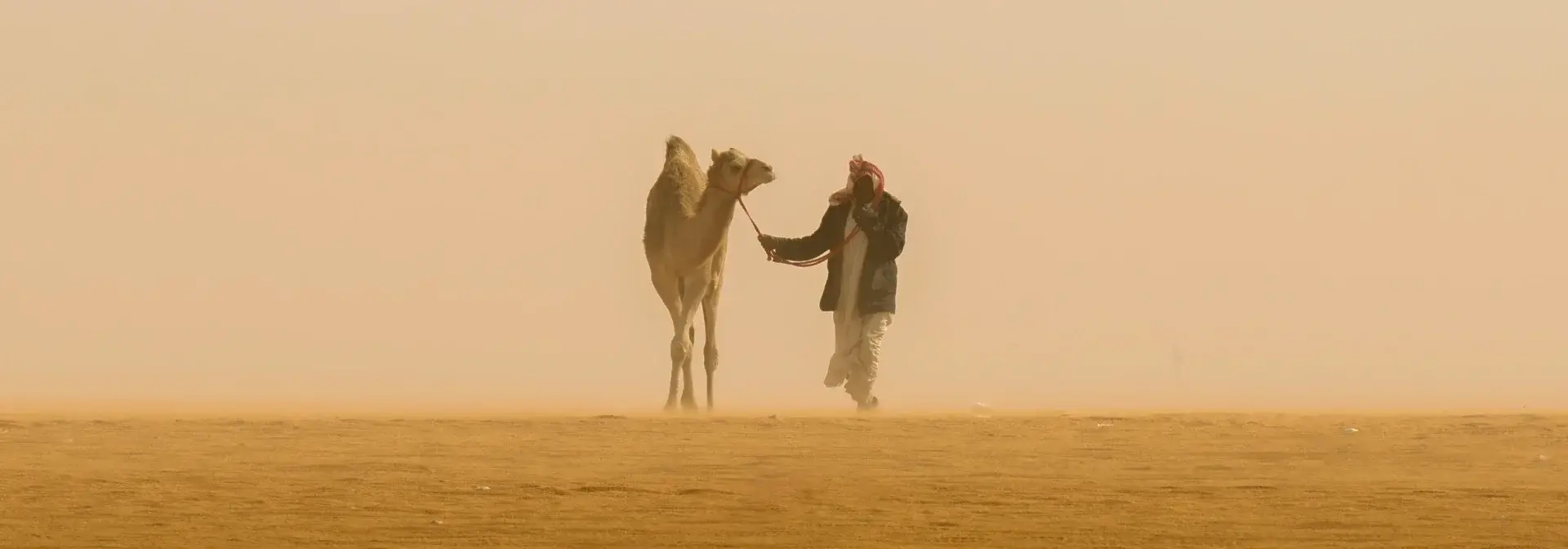
Camel herding in Saudi Arabia is a long-established activity of the Arabian Peninsula, in which the camel stands as a witness to authenticity and an essential element of Saudi identity, bound to the life of its people from the dawn of history to the present day.[1]
Camels receive official care expressed in organisation, welfare and documentation, and in numerous activities, foremost among them camel racing and the King Abdulaziz Camel Festival, alongside their presence in the Kingdom's national and cultural occasions.[1]
Camel Numbers and Their Distribution Across the Regions of the Kingdom
On the International Day of the Camel, corresponding to 22 June 2025, the Ministry of Environment, Water and Agriculture announced that the total number of camels in the Kingdom reached 2,235,297 head, based on the statistical data for 2024 across the regions of the Kingdom.[2]
Riyadh Region leads the Kingdom's regions in camel numbers with 656,423 head, followed by the Eastern Province with 361,178 head, then Makkah Region with 281,164 head; the share of these three regions is 58.1% of the total.[2]
Camel Numbering and Breed Documentation
In May 2024, 85,347 head of camels were numbered in Sakaka and the governorates of Dumat Al-Jandal, Tabarjal and Qurayyat through the An'am electronic platform.[3]
In preserving breeds, the Camel Club launched the Wathiqha platform to document camel information, including DNA, in cooperation with King Faisal Specialist Hospital; in its first phase the platform targets camels taking part in the mazayin of the Club's festivals, and it then documents all camels in the Kingdom to preserve their breeds. The number of distinct DNA strains in camels is 11.[4]
Scientific Research on Camels
The Camel Research Center at King Faisal University, in cooperation with the International Camel Organization, organised the First International Forum of Camel Research Centers on 24 Jumada al-Akhirah 1443 AH / January 2022 in Al-Ahsa, a forum reflecting the historical, heritage, economic and social depth camels hold in the Arabian Peninsula, and the scholarly and research attention they receive at the university.[5]
Institutional Organisation and International Cooperation
At its session on Tuesday 19 November 2024, the Council of Ministers approved a headquarters agreement between the Government of the Kingdom of Saudi Arabia and the International Camel Organization, which has its headquarters in Riyadh.[1][6] The Kingdom took part in launching the International Year of Camelids 2024, which the Food and Agriculture Organization of the United Nations (FAO) launched at its headquarters in Rome under a shared chairmanship between the Kingdom and the Latin American and Caribbean Group (GRULAC), represented by Bolivia, and a royal order was issued forming a steering committee chaired by the Ministry of Environment, Water and Agriculture.[7]
At the bilateral level, a memorandum of understanding was signed between the Ministry of Environment, Water and Agriculture and the Agency for the Development of Veterinary and Livestock in the Republic of Uzbekistan on 5 Rajab 1444 AH / 27 January 2023, covering the coordination of policies in camel and small ruminant husbandry and discussion of joint investment projects introducing new technologies and innovations in livestock husbandry.[8]
Camels in Culture and Heritage
In 2022, Al-Hedaa (camel driving songs) was inscribed on the Representative List of the Intangible Cultural Heritage of the United Nations Educational, Scientific and Cultural Organization (UNESCO), in a joint file led by the Kingdom in cooperation with the Sultanate of Oman and the United Arab Emirates. With this inscription, the number of Saudi intangible cultural heritage elements inscribed on the List reached 11.[9]
Al-Hedaa is a form of light verse recited to delight camels and urge them on, through which herders call their camels, gather them and communicate with them, and the people of the Arabian Peninsula inherit this art through sounds and expressions to which camels have grown accustomed and respond.[10] In the historical record, the first to drive camels with song was Mudar ibn Nizar ibn Ma'add, after he fell from his camel and broke his arm and cried out in his voice; he had a fine voice, so the camels heeded him and pressed on.[10]
The King Salman Global Academy for Arabic Language issued The Camel Guide in 21 sections, covering the names of camels in the Holy Quran and their names by age, herd, body parts, sounds, gaits and classification, their Arabian attributes, behaviour and temperaments, in addition to the most notable sayings about them in Arabic proverbs and poetry.[11] The Council of Ministers, by Decision No. (438) dated 06/06/1445 AH, designated 2024 as the Year of the Camel 2024, and the Ministry of Culture celebrated the conclusion of the initiative at Laysen Valley in Riyadh on 28 December 2024, honouring the partners who contributed to supporting the objectives of the cultural year.[12][13]
The pavilion of the King Abdulaziz Foundation (Darah) at the Ministry of Interior exhibition (Security Oasis) at the King Abdulaziz Camel Festival in Al-Sayahid screened a documentary film on the designation of 2024 as the Year of the Camel, focusing on King Abdulaziz's special care for camels through to the Kings of the Kingdom who continued that care, and on the gains achieved, including the founding of the International Camel Organization and its headquarters in Riyadh.[1]
The King Abdulaziz Camel Festival
The total number of camels taking part in the King Abdulaziz Camel Festival rose from 24,000 head in its sixth edition to 35,000 in its seventh, and the number of participants rose from 1,900 to 2,200 over the 45 days of the festival; the closing ceremony was held in the southern Al-Sayahid of Al-Dahna under the patronage of the Custodian of the Two Holy Mosques.[14]
In its ninth edition, His Royal Highness the Crown Prince and Prime Minister, Supervisor General of the Camel Club, patronised the closing ceremony at the Royal Court in Al-Yamamah Palace in Riyadh on Tuesday 12 Sha'ban 1446 AH, corresponding to 11 February 2025, and presented the awards to the first-place winners and to those honoured from the Club and the sponsors; the crowning covered the six colours of camels: Al-Wadh, Al-Sufr, Al-Sha'l, Al-Majahim, Al-Humr and Al-Shuqh.[15]
Frequently Asked Questions
Q: How many camels are there in Saudi Arabia? A: The total number of camels in the Kingdom reached 2,235,297 head following the statistical data for 2024.[2]
Q: Which regions of the Kingdom lead in camel numbers? A: Riyadh Region leads with 656,423 head, followed by the Eastern Province with 361,178 head, then Makkah Region with 281,164 head, and the three regions represent 58.1% of the total.[2]
Q: What is the An'am platform? A: An electronic platform for numbering camels and registering them, through which 85,347 head were numbered in Sakaka, Dumat Al-Jandal, Tabarjal and Qurayyat in May 2024.[3]
Q: Is Al-Hedaa inscribed on the UNESCO list? A: Yes; it was inscribed in 2022 on the Representative List of the Intangible Cultural Heritage, in a joint file led by the Kingdom together with the Sultanate of Oman and the United Arab Emirates.[9]
Q: What is the Year of the Camel 2024? A: A designation of the year 2024 approved by the Council of Ministers by Decision No. (438) dated 06/06/1445 AH, and the Ministry of Culture celebrated the conclusion of the initiative in Riyadh on 28 December 2024.[12][13]
Conclusion
Camel herding in Saudi Arabia combines a productive sector with a system of organisation, documentation and globally inscribed heritage, extending from numbering camels through the An'am platform to documenting their breeds, their research centres and their national festivals, with a herd base of 2,235,297 head following the 2024 data.[2][3][4][14]
Related topics
- HistoricKing Abdulaziz Camel FestivalKing Abdulaziz Camel Festival is a Saudi event held in the southern As-Sayahid of the Ad-Dahna desert, north-east of Riyadh, devoted to the heritage of camels, their beauty contests, their races and the accompanying activities. The King Abdulaziz Foundation for Research and Archives (Darah) has organised and supervised it from 1438 AH/2017.
- HistoricAl-Heda'aAl-Heda'a is an art of light verse recited to delight camels and urge them onward through traditional oral expressions that enable herders to call their camels, gather them and communicate with them; it is known as camel Al-Heda'a and is passed down by the people of the Arabian Peninsula from generation to generation. The Kingdom of Saudi Arabia led the file for its inscription on the UNESCO Representative List of the Intangible Cultural Heritage of Humanity in cooperation with the Sultanate of Oman and the United Arab Emirates, and it was inscribed on 30 November 2022.
- RegionRiyadh RegionA central Saudi administrative region encompassing the national capital and varied Najdi governorates, with connections to Diriyah, oasis settlement, government and modern economic activity.
- RegionEastern ProvinceA large eastern Saudi region administered from Dammam, combining Gulf cities, the oases of Al Ahsa and Qatif, desert areas, energy industries and maritime commerce.
- RegionAl-Ahsa GovernorateAl-Ahsa Governorate is a governorate in the Kingdom of Saudi Arabia. Within it lies the Al-Ahsa Oasis, the largest self-contained palm oasis in the world, with more than 2.5 million palm trees; it was inscribed on the World Heritage List in 2018 CE.
- HistoricThe Great Nafud DesertThe Great Nafud Desert is a vast sand sea in the north of the Kingdom of Saudi Arabia, covering about 65,000 km², or nearly 3.2% of the Kingdom's land area, with wide parts lying within the Imam Turki bin Abdullah Royal Reserve. It contains a diversity of dune forms and notable landmarks such as Jabal Al-Ulaym and Nafud Al-Ashyakh.
- GovernorateDumat Al-Jandal GovernorateA governorate in Al-Jawf west of Sakaka and one of northern Arabia's oldest towns, with Marid Castle, the Mosque of Umar ibn al-Khattab and Dumat Al-Jandal Lake.
- RegionMakkah RegionA western Saudi region administered from Makkah, encompassing Jeddah, Taif and other governorates, where pilgrimage, maritime trade, coastal landscapes and uplands meet.
- RegionQurayyat CityQurayyat City is a governorate in Al-Jawf Region of the Kingdom of Saudi Arabia; several administrative centers and villages fall under it, and the Al-Hadithah land crossing lies within its boundaries. It is home to the historic Qasr Kaf, which served as the seat of Saudi rule in the region, along with service, health, and municipal projects and a regional airport.
- CityRiyadh (city)Capital of Saudi Arabia and seat of the Riyadh Region emirate, beside Diriyah, home to Qasr Al-Hukm and Masmak Palace.
- RegionSakaka CitySakaka City is a Saudi city in Al-Jouf region, home to the archaeological landmarks of Za'bal Castle and Sisra Well, alongside service and development projects and seasonal festivals.
Sources & references
- Saudi Press Agency (SPA) — the pavilion of the King Abdulaziz Foundation (Darah) at the King Abdulaziz Camel Festival
- Saudi Press Agency (SPA) — camel numbers across the regions of the Kingdom
- Saudi Press Agency (SPA) — camel numbering through the An'am platform
- Saudi Press Agency (SPA) — the Wathiqha platform for documenting camel breeds
- Saudi Press Agency (SPA) — the First International Forum of Camel Research Centers
- Saudi Press Agency (SPA) — the Council of Ministers approves the headquarters agreement of the International Camel Organization
- Saudi Press Agency (SPA) — the launch of the International Year of Camelids 2024
- Umm Al-Qura newspaper — a memorandum of understanding with Uzbekistan on livestock
- Saudi Press Agency (SPA) — the inscription of Al-Hedaa on the UNESCO Representative List
- Saudi Press Agency (SPA) — the art of Al-Hedaa and its origin in Arab heritage
- Saudi Press Agency (SPA) — The Camel Guide of the King Salman Global Academy for Arabic Language
- Saudi Press Agency (SPA) — the conclusion of the Year of the Camel 2024 initiative
- Umm Al-Qura newspaper — the Council of Ministers decision designating 2024 as the Year of the Camel
- Umm Al-Qura newspaper — the closing ceremony of the seventh edition of the King Abdulaziz Camel Festival
- Umm Al-Qura newspaper — the patronage of the Crown Prince of the closing ceremony of the ninth edition of the festival