
Overview
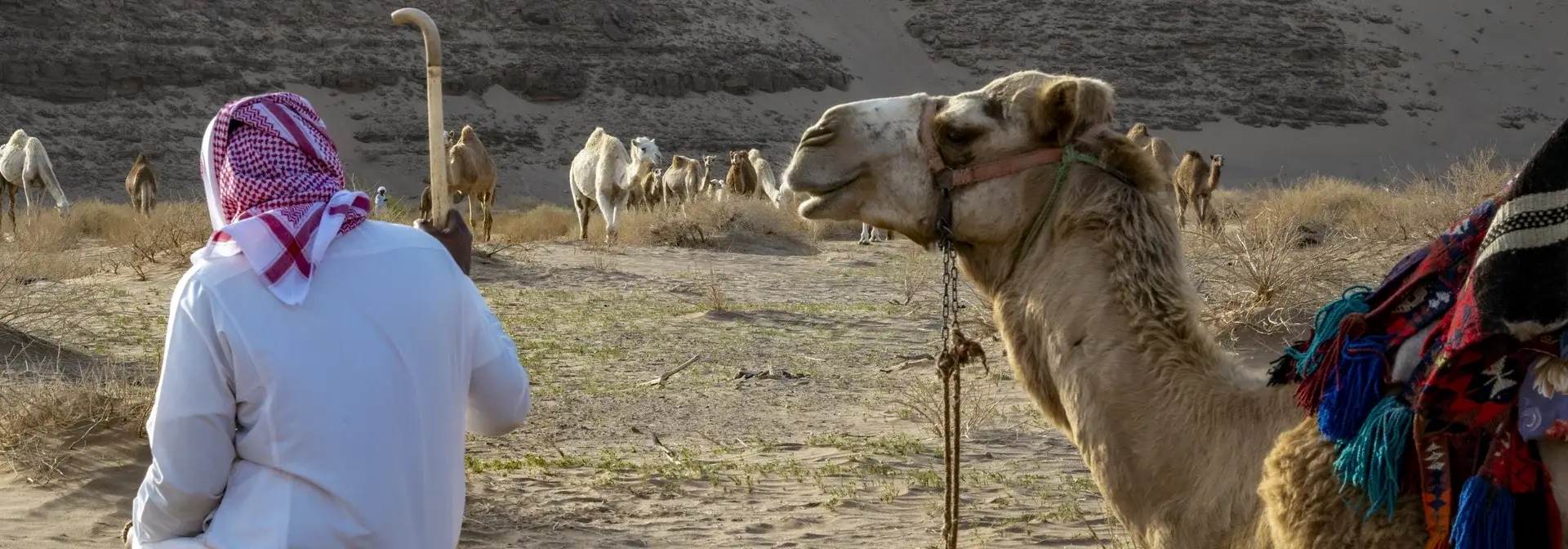
Al-Heda'a is an art of light verse recited to delight camels and urge them onward through traditional oral expressions that enable herders to call their camels, gather them and communicate with them, and it is passed down by the people of the Arabian Peninsula from generation to generation. [1]
It is one of the traditional forms of oral expression associated with camels, known as camel Al-Heda'a, and it is usually performed when camels come to water, when they move out to pasture or while travelling from one place to another. [1] The Kingdom of Saudi Arabia led the file for its inscription on the UNESCO Representative List of the Intangible Cultural Heritage of Humanity in cooperation with the Sultanate of Oman and the United Arab Emirates. [2]
Definition of Al-Heda'a and Its Function
Al-Heda'a is a form of light verse recited to delight camels and urge them onward, and it rests on traditional oral expressions that gave it a practical function in the life of camel owners, enabling herders to call their camels, gather them and communicate with them. [1]
Al-Heda'a is performed when camels come to water, when they head out to pasture or while travelling from one place to another; it consists of short chants that help gather the camels, keep them moving and bring them back in order to their resting place, and its melody varies with the environment and the occasion. [1]
Origin of Al-Heda'a
Accounts of the beginnings of Al-Heda'a relate that Mudar ibn Nizar ibn Ma'add was the first to chant to camels: after he fell from his camel and his hand was broken he cried out, and because his voice was fine the camels listened to him and pressed on in their journey, and from this the idea of using Al-Heda'a to call camels arose. [1]
Al-Heda'a is said to have begun with the tadwiya, a call to camels in a high voice using words such as hayd hayd, hi du hi du, dawh dawh, dih dih and dah dah, and this pattern is still in use today alongside rajaz, differing from one environment to another. [1]
Occasions and Types of Al-Heda'a
Al-Heda'a has various occasions, among them the chant of departure and the chant of travel, the chant for watering camels known as al-'Awbal, and the chant of return known among the people as al-Hawbal, which is specific to gathering camels and driving them to their resting place or pasture. [1]
To these is added the chant of the saniya, sung to the camels that draw water from the well so that they stay brisk in their movement. [1] In Al-Qassim Region the saniya was bound up with an oral and artistic heritage of chants and Al-Heda'a recited by the workers while watering the camels and drawing water from the wells, and it became part of the popular memory attached to the craft. [5]
Al-Heda'a and the Rajaz Meter
Among the most recent works to address the origin of Al-Heda'a is the diwan “Al-Rajaz wa al-Heda'a” by the researcher in popular heritage Ibrahim Al-Khaldi, which documented the long journey of Al-Heda'a in the history of Arabic literature, from its beginnings to the last era of Bedouin life. [1]
This study affirms the clear convergence of Al-Heda'a with the rajaz meter, a simple meter that allowed non-poets to chant Al-Heda'a until it became a unifying song of the Arabs. In the last era of Bedouin life, Al-Heda'a moved from its close association with camels to a distinctive relationship with horses, without its bond with the camel ever being severed. [1]
Al-Heda'a Among the Folk Arts of the Kingdom's Regions
Al-Heda'a is counted among the most important folk arts of Al-Jawf Region, alongside the ardah, the samri, the hijini, the dahha, the song of climbing the palm, the song of the saniya, the rababa and the dabka. [9]
Camels have been linked with songs since ancient times, among them Al-Heda'a, whose melody differs from that of the chant of horses and the hijini. [6] This heritage intersects with other heritage elements on the platform, including the Saudi Ardah and the Dahha, in which the two rows of performers produce a sound resembling the rumbling of camels. [6][9]
Inscription of Camel Al-Heda'a at UNESCO
Work on inscribing camel Al-Heda'a on the UNESCO List of the Intangible Cultural Heritage began with documenting and inventorying the practices and skills associated with it: the team of the Saudi Heritage Preservation Society “Nahnu Turathuna” visited Jazan Region on 28 January 2020 to meet its practitioners among herders and camel owners. [3]
This effort continued through an agreement between the Camel Club and the “Turath” Society on 5 April 2021, aimed at inscribing camel Al-Heda'a within the intangible world heritage at UNESCO and planning to register more intangible heritage associated with camels. [4]
The Kingdom succeeded in inscribing the two elements “camel Al-Heda'a” and “Saudi Khawlani coffee” during the annual meeting of the Intergovernmental Committee for the Safeguarding of the Intangible Cultural Heritage held in the Kingdom of Morocco on 30 November 2022. [2] With this, the number of intangible cultural heritage elements inscribed for the Kingdom on the Representative List reached 11, among them the majlis, Arabic coffee, the Saudi Ardah, falconry, date palm cultivation, Al-Sadu weaving, Arabic calligraphy, camel Al-Heda'a and Saudi Khawlani coffee. [2]
Contemporary Presence
The Ministry of Culture designated the year 2024 the “Year of the Camel”, regarding the camel as a cultural value and one of the pillars of preserving authentic national identity and authentic Arab heritage. [1]
The King Abdulaziz Foundation (Darah) organised the seminar “Camels in Popular Heritage and National Identity” on 26 December 2025, which addressed the longstanding link between camels and songs. [6] On 21 December 2025 the literary partner of the Literature, Publishing and Translation Commission, “Al-Maqha Al-Thaqafi”, in Al-Bahah Region organised the evening “Between the Ship of the Desert and the Ship of the Sea”, which addressed the concept of Al-Heda'a and the nahma and their meanings in Arab heritage. [7]
At the King Abdulaziz Camel Festival, the competitions of the first rounds of the hajjij set off in its eighth edition over a distance of 18 kilometres, with 210 camels entered by 7 participants in the “Safr and Sha'l” categories, on 2 December 2023. [8]
Frequently Asked Questions
Q: What is Al-Heda'a? A: An art of light verse recited to delight camels and urge them onward through traditional oral expressions that enable herders to call their camels, gather them and communicate with them. [1]
Q: Since when has Al-Heda'a been known? A: It has been known since the pre-Islamic era, and it is usually performed when camels come to water, move out to pasture or travel. [1]
Q: What are the occasions and types of Al-Heda'a? A: The chant of departure and the chant of travel, the chant of watering camels “al-'Awbal”, the chant of return “al-Hawbal”, and the chant of the saniya sung to the camels that draw water from the well. [1][5]
Q: What is the relationship of Al-Heda'a to the rajaz meter? A: Al-Heda'a clearly converges with the rajaz meter, a simple meter that allowed non-poets to chant Al-Heda'a until it became a unifying song of the Arabs. [1]
Q: Has camel Al-Heda'a been inscribed at UNESCO? A: Yes, it was inscribed on the UNESCO Representative List of the Intangible Cultural Heritage of Humanity on 30 November 2022 as part of a joint file led by the Kingdom of Saudi Arabia with the Sultanate of Oman and the United Arab Emirates, bringing the number of the Kingdom's inscribed elements to 11. [2]
Related topics
- HistoricAl-DahhaAl-Dahha is a performing art and folk heritage particular to the northern regions of Saudi Arabia, performed collectively in one or two facing rows in which the poet Al-Badda' sings, and closed with the dance of Al-Hashi. Al-Dahha features prominently in national festivals, social occasions and weddings.
- Performing arts and intangible heritageSaudi ArdahA collective performing tradition, also known as Najdi ardah, combining chanted poetry, drumming and movement at social and national occasions.
- Hospitality, food and drinkArabic Coffee in Saudi ArabiaArabic coffee in Saudi Arabia brings together preparation and hospitality, with roast levels, flavourings and customs varying among regions and households.
- HistoricAl-Sadu WeavingAl-Sadu is a handweaving craft based on weaving threads of camel hair, goat hair and sheep wool. It is known among the people of the Kingdom of Saudi Arabia, who used it to make hair houses, carpets, daily necessities and tribal clothing, and its weaving was registered on the Representative List of the Intangible Cultural Heritage at UNESCO.
- HistoricFalconryFalconry is an intangible cultural heritage of the Kingdom of Saudi Arabia, inscribed on the Representative List of the Intangible Cultural Heritage of Humanity of UNESCO since 2010. It receives official attention through the Saudi Falcons Club and the King Abdulaziz Falconry Festival, the largest gathering of falcons in the world, along with the International Falcon Breeders Auction and the AlUla Falcons Cup.
- HistoricArabic CalligraphyArabic Calligraphy is the art of writing the Arabic letters, and in the Kingdom of Saudi Arabia it receives care that extends to serving the Qur'anic text and developing its digital tools. Foremost among the manifestations of that is the collection of computerised fonts produced by the King Fahd Complex for the Printing of the Holy Qur'an, alongside the International Competition for Writing the Holy Qur'an.
- RegionJawf RegionA northern Saudi region administered from Sakaka, encompassing Dumat Al Jandal, Al Qurayyat and Tabarjal, with farming, historical landmarks and solar and wind energy projects.
- RegionJazan RegionA southwestern Saudi region administered from Jazan city, combining the Red Sea coast, Farasan Islands, plains and mountains with farming, fishing, commerce and industry.
- RegionQassim RegionAn inland Najdi region administered from Buraydah, associated with trading towns, date cultivation and markets, and the geographical corridor of Wadi Al Rummah.
- RegionBahah RegionA southwestern Saudi region administered from Al Bahah, combining Sarawat uplands and Tihamah, with historic villages, agricultural terraces and vegetation in its mountain landscapes.
- Agricultural heritage and traditional knowledgeDate Palm Cultivation in Saudi ArabiaDate palm cultivation in Saudi Arabia combines food production with knowledge of irrigation, pollination and fruit care. Al-Ahsa illustrates its links to farming heritage.
Sources & references
- Saudi Press Agency (SPA) — “Camel Al-Heda'a”: a language of communication between camels and their owners within the Saudi intangible cultural heritage
- Saudi Press Agency (SPA) — The Kingdom inscribes “camel Al-Heda'a” and “Saudi Khawlani coffee” on the UNESCO Representative List of the Intangible Cultural Heritage
- Saudi Press Agency (SPA) — The “Nahnu Turathuna” team visits Jazan to document camel Al-Heda'a for the UNESCO cultural heritage list
- Saudi Press Agency (SPA) — Agreement between the Camel Club and “Turath” to preserve popular heritage and the history of camels
- Saudi Press Agency (SPA) — “The Saniya in Al-Qassim”: a water heritage telling the struggle of the ancestors
- Saudi Press Agency (SPA) — Darah organises the seminar “Camels in Popular Heritage and National Identity”
- Saudi Press Agency (SPA) — The Literature Commission in Al-Bahah discusses in an evening the concept of “Al-Heda'a and the Nahma” in Arab heritage
- Saudi Press Agency (SPA) — Launch of the hajjij rounds competitions at the Camel Festival
- Saudi Press Agency (SPA) — Folk arts of the Kingdom's regions / report