Overview
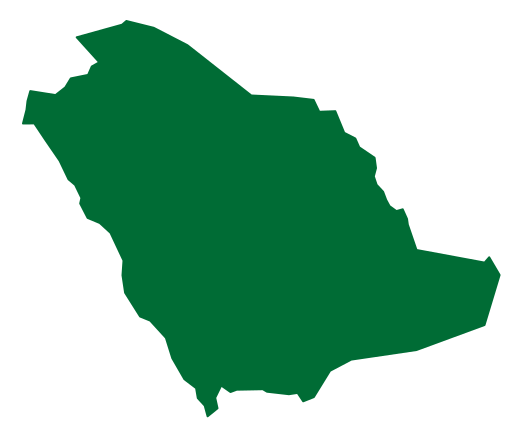
The Great Nafud Desert is a vast sand sea in the north of the Kingdom of Saudi Arabia, with wide parts extending within the Imam Turki bin Abdullah Royal Reserve [1]. It covers an area of about 65,000 km², equivalent to nearly 3.2% of the Kingdom's land area [1].
The desert stretches more than 350 km from east to west and about 225 km from north to south, and is among the best-known landmarks of the northern Arabian Peninsula [1][2].
Location and Extent
The Great Nafud Desert lies in the north of the Kingdom of Saudi Arabia, and its sand ridges run south of Rafha Governorate in the Northern Borders Province, forming striking natural scenery [3].
The desert occupies a prominent position within the Imam Turki bin Abdullah Royal Reserve in the north-east of the Kingdom [1].
Naming
The Great Nafud Desert was known in the past as the Sands of Alij, and takes the name Nafud from the density of its dunes, which give it a rich and distinctive environment [2].
The sands of Alij formed a barrier that made it hard for those outside to reach the Al-Jabalayn area, giving rise to the old saying, 'Between me and you lie the sands of Alij' [2].
Dune Forms
The Great Nafud Desert contains every form of sand dune, combining linear, crescent-shaped and dome-like dunes with large star dunes and undulating complex dunes [1].
Notable Landmarks
Among the desert's prominent landmarks is Jabal Al-Ulaym, located within the Imam Turki bin Abdullah Royal Reserve. It rises about 60 metres above ground level and is formed of ferruginous sandstone and rocky boulders shaped by erosion, and it is known as the 'Sheikh of the Great Nafud' [4].
Nafud Al-Ashyakh lies about 130 km south-west of Rafha Governorate and holds the highest sand peak in the Ad-Dahna Desert, rising 779 metres above sea level at the meeting point of the Dahna sands and the Great Nafud [5].
Reserves and Wildlife
Wide parts of the Great Nafud Desert fall within the Imam Turki bin Abdullah Royal Reserve [1]. Alongside it, the King Salman bin Abdulaziz Royal Reserve is the largest in the Middle East, covering more than 130,000 km². It extends across four administrative regions — Al-Jouf Province, Ha'il Province and Tabuk Province together with the Northern Borders Province — and includes UNESCO-listed antiquities in the Jubbah area [6].
In November 2022, the King Salman bin Abdulaziz Royal Reserve Development Authority registered the reserve in the World Database on Protected Areas, making it the first Saudi royal reserve to be listed there [6].
To support wildlife reintroduction, the authority released 65 sand gazelles in the Al-Khunfah Reserve in January 2022, after releasing 100 gazelles in early 2021 [7].
Rock Art at Jubbah
The southern part of the Great Nafud Desert contains the Rock Art of the Hail Region site, which was inscribed on the UNESCO World Heritage List in 2015 under criteria (i) and (iii), with an area of 2,043.8 hectares [8].
The site includes Jabal Umm Sinman at Jubbah, about 90 km north-west of the city of Hail, along with the Jabal al-Manjor and Raat at Shuwaymis; Jubbah once overlooked a freshwater lake that has since disappeared [8].
The Saudi Commission for Tourism and Antiquities worked with the Jubbah Municipality in the Hail region on a project to develop the historic village of Jubbah through a partnership approach. It included restoring the Grand Mosque and the archaeological site at Jabal Umm Sinman, and establishing a museum and visitor centre [9].
Western Travellers
Among the Western travellers who crossed the Great Nafud were the Finnish explorer Georg August Wallin, the first Western traveller to traverse it, and the English traveller Lady Anne Blunt, the first Western woman to cross it [1].
FAQ
Q: Where is the Great Nafud Desert located? A: It lies in the north of the Kingdom of Saudi Arabia and extends more than 350 km from east to west and about 225 km from north to south [1][2].
Q: How large is the Great Nafud Desert? A: It covers about 65,000 km², equivalent to nearly 3.2% of the Kingdom's land area [1].
Q: What are the most prominent landmarks of the Great Nafud Desert? A: They include Jabal Al-Ulaym, known as the 'Sheikh of the Great Nafud', and Nafud Al-Ashyakh, which holds the highest sand peak in the Ad-Dahna Desert where its sands meet the Nafud [4][5].
Q: Which reserves are most closely associated with the Great Nafud? A: Wide parts of it fall within the Imam Turki bin Abdullah Royal Reserve, and the King Salman bin Abdulaziz Royal Reserve is the largest in the Middle East, covering more than 130,000 km² [1][6].
Q: Does the Great Nafud Desert contain World Heritage sites? A: Yes. The Rock Art of the Hail Region lies in its southern part and was inscribed on the UNESCO World Heritage List in 2015 [8].
Conclusion
The Great Nafud Desert combines vast sand expanses and a diversity of dune forms with prominent landmarks such as Jabal Al-Ulaym and Nafud Al-Ashyakh, alongside royal reserves that protect wildlife and World Heritage sites at Jubbah [1][4][5][6][8].
A related topic on the platform is the Rub' al Khali Desert among the deserts of the Kingdom of Saudi Arabia.
Tourism and nature
- NatureDahna DesertThe Kingdom's third-largest desert, an arc of red sand about 1,200 km long linking the Great Nafud to the Rub al Khali across five regions.
- NatureRub al KhaliThe world's largest continuous sand sea, covering the Kingdom's south-east across the Eastern Province, Riyadh and Najran, named the 'Empty Quarter' for its lack of permanent settlement.
Related topics
- HistoricRock Art of HailThe Rock Art of Hail is a World Heritage property in the Hail Region of Saudi Arabia, inscribed on the UNESCO list in 2015, comprising the largest rock art complexes in the Arabian Peninsula with engravings spanning about 10,000 years.
- RegionHail RegionA north-central Saudi region administered from Hail, associated with the Aja and Salma mountains, the Nafud desert, historical caravan routes and varied regional activities.
- RegionNorthern Borders RegionA northern Saudi region administered from Arar, including Rafha, Turaif and Al Uwayqilah, with histories of pilgrimage routes, pastoral activity, Tapline settlement and mining.
- RegionJawf RegionA northern Saudi region administered from Sakaka, encompassing Dumat Al Jandal, Al Qurayyat and Tabarjal, with farming, historical landmarks and solar and wind energy projects.
- RegionTabuk RegionA northwestern Saudi region administered from Tabuk city, combining Red Sea and Gulf of Aqaba coasts with inland centres such as Tayma and a history of trade and pilgrimage routes.
Sources & references
- Saudi Press Agency (SPA): 'The Great Nafud, one of the most famous landmarks of the Arabian Peninsula, within the Imam Turki bin Abdullah Royal Reserve'
- Saudi Press Agency (SPA): 'Alij, one of the landmarks of the Imam Turki bin Abdullah Royal Reserve'
- Saudi Press Agency (SPA): 'The Great Nafud: a captivating sand scene south of Rafha'
- Saudi Press Agency (SPA): 'Sheikh of the Great Nafud, a prominent landmark in the Imam Turki bin Abdullah Royal Reserve'
- Saudi Press Agency (SPA): 'Nafud Al-Ashyakh: the highest sand peak, where the Dahna sands meet the Great Nafud'
- Saudi Press Agency (SPA): 'The King Salman bin Abdulaziz Royal Reserve joins the World Database on Protected Areas'
- Saudi Press Agency (SPA): 'The King Salman bin Abdulaziz Reserve reintroduces sixty-five gazelles in the Al-Khunfah Reserve'
- UNESCO — World Heritage Centre: 'Rock Art of the Hail Region'
- Saudi Press Agency (SPA): 'The historic village of Jubbah: a development project'