
Overview
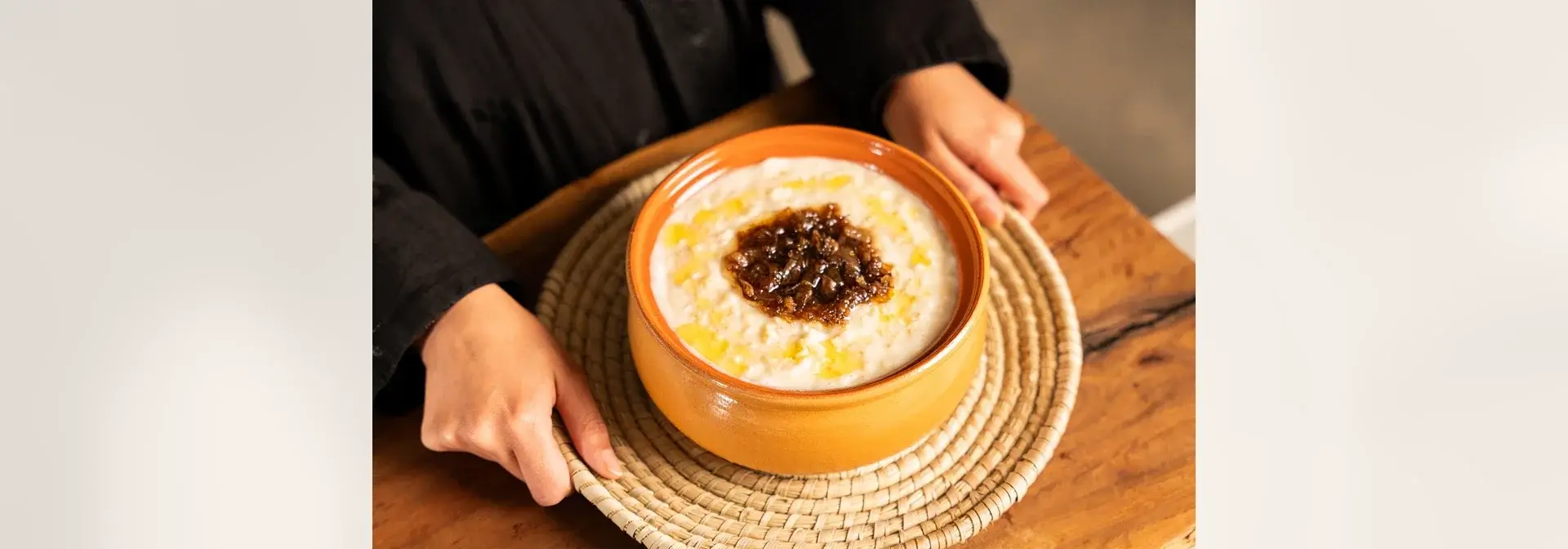
Jareesh is a traditional Saudi dish that the Culinary Arts Commission designated the national dish of the Kingdom of Saudi Arabia, followed by Maqshush as the national Saudi sweet. [1]
Jareesh is among the most prominent traditional Saudi dishes and the most frequently present at social occasions, and it is popular in several regions of the Kingdom, where it is known as 'the master of dishes'. [1][3]
Designation of the National Dish and the Initiative
The Culinary Arts Commission designated Jareesh the national dish of the Kingdom of Saudi Arabia and Maqshush the national sweet, alongside the launch of the 'Narratives of National Dishes and Regional Dishes' initiative on 18 Jumada al-Akhirah 1444 AH, corresponding to 11 January 2023 CE. [1]
The initiative seeks to inventory and classify the well-known local dishes closely tied to Saudi identity across all regions of the Kingdom, in appreciation and celebration of Saudi cuisine and its distinct character. [1]
The initiative is part of the Commission's efforts to meet the objectives of the Ministry of Culture in advancing the Saudi cultural sector, in line with the cultural, social and developmental goals of Saudi Vision 2030. [1]
The scope of the initiative extended to the thirteen regions of the Kingdom, through which the dishes tied to Saudi cultural identity were identified, to celebrate them, document their recipes and promote them through competitive programmes and incentives for making use of the ingredients of the Saudi dish. [1]
Name, Ingredients and Preparation
The name Jareesh derives from the use of wheat or groat grains that are crushed, that is, ground coarsely or pounded to a texture that is not fine rather than fully milled. [6]
Jareesh is made from whole (intact) durum wheat grains that are hulled and unboiled: it is soaked overnight, then onions are cooked in fat (suet), to which the Jareesh and broth, or water when broth is unavailable, are added. [6]
The cooking pot is left over the fire for two hours, after which laban and cumin are added to give it the appropriate flavour and taste, and it is then served at the table. [6]
Its Place on the Saudi Table
Jareesh was chosen as the national dish because it is a staple in Saudi society and has been widespread across the Kingdom since ancient times. [1]
It is mentioned in books of Arab heritage where reference is made to the women of the Arabian Peninsula grinding wheat by hand with the 'coarse grinder' that crushes the grains. [1]
Jareesh is prepared on various social occasions and served with different recipes, in keeping with the diversity of the Saudi table in its breadth and richness. [3]
Jareesh and Maqshush are part of the fabric of national history, and both were mentioned by many travellers, geographers and orientalists during their journeys across the Arabian Peninsula. [5]
Maqshush: The National Sweet
Maqshush is among the dishes widely spread in parts of the Kingdom, and it has a historical mention in the period from 1238 to 1309 AH, corresponding to 1823 to 1891 CE, when it was recorded as one of the traditional and favoured foods of central Arabia. [1]
Maqshush consists of small loaves of wheat flour scraped off the griddle. [1]
The Dishes of the Thirteen Regions
The 'Narratives of National Dishes and Regional Dishes' initiative resulted in the selection of Jareesh as the national dish and Maqshush as the national sweet, along with the designation of 13 dishes for the regions of the Kingdom. [7]
The regional dishes designated were: Marqooq for Riyadh, Saleeg for Makkah, Madini rice for Madinah, Hasawi rice for the Eastern Region, Sayadiyah for Tabuk, Haneeth for Asir, Malehiyah for the Northern Borders, Kleija for Qassim, Maqana for Al-Bahah, Raqsh for Najran, Maghsh for Jazan, Kubaybah for Hail, and Bakilah for Al-Jawf. [7]
The Travelling Exhibition and Its Stations
The Culinary Arts Commission organised a travelling exhibition on the national Saudi dish and the national Saudi sweet, launched at the end of November 2023 and running for seven months, to tour the regions of the Kingdom and including an interactive display on Jareesh and Maqshush. [2]
The travelling exhibition began its journey across the regions of the Kingdom from the city of Riyadh, then moved to the Makkah region and on to Madinah. [5]
At its station in the city of Sakaka, in Al-Nakheel Park in the Al-Jawf region, the exhibition presented a detailed display of the ingredients of the dishes and their methods of preparation through visual shows, along with the tools used in preparing them in the past and the present. [3]
The Commission's caravan reached the Northern Borders region, where the exhibition, at its station in the city of Arar, introduced the national dishes Jareesh and Maqshush, their ingredients and their methods of preparation. [4]
At its tenth station, in the Najran region, the exhibition drew a notable turnout of the residents of the region and its visitors, during the period from 16 to 20 April 2024 at King Fahd National Park in the 'Siqam' forest. [5][6]
Cultural and Economic Value
In its varied categories, Saudi cuisine carries cultural, heritage and historical value drawn from the geographical location of each region and the resources and dietary diversity it enjoys. [8]
These dishes help support the local economy through investment in them and their circulation among the various local and international groups, as one of the facets of the cultural heritage of the regions of the Kingdom. [8]
Frequently Asked Questions
Q: What is Jareesh? A: A traditional Saudi dish made from crushed wheat, designated the national dish of the Kingdom of Saudi Arabia and known as 'the master of dishes'. [1]
Q: When was Jareesh designated the national dish? A: On 18 Jumada al-Akhirah 1444 AH, corresponding to 11 January 2023 CE, within the 'Narratives of National Dishes and Regional Dishes' initiative. [1]
Q: What is Jareesh made from and how is it prepared? A: From whole, hulled and unboiled durum wheat grains, soaked overnight and then cooked with onion and broth for about two hours, with laban and cumin added. [6]
Q: What is the national Saudi sweet? A: Maqshush, which consists of small loaves of wheat flour scraped off the griddle. [1]
Q: How did the travelling exhibition introduce Jareesh? A: Through a detailed display of the ingredients of the dish, its methods of preparation and the tools used in the past and the present, at stations that toured the regions of the Kingdom. [3]
Related topics
- HistoricHareesHarees is a popular traditional dish made from wheat grain, meat and ghee, present in Saudi Arabia, the United Arab Emirates and Oman, where it appears in folk stories, sayings and poetry; preparing and serving it is a sign of hospitality and generosity, and it was inscribed in 2023 on the Representative List of the Intangible Cultural Heritage of Humanity.
- HistoricKabsaKabsa is a traditional Saudi dish and one of the popular foods of the Kingdom of Saudi Arabia, known across the Gulf Cooperation Council states as machboos and in Al-Ahsa Governorate as majboos. It has been adopted by George Mason University in the United States on the menu of its international restaurant, and it appears at heritage festivals and events inside the Kingdom and beyond.
- Hospitality, food and drinkArabic Coffee in Saudi ArabiaArabic coffee in Saudi Arabia brings together preparation and hospitality, with roast levels, flavourings and customs varying among regions and households.
- National visions and programmesSaudi Vision 2030: A Framework for TransformationAn introduction to Saudi Vision 2030, its social, economic and institutional themes, and the relationship between implementation programmes, long-term targets and measured results.
- TopicNational Culture StrategyThe National Culture Strategy is a national strategy approved by the Council of Ministers on 27 March 2019 to organise and develop the cultural sector in the Kingdom of Saudi Arabia. It rests on three pillars — culture as a way of life, culture for economic growth, and culture for enhancing the Kingdom's international standing — and covers the sixteen cultural sectors within the framework of Saudi Vision 2030.
- RegionNajran RegionA southern Saudi region administered from Najran, extending from settled wadis towards the Empty Quarter and containing Al Ukhdud, Hima and traditions of local architecture and crafts.
- RegionJawf RegionA northern Saudi region administered from Sakaka, encompassing Dumat Al Jandal, Al Qurayyat and Tabarjal, with farming, historical landmarks and solar and wind energy projects.
- RegionNorthern Borders RegionA northern Saudi region administered from Arar, including Rafha, Turaif and Al Uwayqilah, with histories of pilgrimage routes, pastoral activity, Tapline settlement and mining.
Sources & references
- Saudi Press Agency (SPA): 'The Culinary Arts Commission launches the Narratives of National Dishes and Regional Dishes initiative'
- Saudi Press Agency (SPA): 'The Culinary Arts Commission organises a travelling exhibition on the national dish and the national sweet'
- Saudi Press Agency (SPA): 'The exhibition of the national dish and the national sweet at its station in Sakaka'
- Saudi Press Agency (SPA): 'The caravan of the travelling culinary exhibition arrives in the Northern Borders region'
- Saudi Press Agency (SPA): 'The exhibition of the national dish and the national sweet at its station in Najran'
- Saudi Press Agency (SPA): 'A notable turnout for the travelling exhibition at its tenth station in Najran'
- Saudi Press Agency (SPA): 'The thirteen regional dishes within the Narratives of National Dishes initiative'
- Saudi Press Agency (SPA): 'The cultural and economic value of Saudi cuisine'