
Overview
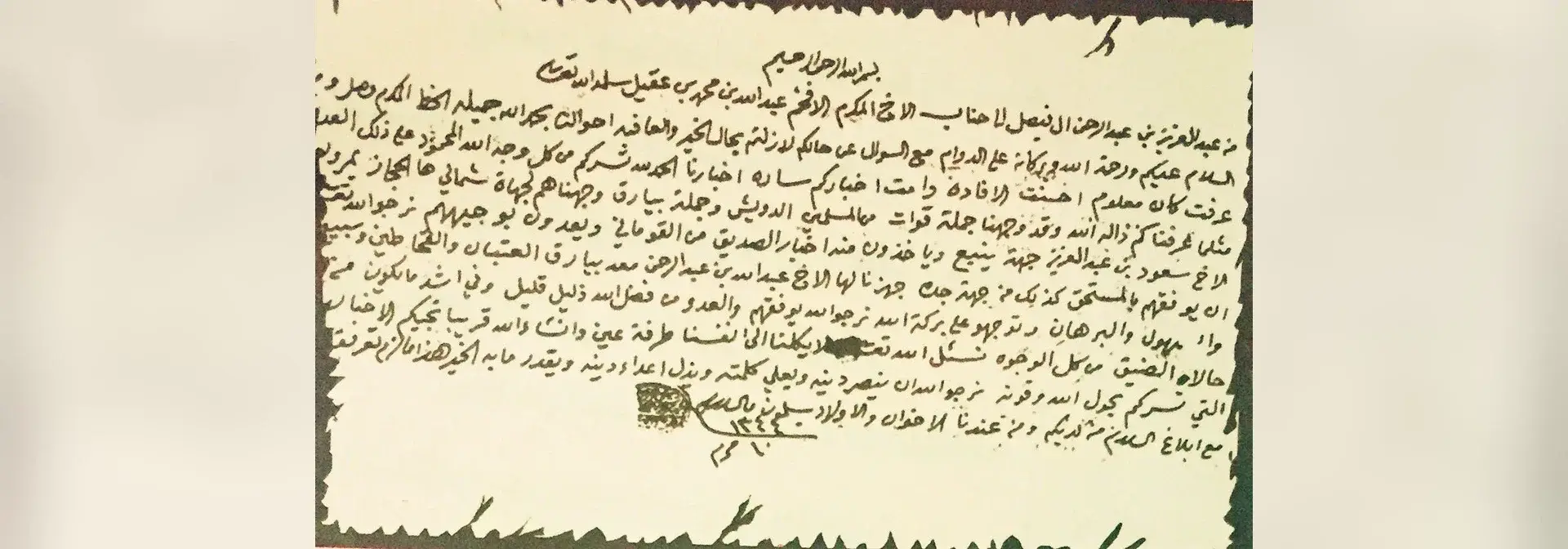
The Conquest of Hejaz is a stage in the unification of the Kingdom of Saudi Arabia, in which King Abdulaziz bin Abdulrahman Al Saud set out from Riyadh to Hejaz in 1343 AH, declaring publicly that he was travelling to Makkah to lift grievances and to apply the rulings of Sharia.[1]
This stage was not a separate event from the course of unification, but a link that joined Nejd to Hejaz in a single state, and it added to the state the responsibility of serving the Two Holy Mosques and organising the affairs of the Hajj and the pilgrims.[1][4]
After Hejaz joined the state, King Abdulaziz's title became "King of Hejaz and Sultan of Nejd and its Dependencies", and later Royal Decree No. (2716) was issued, changing the name of the state to "the Kingdom of Saudi Arabia".[1][8]
The milestones of this stage unfolded over successive years: the Bahra negotiations in the autumn of 1925, then international recognition on 16 February 1926, then the Treaty of Jeddah in 1927, leading up to Royal Decree No. (2716) in 1351 AH.[1][2][3][7]
Departure to Hejaz
King Abdulaziz headed from Riyadh to Hejaz in 1343 AH, announcing to the people that his destination was Makkah, to lift the grievances that had burdened the worshippers and to extend and uphold the rulings of Sharia.[1]
This declaration carried a double meaning, for it set out the objective before public opinion and defined the nature of the coming stage as a transition to a new responsibility in the holiest place on earth.[1]
This march was tied to the course of unification that King Abdulaziz had begun from Riyadh, as the Hejazi stage combined the political dimension of annexing the region with the religious dimension of establishing the rulings of Sharia in the Holy Land.[1]
The effect of this stage on the structure of the state was that it widened its geographical scope and brought it into a circle of regional and international relations, including those connected with the Makkah region and its affairs.[2][3]
Entry into Makkah
King Abdulaziz entered Makkah in a state of ihram, reciting the Talbiyah and the takbir, after ordering his soldiers to lower their weapons and proceed to the Kaaba in humility.[1]
This scene gave the entry a devotional character rather than a mere transfer of authority, as it was joined to a state of ihram, the Talbiyah and the takbir, and to the restraint of the armed force in the presence of the Sacred House.[1]
This arrangement is understood in the context of the state's care to present itself as responsible for the Holy Mosque, its people and its visitors, a matter later reinforced by the measures of restoration and organisation in the Holy Mosque.[1][4]
The New Title and the Organisation of Hejaz Affairs
After Hejaz joined the state, King Abdulaziz's title became "King of Hejaz and Sultan of Nejd and its Dependencies".[1]
This title reflects the new composition of the state, which joined two regions with different histories and administrative arrangements, so that a title was framed combining the sultanate of Nejd and the kingship of Hejaz at one and the same time.[1]
At the administrative level, the accession of Hejaz obliged the state to organise the affairs of the pilgrims and the public facilities in Makkah and Madinah, responsibilities different from the administration of the region of Nejd.[1][4]
The Bahra Negotiations and the Position on Foreign Privileges
In the Bahra negotiations in the autumn of 1925, King Abdulaziz set out to Gilbert Clayton his views on the northern borders of Nejd and expressed his wish to review British–Saudi relations.[2]
He stood firm against the British demands concerning foreign privileges, and in 1926 Britain decided not to raise the matter with him, while he affirmed that there is no law in the Holy Land but the Sharia.[2]
This position set a clear framework for arranging the relationship between the state and the interests of foreign powers in Hejaz, by tying the legal reference in the Holy Land to Islamic Sharia.[2]
The annexation of Hejaz also increased Britain's concerns, and it sent Clayton to reach the Treaty of Hadda.[5]
International Recognition and Regional Relations
On 16 February 1926, the Soviet Union recognised the Saudi state and recognised King Abdulaziz as King of Hejaz and Sultan of Nejd and its Dependencies.[3]
This came amid political shifts in the region, including Sharif Hussein's declaration in 1924 that he had assumed the Islamic Caliphate that had been abolished in Turkey.[3]
The Treaty of Jeddah of 1927 had a significant effect in consolidating relations with the ruler of Bahrain and the other rulers of the Gulf emirates.[7]
This course marks the state's move from the regional circle to the circle of international recognition, and the consolidation of its position in the network of Arab and regional relations.[3][7]
Restoration of the Holy Mosque in Makkah and the Mas'a
As soon as conditions in Hejaz had settled in 1344 AH/1925, King Abdulaziz moved to carry out the necessary restorations and repairs in the Holy Mosque.[4]
In 1345 AH the committee recommended that the floor of the Mas'a be paved with square flint stone and coated with lime, and the work was completed at the end of Dhu al-Qi'dah of the same year, corresponding to 1927.[4]
These works represent a practical priority in the management of the Two Holy Mosques, as they relate directly to the comfort of the worshippers and those performing tawaf and to the safety of the facilities in the seasons of Hajj and Umrah.[4]
The Kaaba Covering
On one of the pieces of the Kaaba covering made in Makkah in 1349 AH, the following was inscribed: "King Abdulaziz bin Abdulrahman Al Faisal Al Saud, King of Hejaz and Nejd and its Dependencies".[10]
This inscription shows the continuity of Saudi care for the covering as one of the affairs of the Holy Mosque, and the association of the King's name with it in a record written on a piece of the Kaaba covering.[10]
The Hejaz Railway
The Hejaz Railway, which ran from Damascus to Madinah, was destroyed during the events of the Arab Revolt in 1334 AH/1915.[6]
The Saudi state's efforts to revive the line extended between 1344 and 1402 AH, corresponding to 1925 and 1982.[6]
These efforts point to the value of the line in linking Hejaz with the rest of the region and to its role in transporting pilgrims and travellers, which made its revival a recurring subject in the state's policies after the accession of Hejaz.[6]
The Official Gazette
King Abdulaziz ordered the founding of an official newspaper after his entry into Makkah, and its first issue appeared on 15 Jumada al-Awwal 1343 AH, corresponding to 12 December 1924.[9]
Its founding came early in the administration of Hejaz, reflecting the state's direction towards organising official media and publishing news and regulations at a transitional stage full of changes.[9]
Renaming the State and the National Day
On 17 Jumada al-Awwal, Royal Decree No. (2716) was issued, changing the name "the Kingdom of Hejaz and Nejd and its Dependencies" to "the Kingdom of Saudi Arabia", and choosing Thursday 21 Jumada al-Awwal 1351 AH, corresponding to the first day of Mizan, as a national day for the proclamation of the unification of the Kingdom.[1]
Article One of Royal Decree No. (2716), dated 1351/5/17 AH, provided that the King's title should become "King of the Kingdom of Saudi Arabia".[8]
This change marks the end of the stage of the conquest and the proclamation of the state under its new name, after Hejaz, Nejd and their dependencies had become a single entity, and the name of King Abdulaziz is linked to this transition.[1][8]
Related people
Frequently Asked Questions
Q: What is meant by the Conquest of Hejaz? A: It is a stage in the unification of the Kingdom of Saudi Arabia, in which King Abdulaziz set out from Riyadh to Hejaz in 1343 AH, declaring that he was travelling to Makkah to lift grievances and apply the rulings of Sharia.
Q: How did King Abdulaziz enter Makkah? A: He entered it in a state of ihram, reciting the Talbiyah and the takbir, after ordering his soldiers to lower their weapons and proceed to the Kaaba in humility.
Q: What title did King Abdulaziz bear after Hejaz joined the state? A: "King of Hejaz and Sultan of Nejd and its Dependencies".
Q: When did the state take its current name? A: By virtue of Royal Decree No. (2716) issued on 17 Jumada al-Awwal 1351 AH, which changed the name "the Kingdom of Hejaz and Nejd and its Dependencies" to "the Kingdom of Saudi Arabia".
Q: What were the most prominent restorations in the Holy Mosque in Makkah after the Conquest of Hejaz? A: The restorations and repairs that began in 1344 AH/1925, and the paving of the floor of the Mas'a with square flint stone coated with lime, which was completed at the end of Dhu al-Qi'dah 1345 AH/1927.
Conclusion
The Conquest of Hejaz brought Nejd and Hejaz together in a single state, and afterwards King Abdulaziz bore the title "King of Hejaz and Sultan of Nejd and its Dependencies", before the name of the state was changed to "the Kingdom of Saudi Arabia" by virtue of Royal Decree No. (2716).[1][8]
Related topics on the platform are the annexation of Makkah, the unification of the Kingdom of Saudi Arabia, and the history of Makkah.[1]
Related topics
- EventConquest of MakkahThe Conquest of Makkah is one of the campaigns of the Messenger of Allah, peace be upon him, hastened by the violation by the polytheists of Quraysh of the terms of the Treaty of Al-Hudaybiyah two years after it was concluded. A number of sites and landmarks in Makkah are associated with it, among them Wadi Tawa, Al-Rayah Mosque, Al-Fath Mosque in Al-Jumum and Al-Ji'ranah Mosque.
- EventUnification of Saudi ArabiaKing Abdulaziz's path from the recovery of Riyadh in 1902 to the proclamation of the Kingdom of Saudi Arabia on 23 September 1932, now National Day.
- EventKingdom of HejazThe Kingdom of Hejaz is an official name borne by the Saudi State at a stage of its formation after the annexation of the Hejaz, and it is associated with the successive titles of King Abdulaziz bin Abdulrahman bin Faisal Al Saud up to the naming of the Kingdom of Saudi Arabia in 1351 AH/1932.
- EventHejaz RailwayThe Hejaz Railway is a railway line ordered to be built in March 1900, with work beginning in 1900, to link the Muslims of the northern Arabian Peninsula with the Holy Places; it runs from Damascus station to Madinah station. The first train reached Madinah on 22 Rajab 1326 AH, corresponding to 23 August 1908, and the line operated for about nine years. The Kingdom of Saudi Arabia today preserves its station, its museum and its antiquities in the Tabuk and Madinah regions.
- EventTreaty of Jeddah (1927)The Treaty of Jeddah is an agreement signed in 1927 between King Abdulaziz bin Abdulrahman Al Saud and Britain. In it Britain recognized Abdulaziz as King of the Hijaz and Najd, affirmed his right to conclude treaties with other states, and brought the Treaty of Darin to an end.
- HistoricThe Grand Mosque (Al-Masjid Al-Haram)The Grand Mosque (Al-Masjid Al-Haram) is the mosque at the centre of which stands the Kaaba in Makkah, and successive states and restorations followed upon its construction across the ages. In the Saudi era it witnessed major expansions and construction works, most notably the Third Saudi Expansion and the raising of the capacity of the Mataf and the courtyards.
- EventHistory of MakkahThe history of Makkah is a continuous record from the age of Ibrahim, peace be upon him, and the building of the Holy Kaaba to the Saudi era, embracing antiquities, landmarks, scholars, endowments and services for pilgrims. Its events are spread across the Mamluk era and the Ottoman period, then the educational and regulatory renaissance in the Kingdom of Saudi Arabia.
- RegionMakkah RegionA western Saudi region administered from Makkah, encompassing Jeddah, Taif and other governorates, where pilgrimage, maritime trade, coastal landscapes and uplands meet.
Sources & references
- Darah Journal (King Abdulaziz Foundation), a study on the departure of King Abdulaziz to Hejaz, his entry into Makkah, his title after the accession of Hejaz and Royal Decree No. (2716)
- Darah Journal (King Abdulaziz Foundation), a study on the Bahra negotiations and the question of foreign privileges
- Darah Journal (King Abdulaziz Foundation), a study on Soviet recognition and the declaration of the Islamic Caliphate
- Darah Journal (King Abdulaziz Foundation), a study on the restorations of the Holy Mosque in Makkah and the paving of the Mas'a
- Darah Journal (King Abdulaziz Foundation), a study on the Treaty of Hadda
- Darah Journal (King Abdulaziz Foundation), a study on the Hejaz Railway and the attempts to revive it
- Darah Journal (King Abdulaziz Foundation), a study on the Treaty of Jeddah of 1927 and its effect on relations with the Gulf
- Umm Al-Qura newspaper — the official Saudi gazette, on the text of Royal Decree No. (2716)
- Umm Al-Qura newspaper — the official Saudi gazette, on the founding of the official newspaper
- Umm Al-Qura newspaper — the official Saudi gazette, on the King's title inscribed on the Kaaba covering