
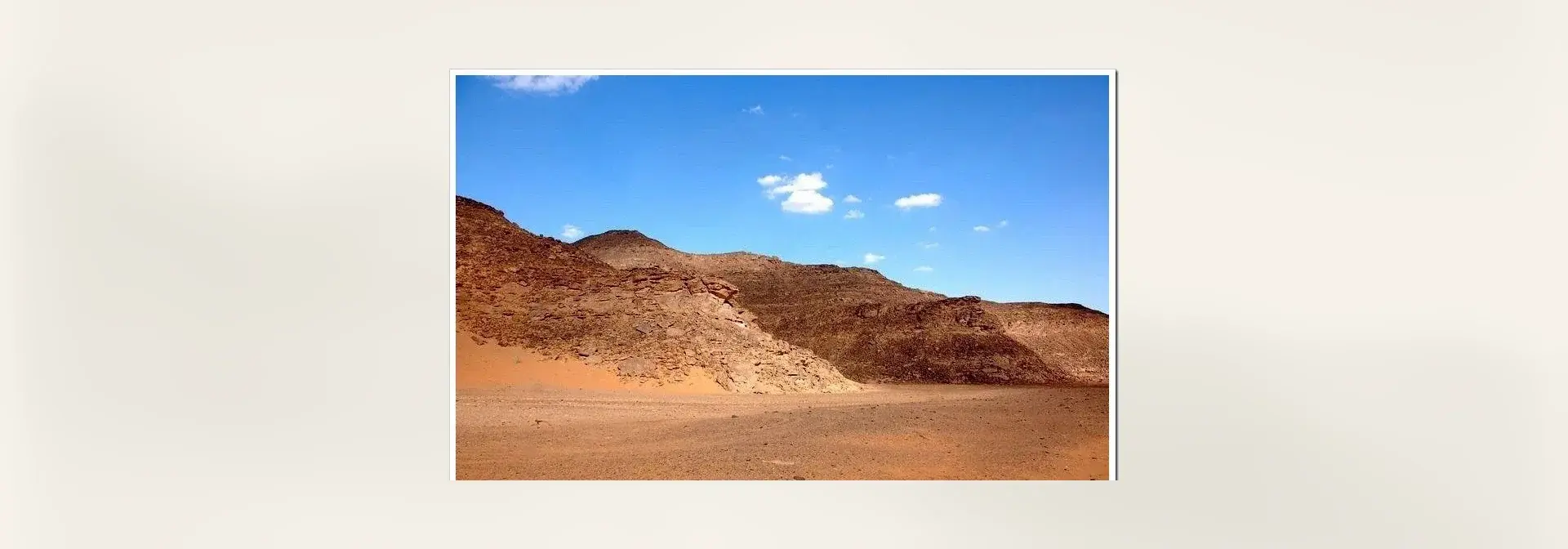
Overview
Al-Tubayq Reserve is a nature reserve in north-western Saudi Arabia on the border of the Hashemite Kingdom of Jordan, with an area of 12,200 square kilometers.[1]
It lies within the boundaries of King Salman bin Abdulaziz Royal Reserve, and is marked by the ruggedness of its terrain and by the wildlife and vegetation it contains.[1][2]
National efforts are under way to resettle wildlife species, rehabilitate the vegetation cover and organise ecotourism.[3][4][5]
Location and Area
Al-Tubayq Reserve lies in the north-west of the Kingdom on the border of the Hashemite Kingdom of Jordan, and its area is 12,200 square kilometers.[1]
It falls within the boundaries of King Salman bin Abdulaziz Royal Reserve, whose area is 130,700 square kilometers and which is the fourth-largest terrestrial reserve in the world.[2]
Terrain and Vegetation
Al-Tubayq Reserve is highly rugged; the Al-Tubayq mountains lie in its western and central parts and rise to 1,388 meters.[1]
Talh and Awsaj trees and some shrubs and grasses are abundant in the reserve's valleys.[1]
Its vegetation cover is limited and work is under way to rehabilitate it, as the planting of 500,000 saplings has begun, of which 100,000 saplings are in Al-Tubayq.[4]
Wildlife
The ibex is among the reserve's most important animals, and it has small numbers of gazelle, wolves, foxes and hares, in addition to species of reptiles and resident and migratory birds.[1]
A monitoring camera in the Al-Tubayq area recorded scenes of wildlife diversity and interaction, documenting the passage of two Reem gazelles, a female and her young, around a nest, and the use by a griffon vulture of a talh tree holding a nest as a night roost.[7]
Resettlement of Wildlife Species
50 Arabian oryx, 100 Reem gazelles and 20 mountain ibex were released at different sites in Al-Tubayq Reserve.[3]
These efforts culminated in the birth of the first Arabian oryx on the reserve's land for the first time after an interruption lasting 90 years.[3]
Administrative Organisation
Al-Tubayq Reserve forms one of three natural areas lying within the boundaries of King Salman bin Abdulaziz Royal Reserve, alongside Al-Khunfah and Harrat al-Harrah.[2]
The King Salman bin Abdulaziz Royal Reserve Development Authority granted the owners of stray animals spread across the Al-Tubayq area a two-week deadline to remove them, through an entry permit issued by the Authority's centre (Al-Mulaysa') in Al-Tubayq.[6]
International Recognition
Ecotourism
The King Salman bin Abdulaziz Royal Reserve Development Authority held the first astrotourism event in Al-Tubayq, to observe the conjunction of the Moon and Jupiter.[2]
The first edition of the “Makshat Al-Tubayq” event was launched on 23 February 2023 in the Tabuk region; it features safari adventures and mountain climbing and is held from Thursday to Saturday every week.[5]
Frequently Asked Questions
Q: Where is Al-Tubayq Reserve located? A: In north-western Saudi Arabia on the border of the Hashemite Kingdom of Jordan.[1]
Q: What is the area of Al-Tubayq Reserve? A: 12,200 square kilometers, and it is one of three natural areas within King Salman bin Abdulaziz Royal Reserve.[1][2]
Q: What are the most important animals in Al-Tubayq Reserve? A: The ibex is among the most important, with small numbers of gazelle, wolves, foxes and hares, and of reptiles and resident and migratory birds.[1]
Q: What resettlement efforts are under way in the reserve? A: 50 Arabian oryx, 100 Reem gazelles and 20 mountain ibex were released, and the first Arabian oryx was born on its land for the first time after an interruption lasting 90 years.[3]
Q: Are tourism events held in Al-Tubayq? A: The first astrotourism event was organised in Al-Tubayq, and the “Makshat Al-Tubayq” event was launched on 23 February 2023, featuring safari adventures and mountain climbing.[2][5]
Related topics
- HistoricKing Salman bin Abdulaziz Royal Nature ReserveKing Salman bin Abdulaziz Royal Nature Reserve is a royal nature reserve in the northwest of the Kingdom of Saudi Arabia and the largest reserve in the Middle East, with a total area of 130,700 square kilometres extending across four administrative regions. It contains broad biodiversity and rock art sites inscribed on the UNESCO World Heritage List.
- HistoricHarrat Al-Harrah ReserveHarrat Al-Harrah Reserve is a high-conservation natural area in northwestern Saudi Arabia, extending across the Northern Borders and Al-Jawf regions within the boundaries of the King Salman bin Abdulaziz Royal Reserve. It features a volcanic plateau and plant and wildlife diversity, and is the first reserve established by the Saudi Wildlife Authority.
- HistoricArabian OryxThe Arabian Oryx, also known as the wadhi oryx, is a species of wild mammal and the largest wild mammal in the Arabian Peninsula. It was absent from its natural habitat in northern Saudi Arabia for about ninety years, then was resettled in protected reserves and released in Uruq Bani Ma'arid Reserve and King Salman bin Abdulaziz Royal Reserve.
- HistoricArabian GazelleThe Arabian Gazelle is among the wildlife species that receive sustained protection in the Kingdom of Saudi Arabia through extensive nature reserves, breeding programmes and reintroduction into natural habitats. Imam Turki bin Abdullah Royal Reserve recorded three newborn Arabian Gazelles in the At-Taysiyah area during the second quarter of 2026.
- HistoricMountain IbexThe Mountain Ibex, known in the Kingdom of Saudi Arabia as the Nubian Ibex, is a wild mountain animal and a symbol of the Kingdom's wildlife. The National Center for Wildlife works to breed and reintroduce it in reserves and national parks under the National Program for the Release and Reintroduction of Endangered Wild Animals.
- RegionTabuk RegionA northwestern Saudi region administered from Tabuk city, combining Red Sea and Gulf of Aqaba coasts with inland centres such as Tayma and a history of trade and pilgrimage routes.
- HistoricVegetation Cover in Saudi ArabiaVegetation Cover in Saudi Arabia is the total of the native plant species and the varied ecological regions across the Kingdom, whose sites are developed, protected and monitored and whose degraded parts are rehabilitated through national programmes for afforestation, combating desertification and land rehabilitation.
- HistoricWildlife of Saudi ArabiaWildlife in Saudi Arabia is a system of desert, sandy, valley, and plateau environments that shelter hundreds of species of mammals, birds, reptiles, and wild plants.[1][2] Nature reserves work to protect and develop it and to reintroduce endangered species into their habitats.[1][3]
- HistoricNafud Al-Urayq ReserveNafud Al-Urayq Reserve is a natural reserve lying within Al-Zahiriya Center in Dariyah Governorate, Qassim Region, and its surroundings connect to Ad-Dasah Forest and Al-Ghada Forest, which form a natural recreation ground for the residents of the region. The body responsible for the protected areas of the Kingdom administers and supervises it, within national targets for the royal reserves that support the protection of 30% of terrestrial and marine areas by 2030.
Sources & references
- Saudi Press Agency (SPA) — “National Commission for Wildlife Conservation and Development: Al-Tubayq Reserve”
- Saudi Press Agency (SPA) — “King Salman bin Abdulaziz Royal Reserve”
- Saudi Press Agency (SPA) — “Release of 50 Arabian oryx and 100 Reem gazelles in Al-Tubayq Reserve”
- Saudi Press Agency (SPA) — “Start of the planting of 500,000 saplings in King Salman bin Abdulaziz Royal Reserve”
- Saudi Press Agency (SPA) — “Launch of the Makshat Al-Tubayq event in its first edition in the Tabuk region”
- Saudi Press Agency (SPA) — “King Salman Reserve Development Authority grants owners of stray animals in the Al-Tubayq area a deadline”
- Saudi Press Agency (SPA) — “A monitoring camera observes wildlife diversity in the Al-Tubayq area”
- Saudi Press Agency (SPA) — “Registration of King Salman Reserve in the World Database on Protected Areas”
- Umm Al-Qura newspaper (Ministry of Media) — “King Salman bin Abdulaziz Royal Reserve Development Authority joins the international ‘Green List’”