
Overview
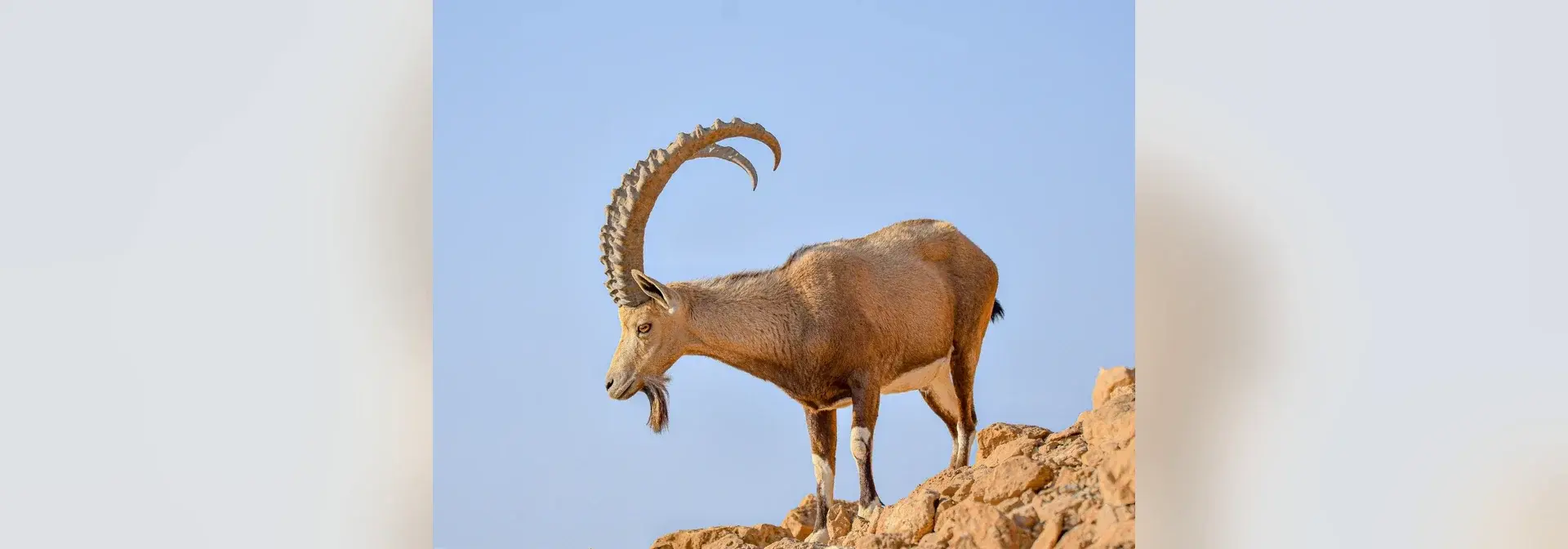
The Mountain Ibex is a wild mountain animal known in the Kingdom of Saudi Arabia as the Nubian Ibex. It is a symbol of the Kingdom's wildlife, distinguished by its ability to adapt to a range of environments and its important role in the ecosystem [2].
The Mountain Ibex is found in reserves and national parks across the Kingdom, where the National Center for Wildlife breeds and reintroduces it into its natural habitats under the National Program for the Release and Reintroduction of Endangered Wild Animals [1][2].
The Mountain Ibex and Wildlife in the Kingdom
Mountain Ibex are among the wild animals that symbolise wildlife in the Kingdom of Saudi Arabia. They play an important role in the ecosystem and can adapt to a variety of environments [2].
In Baljurashi National Park, the Mountain Ibex is one of the most attractive natural features of the Kingdom's mountainous regions, drawing residents and visitors alike to observe the animals in their natural surroundings [1].
The National Release and Reintroduction Program
The National Center for Wildlife implements the National Program for the Release and Reintroduction of Endangered Wild Animals in the Kingdom's reserves and national parks [2].
Programs to breed and reintroduce endangered wild species are part of the Saudi Green Initiative and fall within the National Environment Strategy, in line with the principles of sustainable development under Saudi Vision 2030 [3].
Breeding the Mountain Ibex in King Salman bin Abdulaziz Royal Reserve
The development authority of King Salman bin Abdulaziz Royal Reserve has reintroduced more than 81 Mountain Ibex across different parts of the reserve, and its field team recorded the birth of a Nubian Ibex in March 2025 [4].
The reserve has recorded more than 120 mammal births in the areas under its management, including the Arabian Oryx, the Reem gazelle, the ibex and the Arabian gazelle [4].
King Salman bin Abdulaziz Royal Reserve is the largest terrestrial nature reserve in the Middle East, covering 130,700 km² and overlapping four administrative regions: Al-Jawf, Hail, the Northern Borders and Tabuk [4].
Ibex in the Asir Highlands
Three ibex were born in the Red Rock area of King Abdullah National Park in Al-Sawda, following the release of 23 ibex into natural areas in cooperation with the National Center for Wildlife, which has helped the number of ibex grow inside the protected area [5].
The National Center for Wildlife had earlier released two mothers that gave birth to the newborn ibex in the Red Rock area, while the third mother, about two years old, was born in an enclosure before being released into the project area in February 2023 to give birth to her young in the park [5]. Al-Sawda Development Company monitors a group of nine ibex [5].
Releasing Ibex in the Parks of Al-Bahah Region
In Al-Bahah Region, His Royal Highness Prince Dr. Hussam bin Saud bin Abdulaziz, Governor of Al-Bahah Region, released a number of Mountain Ibex and eagles in Baljurashi National Park [2].
Baljurashi National Park is one of the largest parks under the Ministry of Environment, Water and Agriculture. It covers an estimated area of about 600,000 m², has a mountainous character, and attracts large numbers of residents and visitors who come to see the Mountain Ibex released there by the National Center for Wildlife to breed and reintroduce local endangered species into their natural habitats [1].
In Al-Shukran Park in Baljurashi, the National Center for Wildlife released six ibex in the presence of His Excellency the Minister of Environment, Water and Agriculture and Chairman of the Board of Directors of the National Center for Wildlife, Eng. Abdulrahman bin Abdulmohsen Al-Fadhli [3].
Tourism and nature
Protection of the Mountain Ibex and Penalties for Hunting Violations
Hunting the Mountain Ibex is a violation against an endangered wild species. The penalty is a SAR 60,000 fine, and where the violation is repeated within a single year, the Environment Law provides for a stricter penalty of up to ten years' imprisonment and a fine of up to SAR 30 million, or either of the two [6].
Hunting penalties in the Kingdom are graded: hunting the ibex carries a SAR 60,000 fine, hunting without a licence a SAR 10,000 fine, and hunting in areas where hunting is prohibited a SAR 5,000 fine [7].
Within Prince Mohammed bin Salman Royal Reserve, hunting wild ibex carries a SAR 60,000 fine and the use of firearms in hunting a SAR 80,000 fine [8]. The competent authorities in Ad-Da'ir Governorate in Jazan Region arrested a resident in possession of ibex and gazelles smuggled from outside the Kingdom, and handed the seized animals to the competent authority [9].
Frequently Asked Questions
Q: What is the Mountain Ibex? A: It is a wild mountain animal known in the Kingdom of Saudi Arabia as the Nubian Ibex. It is a symbol of the Kingdom's wildlife, distinguished by its ability to adapt to a range of environments and its important role in the ecosystem.
Q: Who implements the program to breed and reintroduce the Mountain Ibex? A: The National Center for Wildlife implements it under the National Program for the Release and Reintroduction of Endangered Wild Animals in the Kingdom's reserves and national parks.
Q: Where have Mountain Ibex been released in the Kingdom? A: In Baljurashi National Park and Al-Shukran Park in Al-Bahah Region, and in King Abdullah National Park in the Al-Sawda mountains of Asir Region, alongside their reintroduction in King Salman bin Abdulaziz Royal Reserve and Prince Mohammed bin Salman Royal Reserve.
Q: What is the penalty for hunting the Mountain Ibex? A: The fine is SAR 60,000. If the violation is repeated within one year, the penalty reaches up to ten years' imprisonment and a fine of up to SAR 30 million, or either of the two.
Q: How are ibex breeding efforts linked to the Saudi Green Initiative and Vision 2030? A: Breeding and reintroduction programs are part of the Saudi Green Initiative and fall within the National Environment Strategy, in line with the principles of sustainable development under Saudi Vision 2030.
Conclusion
The competent authorities in the Kingdom continue to breed and reintroduce the Mountain Ibex in reserves and national parks and to monitor its births, as part of the National Program for the Release and Reintroduction of Endangered Wild Animals [1][4]. Related topics on the platform include Ibex Reserve, Wildlife in Saudi Arabia and Arabian Oryx.
Related topics
- HistoricAl-Waol Ibex ReserveAl-Waol Ibex Reserve is a nature reserve in the Riyadh Region, supervised and managed by the National Center for Wildlife, located about 120 km south of Riyadh city within the Tuwaiq Mountains range. It was inscribed on 9 October 2024 in the Green List of the International Union for Conservation of Nature, becoming the first reserve in the Kingdom to meet its standards.
- HistoricKing Salman bin Abdulaziz Royal Nature ReserveKing Salman bin Abdulaziz Royal Nature Reserve is a royal nature reserve in the northwest of the Kingdom of Saudi Arabia and the largest reserve in the Middle East, with a total area of 130,700 square kilometres extending across four administrative regions. It contains broad biodiversity and rock art sites inscribed on the UNESCO World Heritage List.
- HistoricPrince Mohammed bin Salman Royal ReservePrince Mohammed bin Salman Royal Reserve is a royal reserve in the northwest of the Kingdom of Saudi Arabia. It extends over an area of 24,500 square kilometers and encompasses 15 ecosystems, containing more than 50% of the Kingdom's wildlife species. Established by royal decree and overseen by the Council of Royal Reserves chaired by His Royal Highness the Crown Prince and Prime Minister, it combines wildlife reintroduction, ecological tourism and biodiversity conservation.
- HistoricWildlife of Saudi ArabiaWildlife in Saudi Arabia is a system of desert, sandy, valley, and plateau environments that shelter hundreds of species of mammals, birds, reptiles, and wild plants.[1][2] Nature reserves work to protect and develop it and to reintroduce endangered species into their habitats.[1][3]
- HistoricArabian OryxThe Arabian Oryx, also known as the wadhi oryx, is a species of wild mammal and the largest wild mammal in the Arabian Peninsula. It was absent from its natural habitat in northern Saudi Arabia for about ninety years, then was resettled in protected reserves and released in Uruq Bani Ma'arid Reserve and King Salman bin Abdulaziz Royal Reserve.
- TopicSaudi Green InitiativeThe Saudi Green Initiative is a national initiative announced by His Royal Highness the Crown Prince and Prime Minister on 27 March 2021, charting the Kingdom's direction in protecting land and nature along a clear and ambitious roadmap. It targets the planting of 10 billion trees, the raising of protected areas to more than 30 percent, and the supply of 50 percent of electricity generation from renewable energy by 2030.
- National visions and programmesSaudi Vision 2030: A Framework for TransformationAn introduction to Saudi Vision 2030, its social, economic and institutional themes, and the relationship between implementation programmes, long-term targets and measured results.
- RegionBahah RegionA southwestern Saudi region administered from Al Bahah, combining Sarawat uplands and Tihamah, with historic villages, agricultural terraces and vegetation in its mountain landscapes.
- RegionJazan RegionA southwestern Saudi region administered from Jazan city, combining the Red Sea coast, Farasan Islands, plains and mountains with farming, fishing, commerce and industry.
Sources & references
- Saudi Press Agency (SPA) — Visitors flock to see Mountain Ibex in Baljurashi National Park
- Saudi Press Agency (SPA) — Release of Mountain Ibex and eagles in Baljurashi National Park
- Saudi Press Agency (SPA) — Release of 6 ibex in Al-Shukran Park, Baljurashi
- Saudi Press Agency (SPA) — Wildlife breeding efforts of King Salman bin Abdulaziz Royal Reserve
- Saudi Press Agency (SPA) — Birth of three ibex in King Abdullah National Park, Al-Sawda
- Saudi Press Agency (SPA) — Penalty for hunting the Mountain Ibex
- Saudi Press Agency (SPA) — Graded penalties for hunting violations
- Saudi Press Agency (SPA) — Hunting violations recorded in Prince Mohammed bin Salman Royal Reserve
- Saudi Press Agency (SPA) — Seizure of smuggled ibex and gazelles in Ad-Da'ir Governorate, Jazan Region