
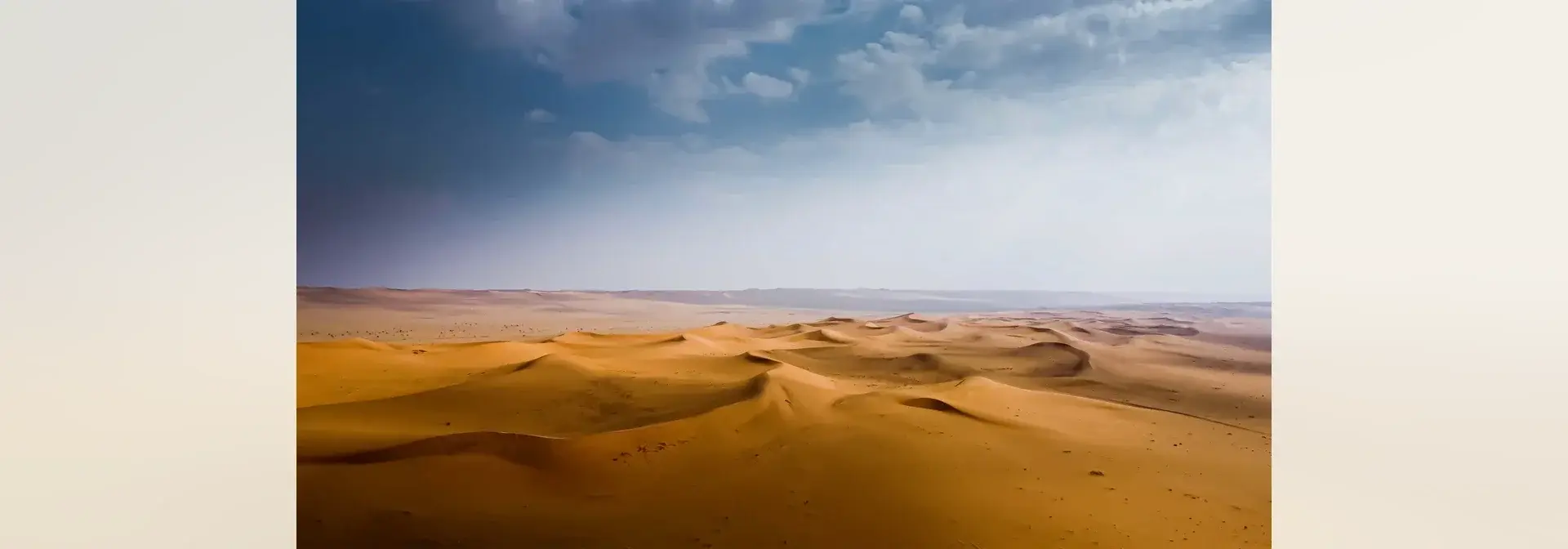
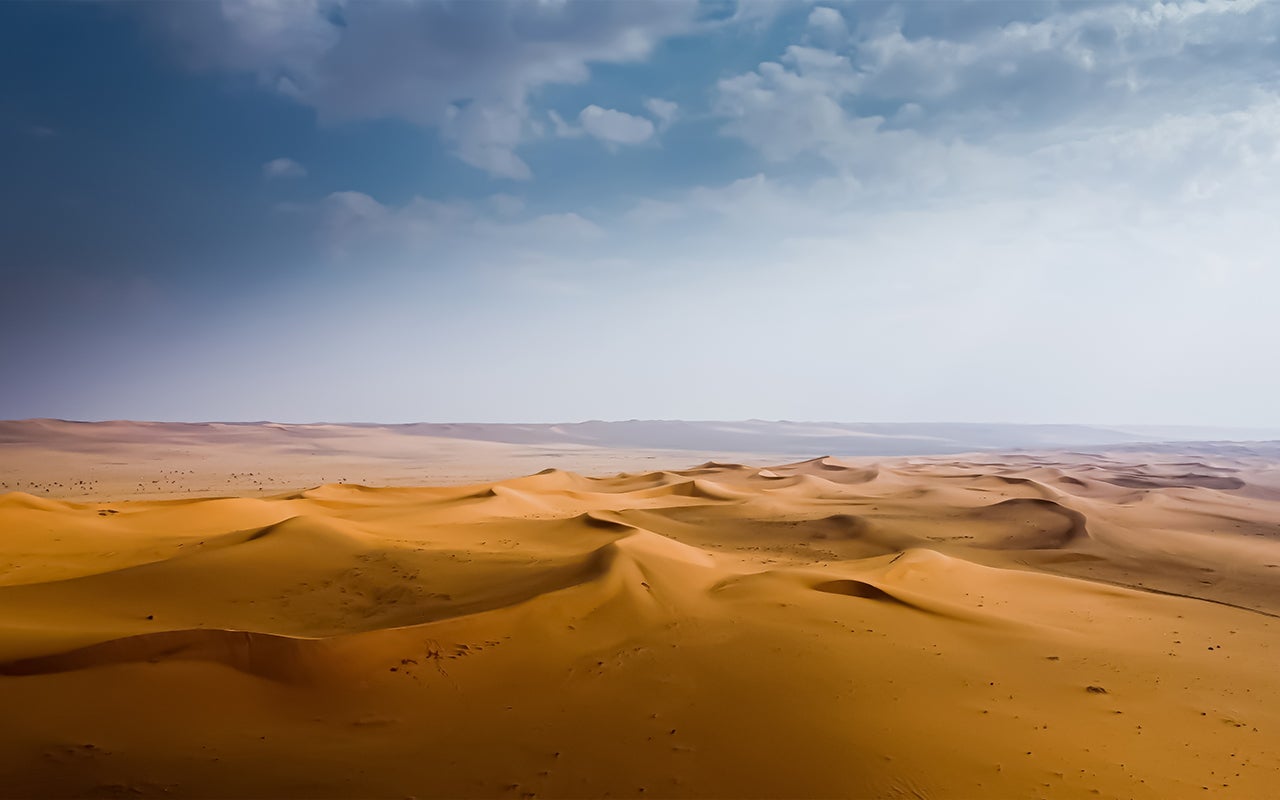
Overview
Nafud Al-Urayq Reserve is a natural reserve lying within Al-Zahiriya Center in Dariyah Governorate, Qassim Region.[1]
The area in which the reserve lies is distinguished by a varied terrain of mountains, plateaus, plains and sandy areas, which creates distinctive natural scenery that appears clearly in spring.[1]
Geographical Location
Nafud Al-Urayq Reserve lies within Al-Zahiriya Center, which is administered by Al-Zahiriya Municipality in Dariyah Governorate in the Qassim Region.[1] Al-Zahiriya forms the south-western gateway to the Qassim Region.[1]
This area combines highlands, plateaus, plains and sandy expanses, which makes the reserve's location part of a varied natural landscape within the region.[1]
Natural Environment and Vegetation Cover
The area surrounding the reserve connects to prominent vegetation cover, comprising the Al-Ghada Forest and Ad-Dasah Forest.[1] These two forests form a natural recreation ground for the residents of the region and the neighbouring areas.[1]
These green spaces are part of the components of vegetation cover in the area, and they give the residents of the region a natural space for outings and recreation.[1]
Protection and the Management of Protected Areas
The National Center for Wildlife manages and supervises the protected areas of the Kingdom,[4] and the provisions for the rehabilitation of environmental media are applied in these areas, alongside rangelands, forests and national parks.[4]
In a connected step, the Ministry of Environment, Water and Agriculture put forward a project to update the Executive Regulation for Protected Areas, allowing its application within the geographical scope of the royal reserves and other reserves.[5]
Royal Reserves and the 2030 Targets
The Council of Royal Reserves, chaired by His Royal Highness the Crown Prince and Prime Minister, approved the 2030 strategic targets for the royal reserves, in support of their comprehensive strategies.[3]
The seven royal reserves make up 13.5% of the total area of the Kingdom of Saudi Arabia,[3] and they support the goal of protecting 30% of terrestrial and marine areas by 2030.[3]
Official Oversight of the National Center's Work
The National Center for Wildlife submits an annual report on its work and achievements in protecting and developing wildlife, including its report for 2025.[2]
His Royal Highness Prince Dr. Faisal bin Mishaal bin Saud bin Abdulaziz, Governor of Qassim Region, commended the efforts of the Center and the specialised work it carries out to protect and develop wildlife.[2]
Development and Services in Dariyah Governorate
The area of Dariyah Governorate is witnessing continuous development, including municipal and environmental projects with a total cost of about 30 million riyals,[6] and the Maskah–Dariyah–Afif road duplication project, which has reached 59% completion.[7]
The Dariyah Areef Market for Productive Families was inaugurated in the governorate, with the aim of supporting productive families and enabling them to market their products.[8]
Frequently Asked Questions
Q: Where is Nafud Al-Urayq Reserve located? A: Within Al-Zahiriya Center in Dariyah Governorate, Qassim Region, and it is the south-western gateway to the Qassim Region.
Q: What distinguishes the natural area surrounding the reserve? A: A varied terrain of mountains, plateaus, plains and sandy areas, along with Ad-Dasah Forest and Al-Ghada Forest, which form a natural recreation ground for the residents of the region.
Q: Which body is responsible for the protected areas of the Kingdom? A: The National Center for Wildlife, which is responsible for managing and supervising them and for applying the provisions for the rehabilitation of environmental media in them.
Q: What are the targets of the royal reserves? A: Strategic 2030 targets approved by the Council of Royal Reserves, chaired by His Royal Highness the Crown Prince and Prime Minister; the seven reserves make up 13.5% of the area of the Kingdom and support the protection of 30% of terrestrial and marine areas by 2030.
Q: What are the most prominent development projects in Dariyah Governorate? A: Municipal and environmental projects worth about 30 million riyals, the Maskah–Dariyah–Afif road duplication project at 59% completion, and the Dariyah Areef Market for Productive Families.
Conclusion
Nafud Al-Urayq Reserve combines its location within Al-Zahiriya Center in Dariyah Governorate, Qassim Region,[1] the vegetation cover around it in Ad-Dasah Forest and Al-Ghada Forest,[1] and management undertaken by the body responsible for the protected areas of the Kingdom.[4]
Related topics on the platform include Saja and Umm Ar-Rimth Reserve, Sharaan Nature Reserve and Prince Mohammed bin Salman Royal Reserve.
Related topics
- RegionQassim RegionAn inland Najdi region administered from Buraydah, associated with trading towns, date cultivation and markets, and the geographical corridor of Wadi Al Rummah.
- RegionBuraydah CityBuraydah is a Saudi city in Qassim Province, known for a dates economy in which Qassim's production reaches more than 390,000 tons annually and its dates are exported to more than 100 countries. The city is home to the water tower registered in the National Register of Modern Urban Heritage and to the Aqilat Museum, and it has been included in the UNESCO Creative Cities Network for gastronomy.
- HistoricGhada TreeThe Ghada tree is a desert plant and one of the most famous plants of the deserts of the Kingdom of Saudi Arabia; it reaches a height of 4 metres and its roots extend for tens of metres until they reach water. It spreads from the Rub' al Khali desert in the south to the northern edge of the An-Nafud desert, it stabilises sand dunes, and Al-Ghada Park in Unaizah Governorate holds the largest botanical garden in the world of Ghada trees.
- HistoricVegetation Cover in Saudi ArabiaVegetation Cover in Saudi Arabia is the total of the native plant species and the varied ecological regions across the Kingdom, whose sites are developed, protected and monitored and whose degraded parts are rehabilitated through national programmes for afforestation, combating desertification and land rehabilitation.
- HistoricWildlife of Saudi ArabiaWildlife in Saudi Arabia is a system of desert, sandy, valley, and plateau environments that shelter hundreds of species of mammals, birds, reptiles, and wild plants.[1][2] Nature reserves work to protect and develop it and to reintroduce endangered species into their habitats.[1][3]
- HistoricSaja and Umm Ar-Rimth ReserveSaja and Umm Ar-Rimth Reserve is a nature reserve in the central-western region of the Kingdom of Saudi Arabia, north-east of Taif, extending over an area of 6528,2 square kilometres. It was established to reintroduce the Asian houbara bustard, the Arabian oryx and the ostrich, and it holds a moderate vegetation cover and wildlife of endemic and rare mammals, birds and reptiles.
- HistoricSharaan Nature ReserveSharaan Nature Reserve is a protected area in the eastern valleys of AlUla governorate in Madinah region, extending over approximately 1,540 square kilometres. It is home to at least 47 species of mammals, about 54 species of reptiles and more than 120 recorded species of birds, supports programmes to restore native plant cover, and is accredited on the International Union for Conservation of Nature's Green List.
- HistoricPrince Mohammed bin Salman Royal ReservePrince Mohammed bin Salman Royal Reserve is a royal reserve in the northwest of the Kingdom of Saudi Arabia. It extends over an area of 24,500 square kilometers and encompasses 15 ecosystems, containing more than 50% of the Kingdom's wildlife species. Established by royal decree and overseen by the Council of Royal Reserves chaired by His Royal Highness the Crown Prince and Prime Minister, it combines wildlife reintroduction, ecological tourism and biodiversity conservation.
- HistoricAl-Tubayq ReserveAl-Tubayq Reserve is a nature reserve in north-western Saudi Arabia on the border of the Hashemite Kingdom of Jordan, with an area of 12,200 square kilometers, lying within King Salman bin Abdulaziz Royal Reserve. It is marked by rugged terrain and diverse wildlife, and national efforts are under way to resettle species and rehabilitate its vegetation cover.
- National visions and programmesSaudi Vision 2030: A Framework for TransformationAn introduction to Saudi Vision 2030, its social, economic and institutional themes, and the relationship between implementation programmes, long-term targets and measured results.
Sources & references
- Qassim Region Municipality — the region's municipalities page (qassim.gov.sa)
- Saudi Press Agency (SPA)
- Saudi Press Agency (SPA)
- Umm Al-Qura — the Executive Regulation for the Rehabilitation of Environmental Media
- Umm Al-Qura — a public consultation
- Saudi Press Agency (SPA)
- Saudi Press Agency (SPA)
- Saudi Press Agency (SPA)