
Overview
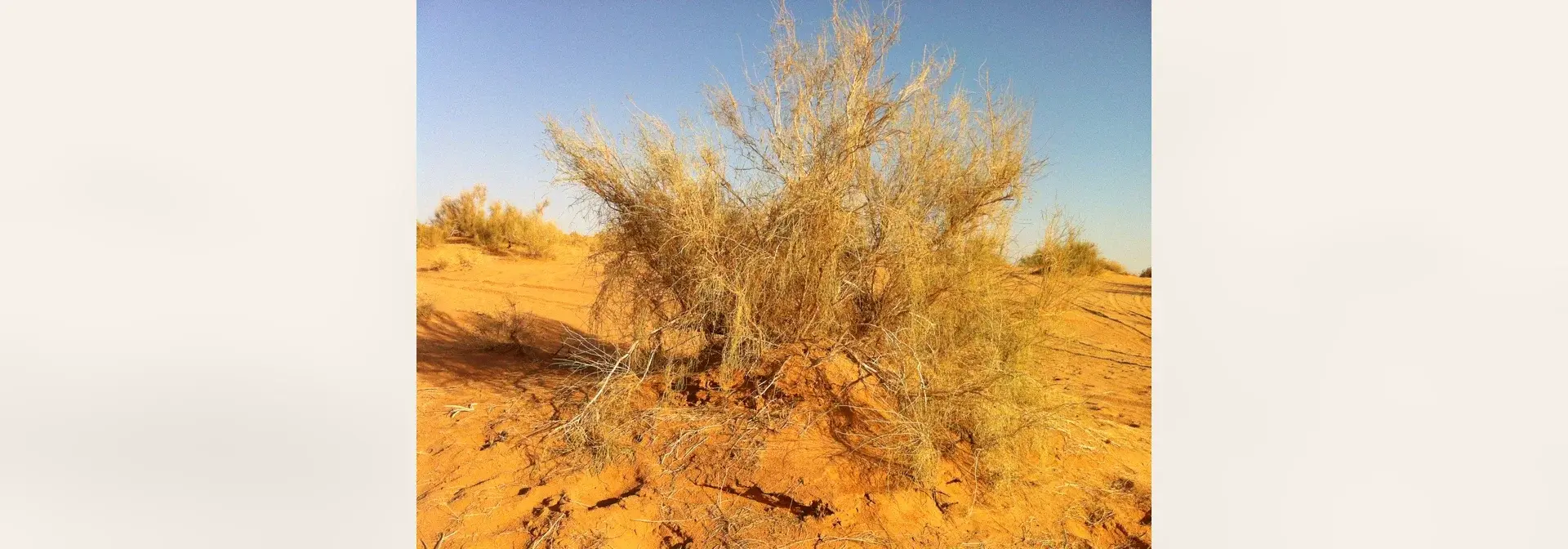
The Ghada tree is a desert plant that reaches a height of 4 metres and can live up to 70 years in dry deserts, and it is among the most famous desert plants, past and present, in the deserts of the Kingdom of Saudi Arabia, the Arabian Gulf, the Levant and Iraq.[1][5]
The Ghada grows in fixed and moving sand dunes, and its range in the Kingdom extends from the Rub' al Khali desert in the south to the northern edge of the An-Nafud desert; it plays a role in stabilising sand dunes and preventing soil erosion within the vegetation cover of sandy environments.[2][5]
Botanical Description
The Ghada is a large tree with woody stems and fresh, drooping new branches; it reaches a height of 4 metres and bears small yellow flowers and winged fruits inclining to yellow.[5]
In many of its locations the Ghada exceeds 3 metres in height, and the reason for its long life in dry deserts is its roots, which extend for tens of metres to reach water.[1]
Environment and Distribution
The Ghada spreads across areas of fixed and moving sand dunes in dry deserts, and it is distinguished by its tolerance of varying degrees of soil acidity, salinity and drought.[2]
The Ghada plant is widely distributed across the sandy environments of the Kingdom, extending from the Rub' al Khali desert in the south to the northern edge of the An-Nafud desert.[5]
Environmental Role
As a plant element, the Ghada is important in stabilising sand dunes and preventing soil erosion; it acts as a windbreak and withstands the impact of sand grains and their accumulation on its branches.[2]
Natural Reserves
The King Salman bin Abdulaziz Royal Reserve contains more than 550 species of wild and pastoral plants, among the most important of which is the Ghada plant, which spreads across its sandy environments in the Northern Borders, Al-Jawf, Tabuk and Hail regions.[6]
The Imam Turki bin Abdullah Royal Reserve holds 235 plant species representing 47 plant families, among the most prominent of which are the Ghada, the Talh, the Sidr, the Arfaj and the Qaysum.[9]
Al-Ghada Park in Unaizah
Al-Ghada Park lies in the south-western part of Unaizah Governorate in Qassim Province in the centre of the Kingdom, where a world record was set for the largest botanical garden in the world of Ghada trees.[3]
The park covers an area of 172,338,379 square metres, equivalent to 42,585.74 acres, and it entered the Guinness World Records as the largest botanical garden in the world for Ghada trees.[3][4]
Cultivation and Sustainability
The National Center for Vegetation Cover Development and Combating Desertification has made available about 500,000 Ghada seedlings and one million Arta trees in support of vegetation-development efforts, and it has carried out fencing projects over an area estimated at about 4 million square metres inside the park that include nearly 100,000 Ghada trees, alongside broader national efforts under the Saudi Green Initiative.[4]
The National Center for Vegetation Cover Development and Combating Desertification signed a cooperation memorandum with the Ghada Environmental Association in Unaizah Governorate to develop vegetation suited to the nature of the area, protect it, rehabilitate it, ensure its sustainability and increase green space.[7] Unregulated grazing and the cutting of firewood are among the most important factors affecting the sustainability of the Ghada.[5]
Rock Art at Al-Ghada
The rock art site in the Al-Ghada parks of Unaizah Governorate lies about 21 km away on the road known as Ad-Dul'ah road, and it consists of a group of rock art panels on a black rectangular hillock about 1 km long extending from east to west, on which animal and human elements were carved.[8]
The site contains stone columns found to be petrified trees that were used as rock surfaces for carving, including part of a cylindrical column 1 m long and 42 cm in diameter; the site is under the continuous supervision of the Heritage Commission and has been protected by a wall to preserve it.[8]
The Ghada in Arabic Poetry
Arab poets sang of the Ghada plant in the past, and the most famous of the lines that mention it is the poem of Malik ibn al-Rayb, whose opening reads: "Would that I knew whether I shall pass a night in the valley of Al-Ghada, driving the swift young she-camels."[2]
Frequently Asked Questions
Q: What is the Ghada tree? A: A desert plant, one of the most famous plants of the deserts of the Kingdom of Saudi Arabia, the Arabian Gulf, the Levant and Iraq; it reaches a height of 4 metres and grows in fixed and moving sand dunes.
Q: To what age does the Ghada tree live, and how does it reach water? A: It can live up to 70 years in dry deserts, and its roots extend for tens of metres until they reach water.
Q: What is the role of the Ghada in stabilising sand? A: It works as a plant element in stabilising sand dunes and preventing soil erosion, it acts as a windbreak, and it withstands the impact of sand grains and their accumulation on its branches.
Q: Where is Al-Ghada Park located and what is its area? A: It lies in the south-western part of Unaizah Governorate in Qassim Province, and its area is 172,338,379 square metres; it has been recorded as the largest botanical garden in the world of Ghada trees.
Q: What efforts are being made to develop the Ghada? A: The National Center for Vegetation Cover Development and Combating Desertification has made available about 500,000 Ghada seedlings and one million Arta trees, carried out fencing projects over about 4 million square metres inside the park, and signed a cooperation memorandum with the Ghada Environmental Association in Unaizah.
Conclusion
The Ghada combines characteristics that allow it to survive in dry deserts, an environmental role in stabilising sand dunes and preventing soil erosion, and a range that extends from the Rub' al Khali in the south to the northern edge of the An-Nafud desert.[1][2][5]
The plant benefits from official efforts to cultivate it, rehabilitate its sites and develop vegetation; it is recorded among the components of the King Salman bin Abdulaziz Royal Reserve and the Imam Turki bin Abdullah Royal Reserve, and Al-Ghada Park in Unaizah Governorate holds the largest botanical garden in the world of Ghada trees.[3][4][6][7][9]
Related topics
- RegionUnaizah CityUnaizah City is one of the historic towns of Qassim Province, and its history is bound up with commercial, agricultural, and scholarly activity that helped shape its local identity. It holds prominent heritage and scholarly landmarks, among them the Al-Bassam Heritage House, the Al-Musawkaf traditional market, and the Sheikh Muhammad ibn Salih al-Uthaymeen Mosque.
- RegionQassim RegionAn inland Najdi region administered from Buraydah, associated with trading towns, date cultivation and markets, and the geographical corridor of Wadi Al Rummah.
- HistoricKing Salman bin Abdulaziz Royal Nature ReserveKing Salman bin Abdulaziz Royal Nature Reserve is a royal nature reserve in the northwest of the Kingdom of Saudi Arabia and the largest reserve in the Middle East, with a total area of 130,700 square kilometres extending across four administrative regions. It contains broad biodiversity and rock art sites inscribed on the UNESCO World Heritage List.
- HistoricVegetation Cover in Saudi ArabiaVegetation Cover in Saudi Arabia is the total of the native plant species and the varied ecological regions across the Kingdom, whose sites are developed, protected and monitored and whose degraded parts are rehabilitated through national programmes for afforestation, combating desertification and land rehabilitation.
- TopicSaudi Green InitiativeThe Saudi Green Initiative is a national initiative announced by His Royal Highness the Crown Prince and Prime Minister on 27 March 2021, charting the Kingdom's direction in protecting land and nature along a clear and ambitious roadmap. It targets the planting of 10 billion trees, the raising of protected areas to more than 30 percent, and the supply of 50 percent of electricity generation from renewable energy by 2030.
- HistoricRock Art of HailThe Rock Art of Hail is a World Heritage property in the Hail Region of Saudi Arabia, inscribed on the UNESCO list in 2015, comprising the largest rock art complexes in the Arabian Peninsula with engravings spanning about 10,000 years.
- RegionHail RegionA north-central Saudi region administered from Hail, associated with the Aja and Salma mountains, the Nafud desert, historical caravan routes and varied regional activities.
- RegionJawf RegionA northern Saudi region administered from Sakaka, encompassing Dumat Al Jandal, Al Qurayyat and Tabarjal, with farming, historical landmarks and solar and wind energy projects.
- RegionNorthern Borders RegionA northern Saudi region administered from Arar, including Rafha, Turaif and Al Uwayqilah, with histories of pilgrimage routes, pastoral activity, Tapline settlement and mining.
- RegionTabuk RegionA northwestern Saudi region administered from Tabuk city, combining Red Sea and Gulf of Aqaba coasts with inland centres such as Tayma and a history of trade and pilgrimage routes.