
Overview
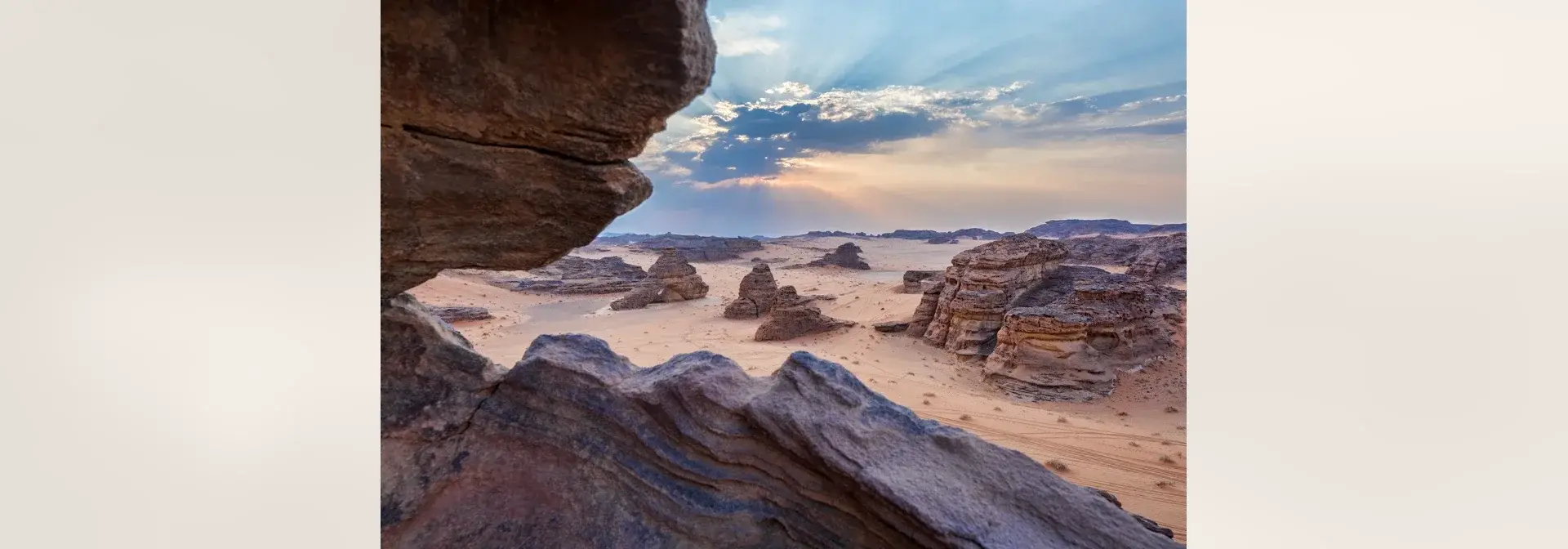
Sharaan Nature Reserve is a protected area in the eastern valleys of AlUla governorate in Madinah region, about 45 minutes from the old town [1]. It extends over approximately 1,540 square kilometres of canyons, valleys and desert [2].
The reserve works to protect and renew the rich biological diversity of this area, to restore balance to fragile ecosystems, to preserve native animal species and to promote sustainable coexistence [2].
Geographic Location
Sharaan Nature Reserve lies in the eastern valleys of AlUla governorate, north-east of Hegra and Jabal AlFil [1]. Its terrain is marked by varied habitats that shelter native animal species [2].
Mountains, valleys and rehabilitated areas are distributed across its range, terrain that gives the reserve a distinctive natural landscape within AlUla governorate [2].
Wildlife and Biodiversity
The reserve contains at least 47 species of mammals, including the Arabian wolf, the Arabian oryx, the reintroduced Arabian gazelle and the Nubian ibex, alongside about 54 species of reptiles [3].
Wildlife includes several kinds of Nubian ibex, sand gazelles and Arabian gazelles, wolves, sand cats and endangered reptiles [5]. The reserve is a habitat for a number of resident and migratory birds; more than 165 species of birds have been recorded in the wider environmental landscape of AlUla [3], while the species recorded within the reserve exceed 120 [5].
In Sharaan Nature Reserve, 39 breeding pairs of the sooty falcon have been recorded, with an estimated total of between 50 and 70 breeding pairs in AlUla, equivalent to about 4% of the species' global population [5].
Protection and Environmental Rehabilitation
The protection measures applied within the reserve, including its fencing and the regulation of grazing, have been reflected in a marked improvement in the density and diversity of vegetation, together with a greater presence of wildlife [3]. The reserve supports programmes to restore plant cover through a nursery and a native seed bank that have together produced more than one million seedlings of native plants used in environmental rehabilitation projects [3]. The Royal Commission also carried out the planting of 500,000 trees and shrubs of native plants in the reserve, with the participation of AlUla residents and students [3].
The Royal Commission for AlUla Governorate joins with the International Union for Conservation of Nature in efforts to restore and monitor the governorate's nature reserves, including Sharaan Nature Reserve [2], and, in partnership with the College of African Wildlife Management (CAWM), the AlUla community is being trained to serve as rangers for the reserve [2].
The reserve has gained accreditation on the International Union for Conservation of Nature's Green List, a model of integrated management of protected areas [5]. Within the first programmes for releasing partridge species, 30 common partridges were released in Sharaan Nature Reserve [6]. An environmental initiative was also carried out to clean part of the reserve's fence in cooperation with AlUla Sports Club, as part of the Environment Week 2025 events [7].
Ecotourism
Sharaan Nature Reserve gives lovers of nature and adventure the chance to explore rock formations, safari trips, mountain hiking and camping [4].
Its position north-east of Hegra and Jabal AlFil adds a dimension that makes the reserve a tributary of the natural experience in AlUla governorate [1].
Frequently Asked Questions
Q: Where is Sharaan Nature Reserve located? A: In the eastern valleys of AlUla governorate in Madinah region, north-east of Hegra and Jabal AlFil, and about 45 minutes from the old town.
Q: What is the area of Sharaan Nature Reserve? A: It extends over approximately 1,540 square kilometres of canyons, valleys and desert.
Q: What are the most prominent kinds of wildlife in the reserve? A: At least 47 species of mammals, including the Arabian wolf, the Arabian oryx, the Arabian gazelle and the Nubian ibex, about 54 species of reptiles, and more than 120 species of birds recorded within the reserve.
Q: What are the protection and environmental rehabilitation efforts there? A: Fencing and the regulation of grazing, a nursery and a native seed bank that have produced more than one million seedlings, the planting of 500,000 trees and shrubs with the participation of AlUla residents and students, and the release of 30 common partridges.
Q: What activities are available to visitors in the reserve? A: Exploring rock formations, safari trips, mountain hiking and camping.
Conclusion
Sharaan Nature Reserve combines a location in the eastern valleys of AlUla governorate over an area of approximately 1,540 square kilometres [2], the richness of its wildlife in mammals, birds and reptiles [3][5], its programmes to restore plant cover [3], and its accreditation on the International Union for Conservation of Nature's Green List [5].
Related topics on the platform include Prince Mohammed bin Salman Reserve and AlUla Governorate.
Related topics
- RegionAlUla CityAlUla City is a city in the north-west of the Kingdom of Saudi Arabia that brings together nature and heritage and holds the sites of ancient civilisations, most notably Hegra, the first UNESCO World Heritage site in the Kingdom, alongside Maraya Hall and heritage and geological landmarks.
- HistoricElephant Rock (Jabal AlFil)Elephant Rock (Jabal AlFil) is a massive rock formation in AlUla Governorate, in the Madinah Region. Resembling an elephant in form and rising about 52 metres above ground, it is one of the most prominent geological landmarks and tourist destinations in AlUla [1][2].
- Archaeological sitesHistory of HegraHegra, also called Mada'in Salih, is an archaeological site in AlUla Governorate whose tombs, wells and inscriptions illuminate Nabataean life and caravan routes.
- HistoricPrince Mohammed bin Salman Royal ReservePrince Mohammed bin Salman Royal Reserve is a royal reserve in the northwest of the Kingdom of Saudi Arabia. It extends over an area of 24,500 square kilometers and encompasses 15 ecosystems, containing more than 50% of the Kingdom's wildlife species. Established by royal decree and overseen by the Council of Royal Reserves chaired by His Royal Highness the Crown Prince and Prime Minister, it combines wildlife reintroduction, ecological tourism and biodiversity conservation.
- HistoricArabian GazelleThe Arabian Gazelle is among the wildlife species that receive sustained protection in the Kingdom of Saudi Arabia through extensive nature reserves, breeding programmes and reintroduction into natural habitats. Imam Turki bin Abdullah Royal Reserve recorded three newborn Arabian Gazelles in the At-Taysiyah area during the second quarter of 2026.
- HistoricArabian OryxThe Arabian Oryx, also known as the wadhi oryx, is a species of wild mammal and the largest wild mammal in the Arabian Peninsula. It was absent from its natural habitat in northern Saudi Arabia for about ninety years, then was resettled in protected reserves and released in Uruq Bani Ma'arid Reserve and King Salman bin Abdulaziz Royal Reserve.
- HistoricArabian WolfThe Arabian wolf is a wild predatory mammal among the mammals of Saudi Arabia and one of the most prominent species within the King Salman bin Abdulaziz Royal Reserve, where it plays a role in preserving ecological balance and enhancing biodiversity. Protection efforts include reintroducing endangered wild species into their natural habitats and monitoring the pure Al-Ra'an wolf lineage in the Northern Borders region.
- HistoricMigratory Birds in Saudi ArabiaMigratory Birds in Saudi Arabia are a recurring seasonal phenomenon in which numbers of birds cross the Kingdom's territory along fixed routes between their habitats in the Northern Hemisphere and the African continent. The Kingdom is a passage and a safe habitat for them thanks to its strategic geographic location and its area of more than two million km², with reserves and coastal environments that receive resident and migratory species.
- HistoricMountain IbexThe Mountain Ibex, known in the Kingdom of Saudi Arabia as the Nubian Ibex, is a wild mountain animal and a symbol of the Kingdom's wildlife. The National Center for Wildlife works to breed and reintroduce it in reserves and national parks under the National Program for the Release and Reintroduction of Endangered Wild Animals.
- HistoricNafud Al-Urayq ReserveNafud Al-Urayq Reserve is a natural reserve lying within Al-Zahiriya Center in Dariyah Governorate, Qassim Region, and its surroundings connect to Ad-Dasah Forest and Al-Ghada Forest, which form a natural recreation ground for the residents of the region. The body responsible for the protected areas of the Kingdom administers and supervises it, within national targets for the royal reserves that support the protection of 30% of terrestrial and marine areas by 2030.