
Overview
AlUla City is a city in the north-west of the Kingdom of Saudi Arabia and a destination that brings together nature and authentic heritage, holding the traces of successive ancient civilisations.[1]
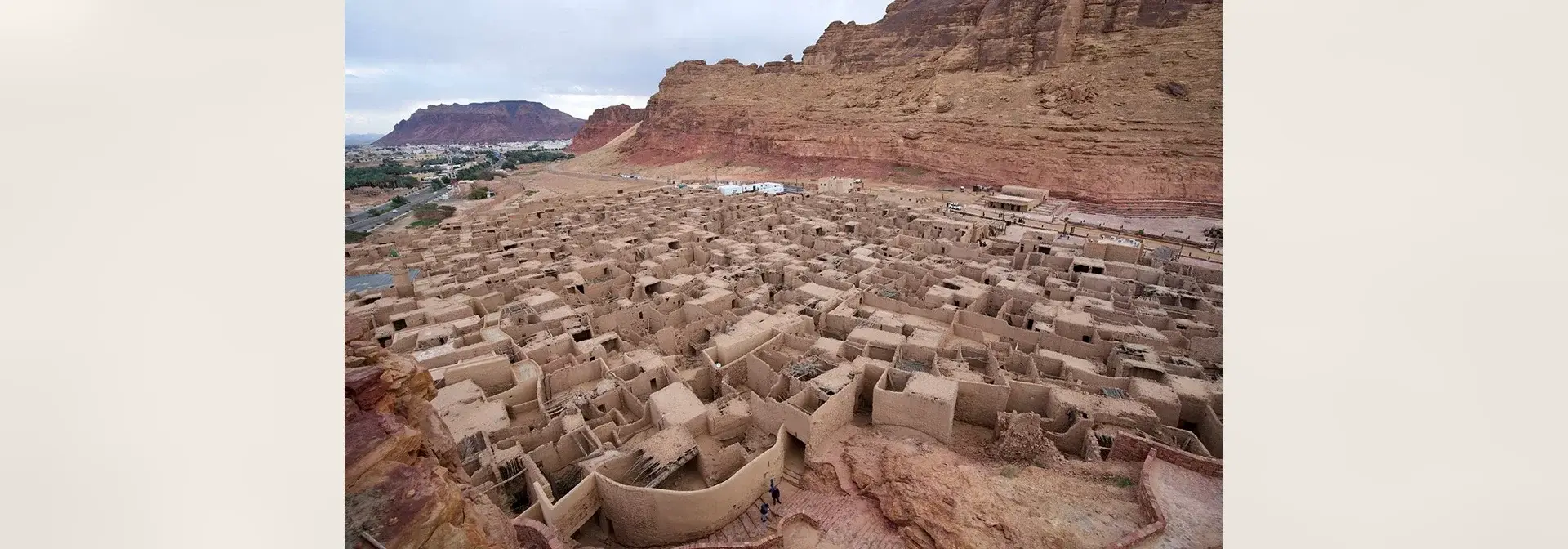
The history of AlUla is evident in the Old Town, encircled by a lush oasis that reveals the sophisticated urban planning of the kingdoms of Dadan and Lihyan, alongside thousands of rock-art sites on Jabal Ikmah and the site that was the first UNESCO World Heritage property in the Kingdom.[1][6]
Location and Landscapes
AlUla lies in the north-west of the Kingdom of Saudi Arabia, and its landscapes cover an area of 22,561 square kilometres.[1]
In southern AlUla lie the oldest rocks in the region, dating back some 900 million years, and a geological record spanning almost a billion years can be seen in the transition from south to north.[4] Volcanoes erupted in AlUla between 10 million and half a million years ago, leaving vast expanses of flat black rock covering hundreds of square kilometres.[4]
History of AlUla and the Ancient Kingdoms
During the first millennium BC, AlUla saw the emergence of the kingdoms of Dadan and Lihyan, among the most prominent ancient civilisations of the Arabian Peninsula, which showed urban development evident in city planning, architecture and advanced inscriptions.[1]
As the centre of these kingdoms, AlUla was also a centre of commercial, religious and political activity, which showed the importance of the region in early Arab history.[1] Between the seventh and twelfth centuries AD, AlUla emerged as a vital centre on the incense trade routes that linked the civilisations of the ancient world and eased the exchange of goods, ideas and cultures.[1]
In the first century AD, Hegra, known today as Mada'in Salih, emerged as a city at the far south of the Nabataean Kingdom, a deep-rooted Arab kingdom renowned for its architectural achievements in stone tombs carved with precision and detailed façades that embody its creativity and its advancement in the arts.[1] The Roman Empire later brought Hegra into its extensive network of commercial and cultural exchange.[1]
In the twentieth century, AlUla had a pivotal role in the Hejaz Railway project, which aimed to ease the journey of Hajj to the holy Islamic cities, strengthening access to the region and its role in the Islamic world.[1]
Heritage Landmarks of AlUla
The archaeological site of Hegra (Mada'in Salih) is the first Saudi site inscribed on the World Heritage List and the largest preserved Nabataean site south of Petra, and it contains massive well-preserved tombs whose decorated façades date from the first century BC through to the first century AD.[6] Its tombs number 111, of which 94 are decorated; it also has about 50 inscriptions from the pre-Nabataean era and a number of cave drawings, and it lies 500 km south-east of Petra.[6]
AlUla holds historic landmarks of different civilisations, among them Hegra, built by the creativity of the Nabataean civilisation and recorded as the first UNESCO World Heritage site in the Kingdom; Jabal Ikmah, classified as the largest open library in the Arabian Peninsula for the hundreds of archaeological inscriptions it holds; Jabal AlFil (Elephant Rock), whose form resembles a carved elephant; and the Old Town of AlUla, long a meeting place for pilgrim caravans.[7]
Among the well-known valleys of the province is Wadi Ashar, with its terrain and rock formations, in the middle of which desert hotels have been built, and which holds the award-winning Maraya hall as the largest building covered in reflective mirrors in the world.[7]
Maraya Hall
Guinness World Records documented Maraya Theatre in AlUla Province as the largest building covered in mirrors in the world; it seats about 500 people, stands in Wadi Ashar near the foot of the Harrat Uwayrid volcanic field, and its exterior façade covers 9,740 square metres of mirrors, a figure that exceeded the minimum threshold of 6,500 square metres.[8]
Maraya Hall is one of the most prominent multipurpose destinations in the province and a global platform for international events in culture, politics, economics and the arts; its façade is clad in 9,740 reflective glass panels that mirror the terrain of Wadi Ashar and the AlUla desert, and it rises 26 metres above the golden sands.[9]
Royal Commission for AlUla
His Royal Highness the Crown Prince and Prime Minister has chaired the board of directors of the Royal Commission for AlUla since its establishment in July 2017.[2] The Commission devotes its efforts to protecting and developing AlUla and combines the preservation of its rich cultural and natural heritage with sustainable tourism and community development.[2]
The Commission's charter was issued by Royal Order No. (A/38), dated 29 Muharram 1442 AH, corresponding to 17 September 2020.[3]
Quality of Life and Development
AlUla takes part in the Global Quality of Life Initiative implemented by the United Nations Human Settlements Programme with the support of the Quality of Life Program, within the Kingdom's broader efforts to raise quality of life among the targets of Saudi Vision 2030.[5]
Frequently Asked Questions
Q: Where is AlUla City located? A: In the north-west of the Kingdom of Saudi Arabia, and its landscapes cover an area of 22,561 square kilometres.[1]
Q: What was the first World Heritage site in the Kingdom? A: The archaeological site of Hegra (Mada'in Salih), which holds 111 massive tombs, 94 of them decorated.[6]
Q: What are the most prominent landmarks of AlUla? A: Hegra, Jabal Ikmah, Jabal AlFil and the Old Town, alongside Wadi Ashar and Maraya Hall.[7]
Q: What are the oldest rocks of AlUla and how old are they? A: They lie in southern AlUla and date back some 900 million years.[4]
Q: Who chairs the board of directors of the Royal Commission for AlUla? A: His Royal Highness the Crown Prince and Prime Minister, since its establishment in July 2017.[2]
Conclusion
AlUla City combines landscapes extending over 22,561 square kilometres [1], archaeological sites led by Hegra, the first World Heritage site in the Kingdom [6], modern landmarks among them Maraya Hall [8][9], and heritage protection and development efforts undertaken by the Royal Commission for AlUla.[2][3]
Related topics on the platform include AlUla Season, the Geography of AlUla and the History of Hegra.
Related topics
- HistoricAlUla SeasonAlUla Season is a tourism and cultural season in AlUla Governorate in north-western Saudi Arabia. It is part of the Saudi Seasons initiative and its most prominent event is the Winter at Tantora festival, organised by the Royal Commission for AlUla.
- Governorate and oasis geographyGeography of AlUlaAlUla is a governorate in Madinah Region in northwestern Saudi Arabia, where cultivated oases and settlements lie among wadis and desert escarpments.
- Archaeological sitesHistory of HegraHegra, also called Mada'in Salih, is an archaeological site in AlUla Governorate whose tombs, wells and inscriptions illuminate Nabataean life and caravan routes.
- HistoricAlUla Old TownAlUla Old Town is a historic settlement in the centre of AlUla Governorate, preserving an earthen urban fabric of hundreds of houses, markets and historic passageways. It was selected among the Best Tourism Villages in the World for 2022.
- EventKingdom of DadanThe Kingdom of Dadan is an ancient Arabian kingdom in the northwest of the Arabian Peninsula; the city of Dadan was its historic capital and later the capital of the Kingdom of Lihyan, with its period extending from the late ninth century BCE. It is located in AlUla Governorate and contains tombs carved into red rock slopes and Dadanitic inscriptions on Jabal Ikmah.
- EventKingdom of LihyanThe Kingdom of Lihyan is an ancient Arab kingdom that flourished in the northwest of the Arabian Peninsula, specifically in the AlUla region, and it followed the Kingdom of Dadan in ruling the area. Its influence extended from the sixth century to the second century BC. Its inscriptions documented its religious thought, its offerings, its civilisational standing and its school of sculpture, and among the most prominent sites connected with it are the Umm Daraj site and the Al-Khuraybah site.
- TopicQuality of Life ProgramThe Quality of Life Program is one of the programs realizing Saudi Vision 2030; it was launched in 2018 to improve and enrich the life of the individual and the family. It works on ten strategic objectives within seven sectors and carries out its work in cooperation with 23 partner entities through 173 initiatives and 42 strategic indicators.
- National visions and programmesSaudi Vision 2030: A Framework for TransformationAn introduction to Saudi Vision 2030, its social, economic and institutional themes, and the relationship between implementation programmes, long-term targets and measured results.
- EventHejaz RailwayThe Hejaz Railway is a railway line ordered to be built in March 1900, with work beginning in 1900, to link the Muslims of the northern Arabian Peninsula with the Holy Places; it runs from Damascus station to Madinah station. The first train reached Madinah on 22 Rajab 1326 AH, corresponding to 23 August 1908, and the line operated for about nine years. The Kingdom of Saudi Arabia today preserves its station, its museum and its antiquities in the Tabuk and Madinah regions.
- HistoricElephant Rock (Jabal AlFil)Elephant Rock (Jabal AlFil) is a massive rock formation in AlUla Governorate, in the Madinah Region. Resembling an elephant in form and rising about 52 metres above ground, it is one of the most prominent geological landmarks and tourist destinations in AlUla [1][2].
- HistoricSharaan Nature ReserveSharaan Nature Reserve is a protected area in the eastern valleys of AlUla governorate in Madinah region, extending over approximately 1,540 square kilometres. It is home to at least 47 species of mammals, about 54 species of reptiles and more than 120 recorded species of birds, supports programmes to restore native plant cover, and is accredited on the International Union for Conservation of Nature's Green List.
- HistoricUmluj IslandsThe Umluj Islands are an archipelago of 104 islands scattered in the Red Sea off the coast of the Tabuk region in north-western Saudi Arabia, and Umluj is one of the most prominent tourist destinations in the Kingdom and in the wider region. Its islands combine marine reserves, large numbers of birds and soft white sand, and their organisation and development are being carried forward under the Red Sea destination and the Commission for the Development of Yanbu, Umluj, Al-Wajh and Duba.
- EventBattle of KhaybarThe Battle of Khaybar is an event in Islamic history associated with the oasis of Khaybar in the north-west of the Arabian Peninsula, and it came after the Muslims moved to an offensive strategy in the aftermath of the Battle of the Trench. Khaybar is an ancient oasis that has hosted human settlement for more than 100,000 years and holds archaeological evidence from the Bronze Age, most notably the town of Al-Natah and a fortified barrier encircling the oasis.
Sources & references
- Royal Commission for AlUla (RCU) — About AlUla
- Royal Commission for AlUla (RCU) — About the Commission
- Royal Commission for AlUla (RCU) — Regulatory Documents
- Royal Commission for AlUla (RCU) — Geology of AlUla
- Royal Commission for AlUla (RCU) — Quality of Life in AlUla
- UNESCO — World Heritage List (Hegra)
- Saudi Press Agency (SPA) — Landmarks of AlUla Province
- Saudi Press Agency (SPA) — Guinness recognition of Maraya Theatre
- Saudi Press Agency (SPA) — Maraya Hall in AlUla