
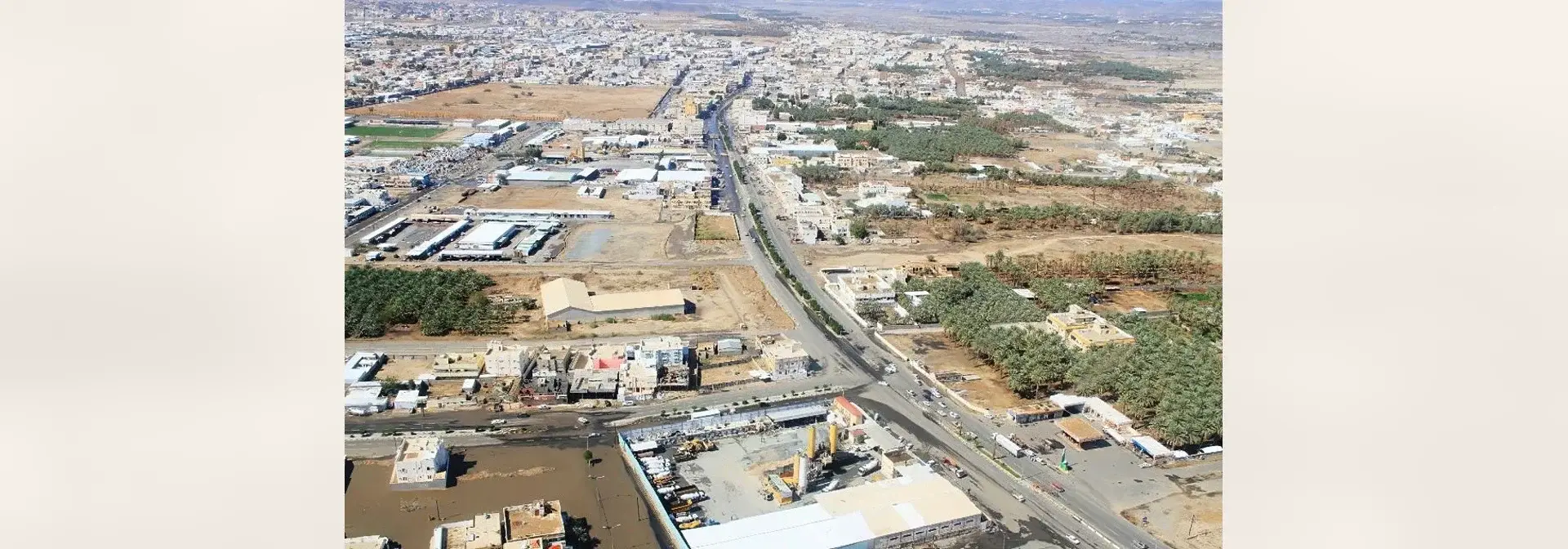
Overview
Bisha Governorate is a Saudi governorate in the Asir Region of southern Saudi Arabia, centered on Wadi Bisha, one of the largest valleys of the Arabian Peninsula and one of the valleys mentioned in historical sources; it extends more than 450 kilometers.[1]
Its local economy rests on agriculture, foremost among them date cultivation, and it contains major water facilities, most notably King Fahd Dam on the valley, alongside archaeological sites spread across its administrative centers.[1][6][8]
Location and the Valley
King Fahd Dam lies on Wadi Bisha about forty kilometers southwest of Bisha city.[1]
At the dam site, Wadi Bisha extends more than 250 kilometers, and the dam's flood catchment area reaches about 7,600 square kilometers.[3] Tabalah center lies west of the governorate, at a link between the Sarat mountains and the plains of Bisha.[7]
King Fahd Dam
King Fahd Dam is the largest concrete dam in the Middle East by size and storage capacity, with a storage capacity of 325 million cubic meters, a height of 103 meters, and a storage lake 18 kilometers long.[1]
It is the second-largest dam in Saudi Arabia, and it stored 104 million cubic meters of rainwater in 2016.[2] On 7 November 2021, the branch of the Ministry of Environment, Water and Agriculture in the Asir Region opened the dam's gates to discharge more than 50 million cubic meters of its stored water.[3]
Wadi Tabalah Dam and Wadi Bisha Bridge
Agriculture and Dates
Bisha Governorate is known for date cultivation, including the Saffari variety known across the Arabian Peninsula, and its palm groves are part of date palm cultivation in Saudi Arabia.[7] The total value of date sales at the Bisha market over 25 days exceeded 80 million riyals in the 1438 AH season.[6]
The economic forum for Bisha Saffari dates includes a date pavilion with 9 government sectors and more than 60 exhibitors in dates and processing industries, and it replaced the Al-Badiyah Festival given its positive effect on developing the date economy.[6][10]
Antiquities and Rock Inscriptions
Bisha Governorate contains more than 100 archaeological sites with more than 10 thousand rock inscriptions and drawings and 2000 written texts, spread across seven of its administrative centers.[8]
Among the most prominent of these sites is the Al-Hama site in Al-Thaniyah center, where more than 1300 rock inscriptions and 50 written texts were found; it is one of the examples of rock art in the Kingdom.[8]
Tabalah Center
Tabalah center lies west of Bisha Governorate, and more than 8 thousand people live in it and its affiliated villages; it features archaeological sites, most of which date to before Islam.[7]
The General Authority for Tourism and National Heritage approved the development of Wasit village in Tabalah at a cost of ten million riyals.[7] The municipality of Al-Thaniyah and Tabalah provided more than 200 concrete barriers to protect archaeological and heritage sites, covering more than 20 archaeological sites.[9]
Frequently Asked Questions
Q: Where is Bisha Governorate located? A: It is in the Asir Region of southern Saudi Arabia, and Wadi Bisha runs through its center.
Q: What are the most prominent landmarks of Bisha Governorate? A: King Fahd Dam, the largest concrete dam in the Middle East, Wadi Tabalah Dam, and the historic Tabalah center.
Q: What is the storage capacity of King Fahd Dam? A: 325 million cubic meters, with a height of 103 meters and a storage lake 18 kilometers long.
Q: What is Bisha Governorate known for agriculturally? A: Date cultivation; it has a date market whose sales exceeded 80 million riyals in 25 days in the 1438 AH season.
Q: What are the most prominent archaeological sites in the governorate? A: The Al-Hama site in Al-Thaniyah center, alongside more than 100 archaeological sites containing thousands of rock inscriptions and drawings and 2000 written texts.
Conclusion
Related topics
- RegionAsir RegionA southwestern Saudi region administered from Abha, combining Sarawat highlands, Tihamah and the coast, with agricultural terraces, historic villages and distinctive local cultural traditions.
- HistoricWadi BishaWadi Bisha is a wadi among the largest of the Arabian Peninsula, in Bisha Governorate in the Asir Region, and its length exceeds 450 kilometres. King Fahd Dam stands on its course with a storage capacity of 325 million cubic metres, and along its banks are date-palm cultivation, the 'Al-Sifri' dates, and rock carvings numbering more than 10,000.
- Agricultural heritage and traditional knowledgeDate Palm Cultivation in Saudi ArabiaDate palm cultivation in Saudi Arabia combines food production with knowledge of irrigation, pollination and fruit care. Al-Ahsa illustrates its links to farming heritage.
- HistoricRock Art of HailThe Rock Art of Hail is a World Heritage property in the Hail Region of Saudi Arabia, inscribed on the UNESCO list in 2015, comprising the largest rock art complexes in the Arabian Peninsula with engravings spanning about 10,000 years.
- RegionKhamis Mushait CityKhamis Mushait City is a Saudi city in the Asir Region, known since ancient times for its substantial commercial activity, and its janbiya souq ranks among the oldest specialised souqs in the Kingdom. The city is seeing projects in roads, water networks, investment sites and car showrooms.