
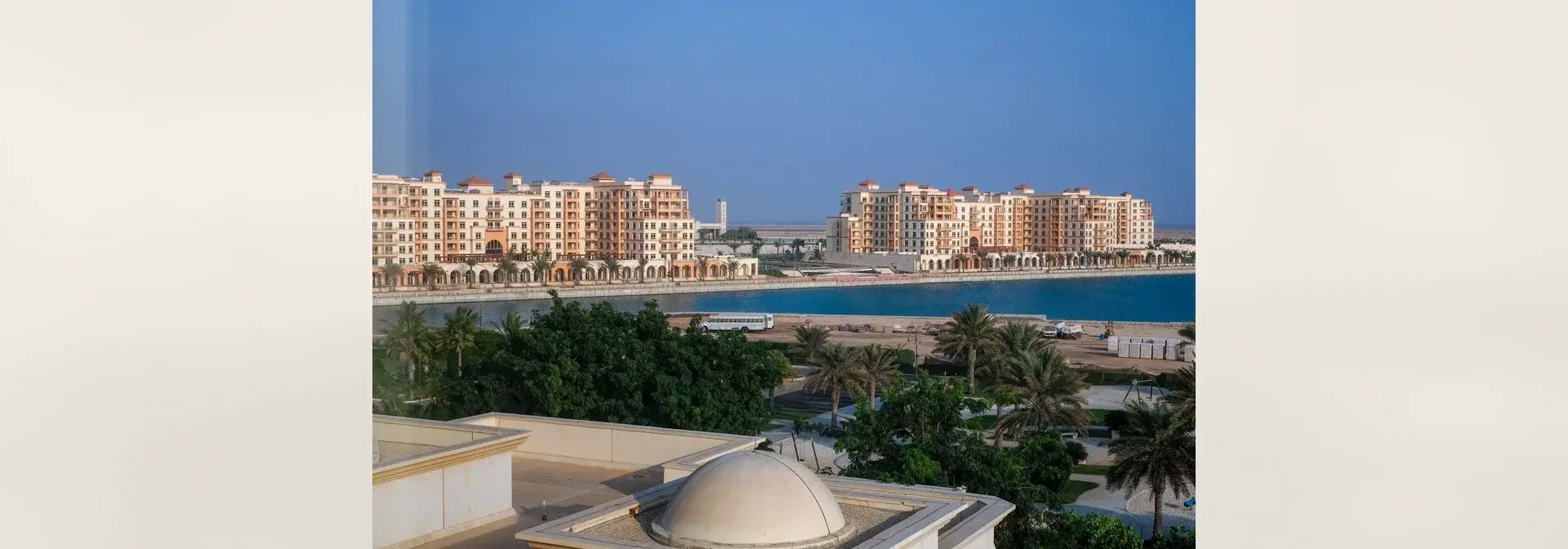
Overview
King Abdullah Economic City is a city in Rabigh on the Red Sea coast in the Makkah Region, combining quality of life, a vital business environment and varied leisure experiences within an integrated urban setting.[1] Its total area is 181 sq km, and it contains 88 factories and more than 9,000 qualified professionals.[1]
The city is spread across five districts, namely Al-Murooj, Al-Bilasan, Al-Tilal, Al-Waha and Al-Shurooq, each with its own character, integrated facilities and varied housing options.[1]
Establishment and Regulation
The special economic zone of King Abdullah Economic City was established by Council of Ministers Resolution No. (233) dated 29/3/1444 AH, and Emaar the Economic City is the entity concerned with it.[3]
The Council of Ministers approved the regulatory frameworks of the special economic zones in Jazan, Cloud Computing and Information Technology, King Abdullah Economic City and Ras Al Khair.[6] The organisation of the Economic Cities and Special Zones Authority was also issued by Royal Order No. (A/19) dated 10/3/1431 AH, corresponding to 24/2/2010 CE.[6]
Economy and Investment
The city's special economic zone extends over 60 sq km and contains three international companies attracted to manufacture original equipment. The berth depth of King Abdullah Port stands at 18 metres, and the target is to manufacture 600,000 vehicles annually by 2035.[2]
The Industrial Valley contains more than 2,500 companies operating across multiple sectors.[1] Cumulative investments in the city have reached SAR 19.5 billion, alongside 88 factories in operation or under construction and industrial, logistics and residential projects.[1]
By 2030 the city aims to provide 138,000 direct and indirect jobs, an expected contribution to gross domestic product of SAR 33 billion, and a total projected population of 255,000.[1] The city's industrial projects complement the National Industrial Strategy.
King Abdullah Port and Logistics Connectivity
King Abdullah Port is the first port in the Middle East and North Africa to be owned and operated by the private sector. In 2022 the World Bank ranked it the most efficient in the world.[1] The city is linked to Jeddah, Makkah and Madinah by the Haramain High Speed Railway, which strengthens its logistics position in western Saudi Arabia.[1]
King Salman Automotive Cluster
On 7 Sha'ban 1446 AH, corresponding to 6 February 2025, His Royal Highness Prince Mohammed bin Salman bin Abdulaziz Al Saud, Crown Prince and Prime Minister, announced the naming of the area dedicated to automotive manufacturing activity within the special economic zone of King Abdullah Economic City as the “King Salman Automotive Cluster”.[4] The cluster aims to contribute more than SAR 92 billion to non-oil gross domestic product by 2035.[4]
Lucid Motors opened its first international factory in the city in 2023.[4] On 21 September 2026, His Royal Highness the Crown Prince and Prime Minister launched the first releases of the national car company Sir under the name “Exobot”, with all its categories to be produced at the Sir industrial complex within the King Salman Automotive Cluster in the city.[5]
Tourism and Hospitality
Rixos Marjanah Resort is the largest full-service luxury resort in the Kingdom. It comprises 488 rooms and suites and 33 villas.[1]
Frequently Asked Questions
Q: Where is King Abdullah Economic City located? A: In Rabigh on the Red Sea coast in the Makkah Region, and the Haramain High Speed Railway links it with Jeddah, Makkah and Madinah.
Q: What is the area of the city, and how many factories and professionals does it contain? A: Its total area is 181 sq km, and it contains 88 factories and more than 9,000 qualified professionals.
Q: Which districts make up the city? A: Five districts, namely Al-Murooj, Al-Bilasan, Al-Tilal, Al-Waha and Al-Shurooq, each with its own character and integrated facilities.
Q: What are the city's targets by 2030? A: Providing 138,000 direct and indirect jobs, an expected contribution to gross domestic product of SAR 33 billion, and a total projected population of 255,000.
Q: What are the most prominent industrial projects in the city? A: The special economic zone extending over 60 sq km, the Industrial Valley with more than 2,500 companies, King Abdullah Port, and the King Salman Automotive Cluster, where “Exobot” is produced at the Sir industrial complex.
Conclusion
King Abdullah Economic City combines its location in Rabigh on the Red Sea coast in the Makkah Region,[1] its area of 181 sq km and its five districts,[1] its special economic zone extending over 60 sq km,[2] its port ranked the most efficient in the world in 2022,[1] the King Salman Automotive Cluster,[4] and Rixos Marjanah Resort.[1]
Related topics on the platform include Yanbu and Saudi Vision 2030.
Related topics
- RegionMakkah RegionA western Saudi region administered from Makkah, encompassing Jeddah, Taif and other governorates, where pilgrimage, maritime trade, coastal landscapes and uplands meet.
- RegionJeddah CityJeddah City is a Saudi city that is a gateway to the Two Holy Mosques and a station through which cultures have passed. Its history spans more than 1,400 years, and it is home to Historic Jeddah, inscribed on the World Heritage List in 2014, alongside modern development projects, most notably the Jeddah Central Project.
- RegionYanbu CityYanbu City is a Saudi city on the Red Sea coast west of Madinah, spread across three cities: Yanbu Al-Bahr, Yanbu Al-Nakhl and Yanbu Industrial City.[1] It is known as the "Pearl of the Red Sea" for the historic heritage, industrial and service renaissance and tourism assets it brings together.[15]
- TopicNational Industrial StrategyThe National Industrial Strategy is a sectoral strategy launched under the vision of His Royal Highness Prince Mohammed bin Salman bin Abdulaziz, Crown Prince and Prime Minister, to build a resilient national industrial economy and transform the Kingdom into a global industrial power. It targets SAR 895 billion in manufacturing gross domestic product, 2.1 million jobs and SAR 557 billion in non-oil exports by 2030.
- National visions and programmesSaudi Vision 2030: A Framework for TransformationAn introduction to Saudi Vision 2030, its social, economic and institutional themes, and the relationship between implementation programmes, long-term targets and measured results.
- RegionRabigh CityRabigh City is a coastal city in the Makkah Region on the Red Sea, and it contains King Abdullah Economic City, the King Abdullah Port and a station on the Haramain High Speed Railway.
- TopicTourism Development FundThe Tourism Development Fund is a Saudi fund that serves as the national enabler for the tourism sector, providing financing and enablement to tourism projects and enterprises and supporting tourism and hospitality development across the Kingdom's regions. Financing through its tourism enablement programmes has reached nearly SAR 3 billion, and it has supported 2,000 tourism projects.
Sources & references
- Economic Cities and Special Zones Authority — King Abdullah Economic City
- Economic Cities and Special Zones Authority — Special Economic Zone of King Abdullah Economic City
- Umm Al-Qura newspaper (Saudi Press Agency — SPA) — Regulatory framework of the special economic zone of King Abdullah Economic City
- Umm Al-Qura newspaper (Saudi Press Agency — SPA) — Naming of the King Salman Automotive Cluster
- Umm Al-Qura newspaper (Saudi Press Agency — SPA) — Launch of the first releases of the national car company Sir
- Umm Al-Qura newspaper (Saudi Press Agency — SPA) — Council of Ministers Resolution No. (468) and the organisation of the Economic Cities and Special Zones Authority