
Overview
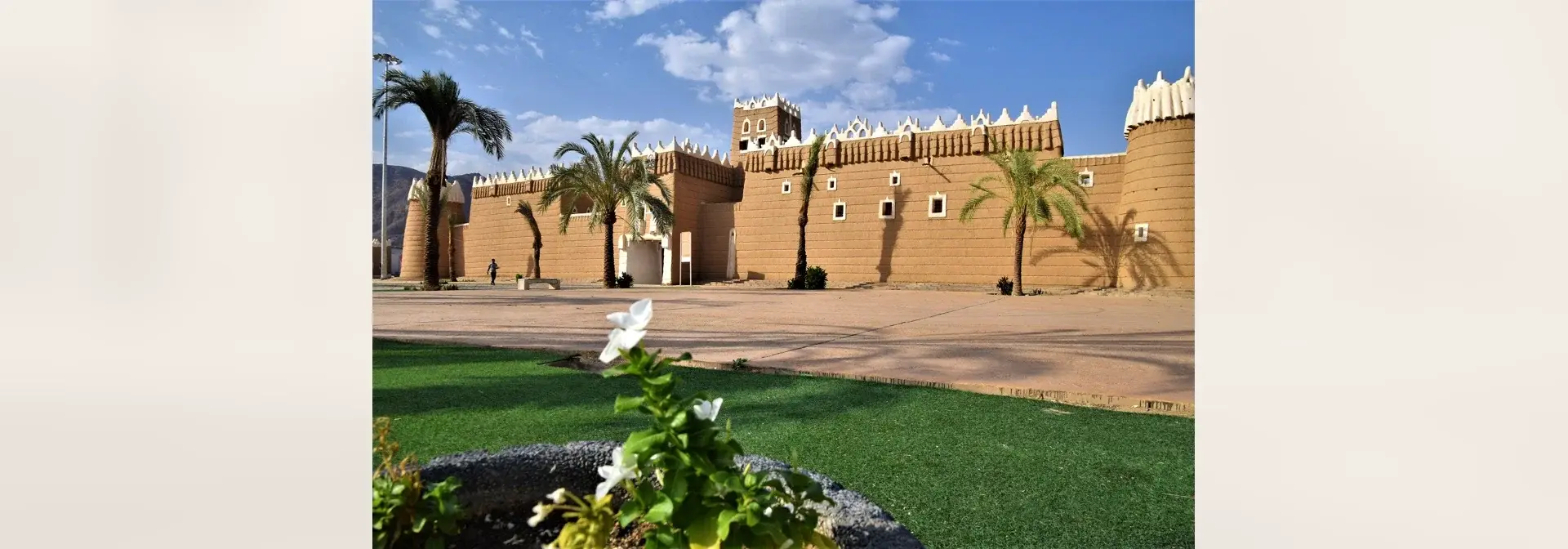
Najran City is a Saudi city in the southwest of the Kingdom of Saudi Arabia, within Najran region; it stands on the banks of Wadi Najran, along whose sides palm farms and heritage villages are spread.[6]
The city is rich in archaeological and heritage sites, foremost among them the Hima Cultural Area inscribed on the World Heritage List, the Al-Ukhdood archaeological site, and the Wadi Najran Dam, the largest dam in the Kingdom.[1][4]
Location
Najran City lies in an arid, mountainous area in the southwest of the Kingdom of Saudi Arabia, on one of the ancient caravan routes of the Arabian Peninsula.[12]
Wadi Najran cuts through the land of the city, with farms and villages spread along its banks; on its western side rises Ra'um Fort between the mountains of Abu Hamdan and Sa'dan.[6]
Hima Cultural Area and World Heritage
On 14 Dhu al-Hijjah 1442 AH, corresponding to 24 July 2021 CE, the Hima Cultural Area was inscribed on the World Heritage List as a cultural site of outstanding universal value.[1]
With its inscription it became the sixth Saudi site on the List, after the Hegra site in 2008 CE, the At-Turaif district in Diriyah in 2010 CE, Historic Jeddah in 2014 CE, the rock art of Hail in 2015 CE, and Al-Ahsa Oasis in 2018 CE.[1]
The Hima Cultural Area lies in an arid, mountainous area in the southwest of the Kingdom of Saudi Arabia, on one of the ancient caravan routes of the Arabian Peninsula, and holds a large collection of rock art images depicting hunting and life over a span of 7000 years.[12]
The rock-art area at Hima extends over an area of 557 square kilometres and holds 550 rock panels containing hundreds of thousands of inscriptions and drawings; it is counted among the largest open-air museums of archaeological rock inscriptions.[2]
The area was inscribed with a property area of 242.17 hectares and a buffer zone of 77,255.34 hectares, under criterion (iii) of the World Heritage List.[12]
Archaeological sites
The Al-Ukhdood archaeological site lies in Al-Qabil district, south of Wadi Najran, and comprises the stone buildings, the fort and the historical drawings and inscriptions that tell the story of the People of the Ditch (Ashab al-Ukhdood) mentioned in the Holy Quran.[6]
The site includes the walls, the fort, the famous Al-Ukhdood millstone, the rock inscriptions and drawings, and the archaeological features.[11]
A Saudi excavation team works at the Al-Ukhdood site, joined by more than 14 Saudi researchers, and the largest regional museum in the Kingdom is being built there, alongside site preparation works, pedestrian walkways, guide signs and the full fencing of the site.[5]
The Hima area contains archaeological wells, among them Al-Hamatah, Saqya, Al-Janah, Umm Nakhlah and Al-Qarain, surrounded by caves and mountains filled with rock drawings and inscriptions; they lie about 130 km north of Najran City, at the historical Hima site belonging to Thar governorate.[2][3]
The Hima wells site dates back to between the seventh millennium and the first millennium BCE, and contains Thamudic inscriptions and texts in Musnad and Kufic script.[3]
Heritage villages and mud architecture
Najran region holds 34 heritage villages, each containing more than 12 heritage houses of the Najrani palaces and forts known as the "mud lanes", set amid the palm farms and orchards on the banks of Wadi Najran.[6]
This urban heritage is a destination for visitors to see the art of ancient building and the architectural engineering used in constructing the mud houses.[6]
Markets and crafts
The historical Aba as-Saud Market in Al-Balad district is an economic and historical mainstay of the city, with its heritage crafts and products for which the region is known, foremost among them the Najrani dagger (Al-Janbiyah) and leather industries.[6]
History and documentation
Najran region is rich in historical and cultural sites, numbering 134, which has made it a focus of care and attention, crowned by the inscription of the Hima Cultural Area on the World Heritage List.[10]
The Najran Society for Archaeology and History ("Jaten") organises the "Najran: History and Civilisation" forum over three days under the patronage of the Governor of Najran region, with working papers and academically refereed research from the Society and the King Abdulaziz Foundation.[8]
The research sessions of the forum were launched with the participation of Najran University and the Gulf Cooperation Council Society for History and Archaeology, and its papers discussed topics including "Najran: A Reading of Its Ancient History to the End of the Prophetic Era" and "Najran in Classical Sources".[9]
Facilities and services
The Najran Region Municipality provides municipal services in the city and the municipalities affiliated to it, and it and its affiliated municipalities carried out 22,815 inspection visits during the month of October 2026 CE.[13]
The new building of the Najran Region Municipality was opened on 10 Rabi' al-Thani 1438 AH, corresponding to 8 January 2017 CE, over an area of 15,000 square metres at a total cost of 41 million, 73,000 and 762 riyals.[7]
The Wadi Najran Dam is counted among the largest dams in the Kingdom and one of its most prominent sites; its construction cost 277 million riyals and it was opened in 1402 AH. It lies at the main gorge south of Najran City, with a reservoir of 110 thousand cubic metres of concrete, a maximum height of 73 metres and a crest length of 274 metres.[4]
Frequently asked questions
Q: Where is Najran City located? A: In the southwest of the Kingdom of Saudi Arabia, on the banks of Wadi Najran.
Q: What are the best-known heritage and archaeological sites in Najran? A: The Hima Cultural Area inscribed on the World Heritage List, and the Al-Ukhdood archaeological site, where the largest regional museum in the Kingdom is being built.
Q: When was the Hima Cultural Area inscribed on the World Heritage List? A: On 24 July 2021 CE, corresponding to 14 Dhu al-Hijjah 1442 AH, and it was the sixth Saudi site on the List.
Q: What are the most prominent landmarks of Najran City? A: The Al-Ukhdood archaeological site, Ra'um Fort, 34 heritage villages, the Aba as-Saud Market and the Wadi Najran Dam.
Q: What is the Aba as-Saud Market in Najran known for? A: For its heritage products and crafts, foremost among them the Najrani dagger (Al-Janbiyah) and leather industries.
Summary
Related topics
- RegionNajran RegionA southern Saudi region administered from Najran, extending from settled wadis towards the Empty Quarter and containing Al Ukhdud, Hima and traditions of local architecture and crafts.
- HistoricHima Cultural AreaOne of the world's largest rock-art complexes, in Thar governorate north of Najran city, inscribed on the UNESCO World Heritage List in 2021.
- HistoricAt-Turaif DistrictA historic district at the heart of Diriyah, built in the mid-eighteenth century CE, seat of the First Saudi State and a UNESCO World Heritage site since 2010.
- HistoricAl-Ahsa OasisThe world's largest self-contained oasis according to Guinness World Records, inscribed on the UNESCO World Heritage List in 2018 as a cultural landscape of human interaction with the environment.
- HistoricHistoric JeddahHistoric Jeddah, or Al-Balad, is an urban core on the Red Sea shaped by maritime trade and pilgrimage, with houses distinguished by projecting wooden windows.
- HistoricRock Art of HailThe Rock Art of Hail is a World Heritage property in the Hail Region of Saudi Arabia, inscribed on the UNESCO list in 2015, comprising the largest rock art complexes in the Arabian Peninsula with engravings spanning about 10,000 years.
Sources & references
- Saudi Press Agency (SPA)
- Saudi Press Agency (SPA)
- Saudi Press Agency (SPA)
- Saudi Press Agency (SPA)
- Saudi Press Agency (SPA)
- Saudi Press Agency (SPA)
- Saudi Press Agency (SPA)
- Saudi Press Agency (SPA)
- Saudi Press Agency (SPA)
- Saudi Press Agency (SPA)
- Saudi Press Agency (SPA)
- United Nations Educational, Scientific and Cultural Organization (UNESCO) — World Heritage List
- Najran Region Municipality — official website